Contact Me By Email

Contact Me By Email

Friday, February 04, 2022

Why the COVID death rate in the U.S. is so much higher than other wealth...

'Un-American': Pence Drops MAGA-World Bomb Rebuking Vote Stealing Plot

W.E.B. Du Bois Would Have Seen Right Through the C.R.T. Backlash

W.E.B. Du Bois Would Have Seen Right Through the C.R.T. Backlash

W.E.B. Du Bois in 1911.
 Gado/Getty Images

Sign up for the Jamelle Bouie newsletter, for Times subscribers only.  Join Jamelle Bouie as he shines a light on overlooked writing, culture and ideas from around the internet.

“Since January 2021, according to an analysis by Education Week, Republican lawmakers in 37 states have introduced dozens of bills to restrict teaching on the subject of race and racism under the guise of opposition to “critical race theory.” In 14 states, restrictions have either passed into law or been imposed through either executive action or on the authority of a state education commission. One such law, passed in Texas, prohibits teaching that “slavery and racism are anything other than deviations from, betrayals of, or failures to live up to the authentic founding principles of the United States, which include liberty and equality.”

One predictable outcome of this frenzy — which includes state lawmakers scrutinizing K-12 and college curriculums for “indoctrination” — is a chilling effect in classrooms, as any attempt to teach an accurate history of racism in the United States is placed under hostile scrutiny. Educators accused of indoctrinating students with “critical race theory” have reported threats and physical harassment, and some schools — in Alabama, for example — are now defending their Black History Month programs from similar accusations of subversion.

Last fall, around the same time that Republican lawmakers in several states were drafting and championing these bills, the Library of America — a nonprofit publisher of significant works in American writing and literature — released its edition of W.E.B. Du Bois’s groundbreaking “Black Reconstruction in America: An Essay Toward a History of the Part which Black Folk Played in the Attempt to Reconstruct Democracy in America, 1860-1880.” There is no direct connection between the book’s republication and the wave of educational gag orders around race and racism. Nonetheless, there is something fortuitous in how Du Bois, writing from 1935, comments on and critiques the politics of history in 2022.

The concluding chapter of “Black Reconstruction,” “The Propaganda of History,” is a polemical essay on the uses and abuses of historical narrative as well as a heated attack on the mainstream of American history writing as it existed in the 1920s and ’30s, when Du Bois’s book was conceived, researched and written.

Du Bois excoriates those historians for acting less as “scientists” in search of something like objective truth and more as propagandists for a social and economic order of segregation, violence and exploitation:

In order to paint the South as a martyr to inescapable fate, to make the North the magnanimous emancipator, and to ridicule the Negro as the impossible joke in the whole development, we have in fifty years, by libel, innuendo and silence, so completely misstated and obliterated the history of the Negro in America and his relation to its work and government that it is almost unknown.

Du Bois, by his own account, is “astonished” by the idea that the evil of history must be “forgotten, distorted, skimmed over.”

“We must forget,” he writes, “that George Washington was a slave owner, or that Thomas Jefferson had mulatto children … and simply remember the things we regard as creditable and inspiring.” The difficulty with this approach, he continues, “is that history loses its value and incentive and example; it paints perfect men and noble nations, but it does not tell the truth.”

Du Bois, who studied at the University of Berlin with some of the most acclaimed scholars of his day and who was the first Black American to receive a doctorate from Harvard, believed that history should aspire to be something like a science. And if that was to be the case, “if the record of human action is going to be set down with that accuracy and faithfulness of detail which will allow its use as a measuring rod and guidepost for the future of nations,” then in his view, “there must be set some standards of ethics in research and interpretation.”

Du Bois’s view was that, when it came to Reconstruction and the “American Negro,” American historians had fallen far short of that ideal. Instead, they produced — for the consumption of both students and the general public — a history that cast Reconstruction as a “disgraceful attempt to subject white people to ignorant Negro rule.” Rather than treat history as “a science or as an art using the results of science,” they had used it as a tool of “pleasure and amusement, for inflating our national ego, and giving us a false but pleasurable sense of accomplishment.” This history, wrote Du Bois, existed only to “influence and educate the new generation along the way we wish,” where “we” meant the existing power structure.

It is not hard to see how this critique applies to present circumstances. Spurred by a wave of youth protest that revealed (and then underscored) the extent to which the conservative movement had failed to inculcate, in the next generation, its view of what America is, this effort to gag any discussion of the United States that doesn’t affirm a triumphant narrative of national innocence is a clear and obvious attempt to make up for lost time.

I am not so Whiggish in my thinking as to believe that this effort to censor American history for students is doomed to failure. But I do think that the urgency with which it has been fought is a sign of something important. The ferocity of the drive to keep serious discussions of race and racism out of America’s classrooms is an admission, however tacit, that something has changed, and conservatives are on the losing end of that transformation. Where once they were an establishment — such that Du Bois was a voice in the wilderness — now they are on the defensive.

Put simply, the people and institutions behind the bans on “critical race theory” are fighting a rear-guard action, and they know it.“

Thursday, February 03, 2022

‘Criminal Peril’: Dominoes Against Trump Start Falling In Riot Probe

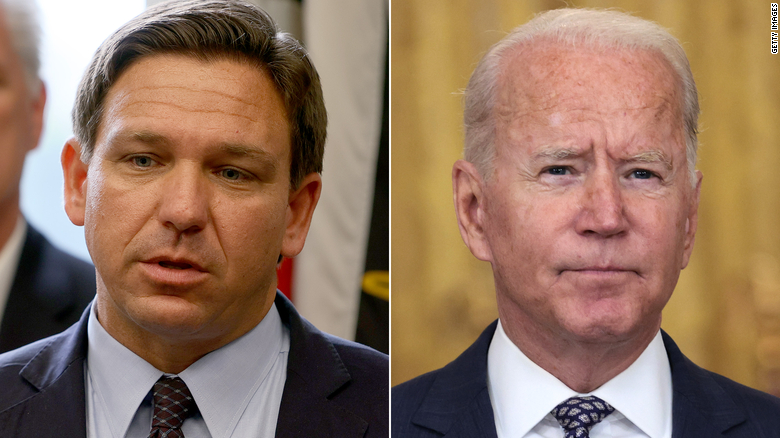
Internal documents show heated back-and-forth between DeSantis and Biden admin over care of migrant children

Internal documents show heated back-and-forth between DeSantis and Biden admin over care of migrant children

(CNN)An ongoing feud over President Joe Biden's immigration policies is escalating in Florida where Gov. Ron DeSantis is threatening to keep long-standing shelters from caring for migrant children, culminating in a heated back and forth unfolding in internal correspondence obtained by CNN. 

The Republican governor's office and the Biden administration are sparring over whether migrant children who arrive at the US-Mexico border alone should be cared for by shelters in Florida, as they have been since 2005. The children, who are in government custody, stay at shelters until they can be reunited with a vetted sponsor, like a parent or relative, in the United States.
DeSantis strategizes for his future while Trump obsesses over his election loss
But in a letter sent to the Health and Human Services Department last week, obtained by CNN, Florida's general counsel, Ryan Newman, alleged the federal government was participating in a "human trafficking scheme." HHS, which is responsible for the care of migrant children, said DeSantis' threat to revoke state licenses from shelters that take these migrants raises "serious legal concerns" and threatened to take the matter to the Justice Department.
    The spat pits DeSantis, a potential 2024 GOP presidential candidate, up against the Biden administration with migrant children in the middle, as evidenced in the leaked documents.
      In December, the DeSantis administration issued an emergency rule that would strip shelters caring for migrant minors in Florida of state licensing, and therefore oversight, if they accept new placements from the border, potentially affecting hundreds of children. 
        Unaccompanied migrant children have become a target for other GOP governors as well, following a surge of minors at the US southern border last year. Texas Gov. Greg Abbott, who's running for reelection and is a vocal critic of Biden, stripped his state shelters of licenses last year, leaving providers to operate without state oversight and largely without sufficient guardrails in the event something happened. And in Pennsylvania, Republican gubernatorial candidate Lou Barletta has cited flights carrying children to the state for care from the border in his criticism of the Biden administration. 
        US begins quietly flying Venezuelan migrants to Colombia under controversial border policy
        For years, minors largely from Central America have journeyed to the US-Mexico border seeking refuge -- often vexing officials in the Obama and Trump administrations. But the issue has taken on new life as Republicans try to elevate immigration and what they describe as poor management of the US-Mexico border ahead of the midterm elections, particularly as Biden's polling numbers sag. 
          "Historically, when we've talked about children, there's been nonpartisan agreement that children deserve protection," said Lisette Burton, chief policy and practice adviser at the Association of Children's Residential & Community services. "I haven't seen before a time where really vulnerable children have been put at the center of political arguments in this way."

          Opinion | For Ukraine, Europe Thinks Russia’s Putin Wants More Than War - The New York Times

          GUEST ESSAY

          Europe Thinks Putin Is Planning Something Even Worse Than War

          Credit...Pool photo by Yuri Kochetkov
          "In New York City Sewage, a Mysterious Coronavirus Signal By View Original Emily Anthes • The New York Times • 6 min For the past year, scientists have been looking for the source of strange coronavirus sequences that have appeared in the city’s wastewater. ca Trujillo, a microbiologist at Queensborough Community College, filtered bacteria from a wastewater sample containing of coronavirus.Credit...Jackie Molloy for The New York Times 2/3/2022 Pocket - In New York City Sewage, a Mysterious Coronavirus Signal https://getpocket.com/read/3543635796 2/8 Last January, a team of researchers searching for the coronavirus in New York City’s wastewater spotted something strange in their samples. The viral fragments they found had a unique constellation of mutations that had never been reported before in human patients — a potential sign of a new, previously undetected variant. For the past year, these oddball sequences, or what the scientists call “cryptic lineages, ” have continued to pop up in the city’s wastewater. 

          There is no evidence that the lineages, which have been circulating for at least a year without overtaking Delta or Omicron, pose an elevated health risk to humans. But the researchers, whose findings in Nature Communications on Thursday, still have no idea where they came from. “At this point, what we can say is that we haven’t found the cryptic lineages in human databases, and we have looked all over, ” said Monica Trujillo, a microbiologist at Queensborough Community College and an author of the new paper. The researchers themselves are torn about the lineages’ origins. Some lean toward the explanation that the virus is coming from people whose infections aren’t being captured by sequencing. But others suspect that the lineages may be coming from virus-infected animals, possibly the city’s enormous population of rats. Even then, the favored theory can change from day-to-day or hour-to-hour. Answers remain elusive. 

          In New York City Sewage, a Mysterious Coronavirus Signal https://getpocket.com/read/3543635796 3/8 “I think it’s really important that we find the source, and we have not been able to pin that down, ” said John Dennehy, a virologist at Queens College and an author of the paper. ed wastewater samples, colored black because of the binding agent that adheres to coronavirus particles, in John Dennehy’ eens College.Credit...Jackie Molloy for The New York Times Strange sequences The researchers — who also include Marc Johnson, a virologist at the University of Missouri, Davida Smyth, a microbiologist at Texas A&M University and others — have been sampling wastewater from 14 treatment plants in New York City since June 2020. In January of 2021, they began doing targeted sequencing of the samples, focusing on part of the gene for the virus’s all-important spike protein. Although this approach provides a limited look at the viral genome, it allows researchers to extract a lot of data from wastewater, in which the virus is typically fragmented. Viral fragments with novel patterns of mutations appeared repeatedly at a handful of treatment plants, the researchers found. (They could not disclose the specific plants or areas of the city, they said.) “To date we have not seen these variants among clinical patients in N.Y.C., ” said Michael Lanza, a spokesman for New York City Department of Health and Mental Hygiene. 2/3/2022 Pocket - In New York City Sewage, a Mysterious Coronavirus Signal https://getpocket.com/read/3543635796 4/8 Researchers at the University of California at Berkeley have found similar sequences in one California sewershed, said Rose Kantor, a microbiologist at the university. ennehy speculated that the “cryptic lineages” could be coming from people who are confined to long-term health care facil e has been unable to prove it.Credit...Jackie Molloy for The New York Times The scientists’ continuing quest to figure out where the sequences are coming from highlights both the potential of wastewater surveillance, which can help scientists keep tabs on how the virus is evolving, and the challenge of making sense of any anomalies pulled out of the murk. “We really struggled trying to understand what it was that we had, ” Dr. Trujillo said. The lineages could be coming from people whose infections have escaped detection or whose virus has not been sequenced. But the fact that they kept turning up at the same few wastewater plants makes this theory less likely, the researchers said, given that New Yorkers, and any variants they may be carrying, tend to move throughout the city without restriction. Still, Dr. Dennehy speculated that the sequences could be coming from people who are confined to long-term health care facilities in just a few areas of the city. But he has not been able to prove it. 2/3/2022 Pocket - In New York City Sewage, a Mysterious Coronavirus Signal https://getpocket.com/read/3543635796 5/8 “We were able to pin it down to a very small area of the sewershed, ” Dr. Dennehy said. “And I emailed doctors and hospitals in those areas and never once got a response to my emails.” Indeed, people who have compromised immune systems may have more difficulty fighting off the virus, giving it more opportunities to mutate. Many scientists theorize that Omicron emerged from an immunocompromised patient. Intriguingly, some of the cryptic lineages have some of the same mutations as Omicron, or mutations in the same locations. Laboratory experiments suggest that these lineages may also be able to evade some antibodies. The New York City lineages might be a result of the same kind of selective pressure to evade some of the body’s immune defenses, the researchers theorize. Johnson, a virologist at the University of Missouri, loaded wastewater samples into a centrifuge. “This is a very promiscuo ” he said. “It can infect all kinds of species.”Credit...Michael B. Thomas for The New York Times On the other hand, the lineages have been circulating for long enough now that they should have appeared in at least one sample sequenced from an infected person, some scientists said. “To have something in a sewershed that you’re detecting, you need a fair bit of it around, ” said Dr. Adam Lauring, a virologist at the University of Michigan, who was not involved in the research. 2/3/2022 Pocket - In New York City Sewage, a Mysterious Coronavirus Signal https://getpocket.com/read/3543635796 6/8 Dr. Johnson, the Missouri virologist, agrees. He favors the hypothesis that the sequences are coming from animals, perhaps a few specific populations with limited territories. In May and June of 2021, when the number of human Covid-19 cases in the city was low, the mysterious lineages made up a greater proportion of the viral RNA in wastewater, suggesting that they may have come from a nonhuman source. The researchers initially considered a diverse array of potential hosts, from squirrels to skunks. “This is a very promiscuous virus, ” Dr. Johnson said. “It can infect all kinds of species.” To narrow down the possibilities, they went back to the wastewater, assuming that any animal that was shedding virus might be leaving its own genetic material behind, too. Although a vast majority of the genetic material in the water came from humans, small amounts of RNA from dogs, cats and rats were also present, the scientists found. Dr. Johnson has been considering rats, which roam the city by the millions. In his lab, he created pseudoviruses — harmless, nonreplicating viruses — with the same mutations present in the cryptic sequences. The pseudoviruses were able to infect both mouse and rat cells, he found. The original version of the virus does not appear able to infect rodents, although some other variants, like Beta, can. 2/3/2022 Pocket - In New York City Sewage, a Mysterious Coronavirus Signal https://getpocket.com/read/3543635796 7/8 “So in and of itself, that isn’t huge data, but it is at least consistent with the idea that it’s coming from rodents, ” Dr. Johnson said. Since last summer, the scientists have been working with Animal and Plant Health Inspection Service at the U.S. Department of Agriculture to look for signs of the virus in blood and fecal samples from local rats. So far, they’ve come up empty. “Maybe we’re not hitting the right animals, ” Dr. Dennehy said. Or maybe rats aren’t the source of the mystery lineages. Scientists have repeatedly found that human can pass the virus to animals, especially pets, zoo animals, farmed mink and others with which they are in frequent contact. That has raised concerns that the virus might establish itself in an animal reservoir, where it might mutate and get passed back to humans. But rats have not typically been high on the list of concern, and there has not been any evidence that the virus is circulating in wild rats. The pathway by which humans could have infected rats is also unknown. “Nothing makes perfect sense, ” Dr. Johnson said. But some kind of animal origin remains a possibility, scientists said. “It’s just as plausible, if not more plausible, than a human origin, ” Dr. Lauring said. 2/3/2022 Pocket - In New York City Sewage, a Mysterious Coronavirus Signal https://getpocket.com/read/3543635796 8/8 Printed with ❤️ from Pocket So the search continues. Dr. Johnson has developed a new technique that can amplify only non-Omicron sequences, which should make it easier to detect the lineages. He has also begun searching for similar lineages in sewage samples from other states, which might help provide further clues to their origins. “We will know eventually, ” Dr. Johnson said."

          Opinion | For Ukraine, Europe Thinks Russia’s Putin Wants More Than War - The New York Times