Contact Me By Email

Contact Me By Email

Wednesday, June 28, 2023

Giuliani Sat for Voluntary Interview in Jan. 6 Investigation

Giuliani Sat for Voluntary Interview in Jan. 6 Investigation

“The onetime personal lawyer for Donald Trump answered questions from federal prosecutors about the former president’s efforts to remain in power after his 2020 election loss.

Rudolph W. Giuliani speaking to reporters and wearing a dark suit.
Rudolph W. Giuliani, who served as former President Donald J. Trump’s personal lawyer, interviewed with Jack Smith, the special counsel investigating the former president.Leah Millis/Reuters

Rudolph W. Giuliani, who served as former President Donald J. Trump’s personal lawyer, was interviewed last week by federal prosecutors investigating Mr. Trump’s efforts to overturn the 2020 election, people familiar with the matter said.

The voluntary interview, which took place under what is known as a proffer agreement, was a significant development in the election interference investigation led by Jack Smith, the special counsel, and the latest indication that Mr. Smith and his team are actively seeking witnesses who might cooperate in the case.

The session with Mr. Giuliani, the people familiar with it said, touched on some of the most important aspects of the special counsel’s inquiry into the ways that Mr. Trump sought to maintain his grip on power after losing the election to Joseph R. Biden Jr.

“The appearance was entirely voluntary and conducted in a professional manner,” said Ted Goodman, a political adviser to Mr. Giuliani.

A proffer agreement is an understanding between prosecutors and people who are subjects of criminal investigations that can precede a formal cooperation deal. The subjects agree to provide useful information to the government, sometimes to tell their side of events, to stave off potential charges or to avoid testifying under subpoena before a grand jury. In exchange, prosecutors agree not to use those statements against them in future criminal proceedings unless it is determined they were lying.

Prosecutors working for Mr. Smith asked Mr. Giuliani about a plan to create fake slates of pro-Trump electors in key swing states that were actually won by Mr. Biden, one person familiar with the matter said, speaking on the condition of anonymity to discuss an ongoing criminal investigation. They focused specifically on the role played in that effort by John Eastman, another lawyer who advised Mr. Trump about ways to stay in office after his defeat.

Mr. Giuliani also discussed Sidney Powell, a lawyer who was briefly tied to Mr. Trump’s campaign and who made baseless claims about a cabal of foreign actors hacking into voting machines to steal the election from Mr. Trump, the person said.

Ms. Powell, who was sanctioned by a federal judge for promoting conspiracy theories about the voting machines, also took part in a meeting in the Oval Office in December 2020 during which Mr. Trump was presented with a brazen plan — opposed by Mr. Giuliani — to use the military to seize control of voting machines and rerun the election.

The person said that prosecutors further asked Mr. Giuliani about the scene at the Willard Hotel days before the attack on the Capitol. Mr. Giuliani and a group of close Trump advisers — among them, Mr. Eastman, Mr. Trump’s former chief strategist Stephen K. Bannon and Mr. Trump’s current adviser Boris Epshteyn — had gathered at the hotel, near the White House, to discuss strategies before a violent mob stormed the Capitol on Jan. 6, 2021, disrupting the certification of Mr. Biden’s victory over Mr. Trump.

Jack Smith wearing a dark suit and white tie.
Shortly before Mr. Smith was appointed to his job as special counsel, the Justice Department issued a subpoena to Mr. Giuliani.Kenny Holston/The New York Times

The proffer session with Mr. Giuliani, elements of which were reported earlier by CNN, came as Mr. Smith’s team pressed ahead with its election interference inquiry of Mr. Trump even as it prepares for the former president’s trial on separate charges of putting national security secrets at risk and obstructing government efforts to recover classified documents.

How Times reporters cover politics. Times journalists may vote, but they are not allowed to endorse or campaign for candidates or political causes. That includes participating in rallies and donating money to a candidate or cause.

Did you find this information helpful?

The prosecutors have been bringing witnesses before a grand jury and conducting separate interviews of others as they seek to assemble a fuller picture of the various ways in which Mr. Trump and his allies were promoting baseless claims that the election had been stolen from him and seeking to reverse his electoral defeat.

In some cases, they appear to be gauging whether they can elicit useful information without necessarily agreeing to formal cooperation deals.

Last week, The New York Times reported that prosecutors were in negotiations to reach a proffer agreement with Michael Roman, the former director of Election Day operations for Mr. Trump’s 2020 campaign. Mr. Roman was also instrumental in helping put together the so-called fake elector plan.

The push to assemble slates of pro-Trump electors from swing states won by Mr. Biden is one of a number of components of Mr. Smith’s investigation. Prosecutors have also scrutinized whether Mr. Trump and his allies bilked donors by raising money through false claims of election fraud, examined efforts to use the Justice Department to give credence to election-fraud claims and sought to piece together a detailed picture of the role played by Mr. Trump in inciting the attack on the Capitol and the disruption of the congressional certification of his loss.

It remains unclear whether Mr. Giuliani will face charges in the special counsel’s investigation. He is also under scrutiny on many of the same subjects by the district attorney in Fulton County, Ga., who is pursuing a wide-ranging investigation into Mr. Trump’s effort to reverse his election loss in that swing state.

As part of Mr. Smith’s inquiry, prosecutors questioned Mr. Roman’s deputy, Gary Michael Brown, last week in front of a grand jury in Federal District Court in Washington that has been investigating the attempts by Mr. Trump and his allies to overturn the election. Federal prosecutors on Wednesday are also scheduled to interview Brad Raffensperger, the secretary of state of Georgia, who took a call from Mr. Trump in early January 2021 during which the former president asked him to “find” sufficient votes that would put him over the top in the election in that state.

A longtime ally of Mr. Trump who served two terms as New York City’s mayor, Mr. Giuliani effectively led the former president’s attempts to overturn his defeat in the last presidential race and has for months been a chief focus of the Justice Department’s broad investigation into the postelection period. His name has appeared on several subpoenas sent to former aides to Mr. Trump and to a host of Republican state officials involved in the plan to create fake slates of electors.

Last year, shortly before Mr. Smith was appointed to his job as special counsel, the Justice Department issued a subpoena to Mr. Giuliani for records related to his representation of Mr. Trump, including those that detailed any payments he had received. A group of federal prosecutors including Thomas Windom had been pursuing various strands of the inquiry into Mr. Trump’s efforts to remain in power before Mr. Smith’s appointment and they continue to play key roles in the investigation.

Among the things that prosecutors have been examining are the inner workings of Mr. Trump’s fund-raising vehicle, Save America PAC. The records subpoenaed from Mr. Giuliani could include some related to payments made by the PAC, according to a person familiar with the matter.

More recently, prosecutors have been asking questions about Mr. Trump’s false claims that his defeat in the election was caused by widespread fraud, and how he aggressively raised money off those claims. The prosecutors have drilled down on the issue of whether people around Mr. Trump knew that he had lost the race, but continued raising money off the fraud claims anyway.

Mr. Trump wearing a dark suit, red tie and white shirt. U.S. flags are on display behind him.
The session with Mr. Giuliani came as Mr. Smith’s team pressed ahead with its election interference inquiry of Mr. Trump.John Tully for The New York Times

The House select committee that investigated the attack on the Capitol on Jan. 6 first raised questions publicly about Mr. Trump’s fund-raising, and the special counsel’s team has picked up on that thread. Among other questions they have asked witnesses is whether their lawyers are being paid for by the political action committee that became a repository for money raised off Mr. Trump’s false claims of widespread fraud.

Investigators have walked through a timeline with various witnesses, including asking people about election night and what Mr. Giuliani may have been telling Mr. Trump before his defiant speech declaring he had won the election, as well as about Jan. 6 and Mr. Trump’s actions that day.

The special counsel’s office has focused on Mr. Trump’s mind-set and who was telling him he lost, according to people familiar with the questions. Among the questions has been whether there were concerns raised among people working with the campaign as to the language used in television ads about fraud in December 2020, and who signed off on the ad copy.

Prosecutors also subpoenaed former Vice President Mike Pence, who was a key focus of Mr. Trump’s efforts to stay in power as Mr. Trump tried to pressure him to use his ceremonial role overseeing congressional certification to block Mr. Biden from being certified.

Ben Protess is an investigative reporter covering the federal government, law enforcement and various criminal investigations into former President Trump and his allies. @benprotess

Alan Feuer covers extremism and political violence. He joined The Times in 1999. @alanfeuer

Maggie Haberman is a senior political correspondent and the author of “Confidence Man: The Making of Donald Trump and the Breaking of America.” She was part of a team that won a Pulitzer Prize in 2018 for reporting on President Trump’s advisers and their connections to Russia. @maggieNYT

Ron DeSantis vetoes popular criminal justice bill as he moves to Trump’s right

Ron DeSantis vetoes popular criminal justice bill as he moves to Trump’s right

“The legislation had near universal support and was sponsored in the state House by a DeSantis supporter, who told NBC News he's "disappointed."

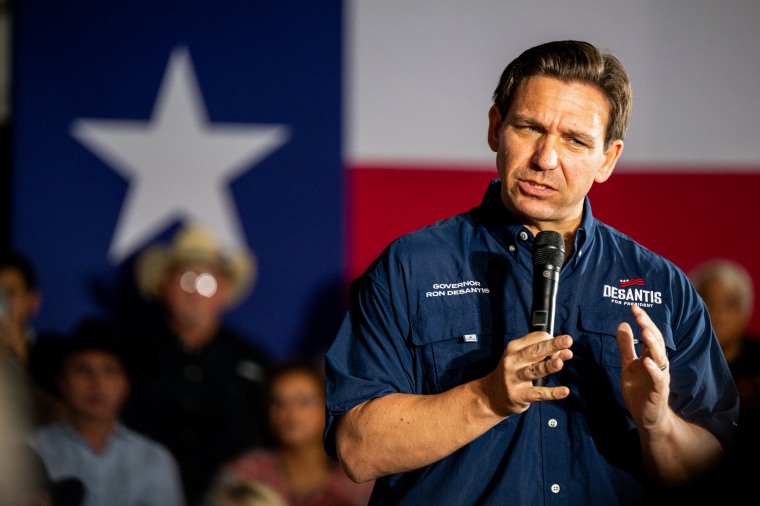
Republican presidential candidate, Florida Gov. Ron DeSantis in Eagle Pass, Texas, on June 26, 2023.

TALLAHASSEE, Fla. — Gov. Ron DeSantis issued a surprise veto Tuesday, rejecting a popular criminal justice reform bill that had received overwhelming bipartisan support in the state Legislature. 

The move amplified his efforts to move to the right of former President Donald Trump on a range of issues, including on crime prevention. 

Criminal justice has become a hot topic in the 2024 presidential campaign in recent weeks. Last month, DeSantis told conservative pundit Ben Shapiro that, if elected to the White House, he would try to repeal Trump's First Step Act, a law aimed at lowering recidivism rates. 

DeSantis’ campaign has also tried to spotlight his hard-line approach to fighting crime by taking a trip to San Francisco to show the Democratic stronghold’s struggles, and this week, he said he would use “deadly force” against suspected drug traffickers trying to break through barriers at the southern border.

DeSantis voted for an early version of the First Step Act as a member of Congress, but during his time as governor and now a presidential candidate, he has honed a message much more in line with hard-line conservatives who have generally opposed policies that could be perceived as soft on crime.

The latest example came Tuesday night when he vetoed legislation that would allow adults to expunge their criminal record — even if they previously had their record expunged as a minor — which is not allowed under current Florida law. The proposal, HB 605, would open up the opportunity only to people who had charges dropped, were found not guilty or were arrested but not ultimately charged.

The bill was sponsored in the Florida House by Republican state Rep. David Smith, who has endorsed DeSantis’ presidential bid. Smith said he was “disappointed” by the governor's move.

“I was not provided any reason for the veto," Smith told NBC News. "However, his senior staff has expressed to me a willingness to work on the bill language before the 2024 legislative session with the expectation it could be signed into law next year.”

He said he is not reconsidering his presidential endorsement of DeSantis because of the veto, even though it’s the second time he has had a criminal justice reform bill vetoed by the governor. The other was a 2021 bill that proposed allowing the expungement of juvenile criminal records for those who went through a diversion program. 

One year later, DeSantis signed a version of the bill that did not include "forcible felonies."

Criminal justice groups who supported the bill that was vetoed Tuesday were surprised because it had passed with unanimous support in the Florida Senate, and only two “no” votes in the House. 

“Expungement is not a ‘soft on crime’ policy,” said Christian Minor, a Florida lobbyist who was directly involved in advocating for the bill’s passage. It “would have afforded Floridians never convicted of a crime the opportunity to expunge their records and go on to lead a life of success and become tax-paying citizens.” 

In a departure from the norm, DeSantis did not offer any explanation in his veto message Tuesday night. His office did not respond to a request seeking comment.

Some of the governor’s advisers, however, said the move was consistent with the message he wants to send as a tough-on-crime presidential candidate.

“Gov. DeSantis has always been a law and order leader. While well-intentioned, he seems worried about the ratification of a more lenient view on criminal records,” one adviser familiar with his thinking said. 

"The California and Soros prosecutor’s view is not what he wants for Florida," the person added, referring to the liberal billionaire George Soros, who has been backing progressive prosecutors in elections all over the country.

Another DeSantis supporter said signing the bill into law could have sent mixed signals and opened “him up to criticism since he’s been vocally against Trump’s First Step Act.”

In May, DeSantis signed legislation allowing for the death penalty for child rapists, a move that was part of a larger criminal justice reform package passed by GOP lawmakers at his urging. It also lowered the number of jurors needed to recommend the death penalty, from 12 to eight. 

As a 2024 presidential candidate, Trump has had something of an uncomfortable relationship with the reforms he implemented while in office. 

In an interview last week, Fox News' Bret Baier brought up the First Step Act. The former president pointed, as he has in the past, to a woman named Alice Johnson. As president, Trump granted her clemency and early release from prison after she was convicted of a nonviolent drug crime. 

Baier pressed Trump on the fact that Johnson could be killed under a proposal he has now put forward to make drug dealers eligible for the death penalty.

Trump seemed confused about the details of his current plan and then concluded simply that Johnson "would not have done" that crime because extending the death penalty to drug dealers would be a deterrent.

A Trump spokesman did not immediately return a request for comment.

Former Florida state Sen. Jeff Brandes, a Republican who focused much of his efforts on prison reform while in the Legislature, said Florida-based criminal justice reformers have struggled to see eye to eye with DeSantis for years.

“The criminal justice community struggled to find hope, but persevered because this issue affects their friends, family and loved ones,” he said. “Florida continues to have more than 12,000 pending clemency cases, the National Guard still patrols our understaffed prisons, and Florida has still yet to adopt policies that reduce inmate idleness or provide second chances.”

“We pray daily that God will soften his heart, and show him that justice must be tempered by mercy,” he added of DeSantis.

Jenna Bottler, president and executive director of the Justice Action Network, the nation’s largest group working on bipartisan criminal justice reform, says that since he announced his presidential bid, she has seen a change in DeSantis, who previously had signed some policies she supported.

“Before launching his presidential campaign, Gov. Ron DeSantis and overwhelming bipartisan majorities of the Florida Legislature were aligned with the Republican Party and red states across the country: They saw a criminal justice system failing to efficiently protect public safety, all while failing to wisely use taxpayer dollars,” she said.

“Unfortunately, just in the last few weeks, we have seen rhetoric out of the campaign that is out of step with Republican voters and Gov. DeSantis’ own track record on these issues,” she added.“

‘Good luck.’ DeSantis’ promise to end birthright citizenship is easier said than done

14th Amendment Section 1 - All persons born or naturalized in the United States, and subject to the jurisdiction thereof, are citizens of the United States and of the State wherein they reside. No State shall make or enforce any law which shall abridge the privileges or immunities of citizens of the United States; nor shall any State deprive any person of life, liberty, or property, without due process of law; nor deny to any person within its jurisdiction the equal protection of the laws.

‘Good luck.’ DeSantis’ promise to end birthright citizenship is easier said than done

miamiherald Logo

Florida Gov. Ron DeSantis at an Iowa GOP reception on May 13 in Cedar Rapids.
Florida Gov. Ron DeSantis at an Iowa GOP reception on May 13 in Cedar Rapids. Joseph Cress Iowa City Press-Citizen / USA TODAY NETWORK

Andressa Reis, a 29-year-old from Coconut Creek, repeatedly refers to her U.S. citizenship status as a “privilege.” She was born in Florida after her newlywed Brazilian parents, who were in the United States at the time, decided to start a family.

“It was pretty common within my community to have people who were undocumented,” Reis said in an interview with the Miami Herald. “So I grew up recognizing the privilege I had. I didn’t have to go through a quarter of the fight that most people do.”

Florida Gov. Ron DeSantis, however, is promising that if he is elected president, he will eliminate the constitutional guarantee of citizenship for children of undocumented immigrants born in the United States. 

DeSantis made the promise to end birthright citizenship this week as he unveiled a host of hardline immigration policies meant to appeal to conservative voters. Former President Donald Trump also vowed years ago to do so through an executive order and, though he never followed through, has renewed the promise for the 2024 campaign.

But legal experts — and even some Republicans — are skeptical of the proposal, which would likely run into legal hurdles.

“It’s unrealistic,” Republican former U.S. Rep. Carlos Curbelo, who condemned Trump’s proposal in 2018, told the Herald. “It wouldn’t even solve much considering most people who immigrate illegally are seeking economic opportunity — not the opportunity to birth citizens.” 

Curbelo lost his 2018 reelection bid to represent a majority-Hispanic, Miami-area swing seat about a week after Trump first said he’d end birthright citizenship. Curbelo said that such a proposal may draw some attention from conservative voters in a Republican presidential primary, but wouldn’t amount to much beyond that.

“It can get you some attention in a GOP primary, but it will have a cost with Hispanic voters and swing voters in a general election,” he said. 

A spokesperson for U.S. Sen. Rick Scott, DeSantis’ predecessor in the governor’s mansion, said the senator opposes any incentive for citizens of other countries to enter the U.S. to give birth to an American citizen. But the senator, who is up for reelection next year, believes securing the border is the answer.

“Senator Scott has said we should never tolerate that, and should put an end to it, but that ANY proposal should start with securing the border — that’s the answer to this and every other immigration problem we currently have,” McKinley Lewis, the senator’s communications director, said.

Scott is seeking reelection to the Senate.

The campaign is mum on details

DeSantis has made the proposal to end birthright citizenship a key part of his plan to overhaul the nation’s immigration system if he is elected president. He said he will do what Trump couldn’t, but he has yet to provide specifics on exactly how he would plan to execute such a plan.

A spokesperson for his campaign did not respond to questions from the Herald about how he plans to end birthright citizenship, including whether he would attempt to revoke that right retroactively or through an executive order.

A written outline of the border security plan released by the campaign on Monday simply noted that the governor “will take action to end the idea that the children of illegal aliens are entitled to birthright citizenship if they are born in the United States.” 

“Dangling the prize of citizenship to the future offspring of illegal immigrants is a major driver of illegal migration,” the campaign said in unveiling the proposal. “It is also inconsistent with the original understanding of 14th Amendment, and DeSantis will force the courts and Congress to finally address this failed policy.”

That policy may have impacted DeSantis’ own lineage. A century ago, DeSantis’ great-great-grandmother, Luigia Colucci, left Italy and arrived at Ellis Island. She was pregnant at the time.

Colucci was nearly barred entry. While she crossed the Atlantic Ocean, the U.S. Congress passed the Immigration Act of 1917. Among other restrictions on “undesirable” immigrants, it barred illiterate people from entering the United States. Colucchi couldn’t read or write, according to immigration documents obtained by a professional genealogist, according to the Tampa Bay Times.

To do away with birthright citizenship, DeSantis will have to face the 14th Amendment of the U.S. Constitution, which states that “all persons born or naturalized in the United States and subject to the jurisdiction thereof, are citizens of the United States and of the State wherein they reside.” 

That clause was included mainly to overrule the U.S. Supreme Court’s infamous Dred Scott decision, which held that Black slaves were not citizens, Kunal Parker, a law professor at the University of Miami, said. For that reason, he noted, the amendment’s language is “actually pretty clear.”

Parker said that doing away with birthright citizenship would likely require amending the U.S. Constitution — an extraordinarily difficult process, especially in the country’s current political environment. Amendments may be proposed either by Congress, through a joint resolution passed by a two-thirds vote, or by a convention called by Congress in response to an application from two-thirds of state Legislatures.

DeSantis could try to force Congress to act, though any piece of legislation ending birthright citizenship would almost certainly be subject to ardent legal challenges.

“If it’s through legislation, the risk is that it would be unconstitutional in the context of the meaning of the 14th Amendment,” Parker said, also noting that the modern day Supreme Court would be highly unlikely to overrule longstanding legal precedent on the matter. “And if he’s trying to amend the Constitution — well, good luck.” 

In 1967, the Supreme Court raised concerns about revoking birthright citizenship in a case involving a federal law stripping the citizenship of Americans who voted in foreign elections. In a 5-to-4 ruling, the court said the 14th Amendment is designed to “protect every citizen of this Nation against a congressional forcible destruction of his citizenship.”

“The very nature of our free government makes it completely incongruous to have a rule of law under which a group of citizens temporarily in office can deprive another group of citizens of their citizenship,” Justice Hugo. L. Black wrote in the 1967 decision in Afroyim v. Rusk.

Leandro De Assis, a 34-year-old software engineer who lives in Boca Raton, would potentially be impacted by DeSantis’ proposal, if successful. He says the idea is “beyond ridiculous.”

“If you were born in America you can proudly say you’re an American citizen,” De Assis said. “To remove that possibility, even if it’s not retroactively but for future generations, that’s a step backwards. If we want to move forward, we have to embrace all the people, be more about the people, and not about the two different sides of people.”

DeSantis’ track record

Whether DeSantis will be able to deliver remains to be seen.

DeSantis’ call to end birthright citizenship is only one item in a long list of hard-right immigration and border security policies unveiled this week, including finishing construction of a wall along the U.S. southern border, deputizing state and local governments to arrest and deport migrants and establishing “appropriate rules of engagement so that those trying to smuggle drugs into the United States are met with the use of force.”

Twice this week, DeSantis advocated for the use of deadly force against suspected drug traffickers caught breaking through border barriers, warning that they would end up “stone-cold dead.”

The policy proposals underscore how hardline views on immigration and border security have come to dominate Republican primary politics in the years since Trump launched his first presidential bid in 2015, railing against undocumented immigrants, “chain migration” and so-called “anchor babies,” children born to non-citizens in the U.S. who could help give their families a path to legal residency.

At the time, those remarks drew derision from fellow Republicans, including Jeb Bush, the former Florida governor and unsuccessful 2016 presidential candidate, who pushed back on Trump’s threats to end birthright citizenship by declaring it a “constitutional right.”

“Mr. Trump can say that he’s for this because people are frustrated that it’s abused,” Bush told CBS News in an interview in 2015, shortly after Trump launched his White House campaign. “But we ought to fix the problem rather than take away rights that are constitutionally endowed.”

As Florida governor, DeSantis has shown a willingness to make unilateral decisions on immigration issues through executive orders and administrative rules, and has tested the limits of his gubernatorial powers with other actions, including creating a state-funded program to transport migrants anywhere in the country.

Some of his actions have led to several lawsuitscriminal investigations over the treatment of migrants, administration scandals and fixes in state law. DeSantis, however, has delivered on immigration campaign promises — at least to some extent.

For instance, DeSantis vowed to mandate that all Florida employers use the federal electronic system E-Verify system to check the immigration status of all hires. But the Republican-led Legislature approved legislation requiring all public employers and private businesses with 25 or more employees to use the system, while exempting small businesses, employers who hire independent contractors or homeowners who hire people to do work in their homes, such as gardeners, handyman workers and maids. 

This year, DeSantis asked legislators to repeal a 2014 law — championed by DeSantis’ own lieutenant governor, Jeanette Nuñez — that has allowed young undocumented immigrants known as Dreamers to pay in-state tuition at state colleges and universities. But the proposal went nowhere in the Legislature, after a weeks-long behind the scenes effort led by a group of Dreamers.

Read more: Dreamers may not be able to vote, but they convinced GOP lawmakers to aid their cause

The dynamics at the state level will be different at the federal level. 

“When we go in on day one we’re gonna marshal every bit of authority that we have, will work with Congress when we need to, we’ll take executive action when we can, and it will be a day one priority, and you’re gonna see a big change very, very quickly,” DeSantis said at a campaign event in Texas on Monday.

Parker, the UM law professor, reiterated that more specifics are needed to see how DeSantis plans to get things done.

“It’s part of a political campaign, and I think a lot of people say things in campaigns that they think their electorate wants to hear,” Parker said. “It’s not actually so clear how he can deliver on this. He hasn’t offered a theory for why the children of undocumented aliens should be excepted from the reach of the 14th Amendment.” 

This story was originally published June 28, 2023, 4:52 PM.“

Opinion | Why K-12 education’s alarming decline could be a dominant 2024 issue - The Washington Post

Opinion Why K-12 education’s alarming decline could be a dominant 2024 issue

Fairfax County Public School buses lined up at a maintenance facility in Lorton, Va., in 2020. (J. Scott Applewhite/AP Photo) 

"Time was, when the school year ended, parents worried about “summer learning loss.” Nowadays, there is less learning to worry about losing.

This is the 40th anniversary of a blue-ribbon commission’s “A Nation at Risk” reportthat decried a “rising tide of mediocrity” in K-12 education, and said if “an unfriendly foreign power had attempted to impose on America the mediocre educational performance that exists today, we might well have viewed it as an act of war.” Two generations on, mediocrity might be an aspiration.

The National Assessment of Educational Progress, a.k.a. “the nation’s report card,” for 2022 shows that a decline that started in 2014 (do not blame the pandemic) continues: Just 13 percent and 20 percent of eighth-graders met U.S. history and civics proficiency standards, the lowest rates ever recorded, erasing gains made since the 1990s.

Only 33 percent and 36 percent of fourth-graders were proficient in reading and math, respectively. Eighth-graders were worse: 31 percent were proficient in reading, 26 percent in math. Four more years of schooling, less proficiency. Perhaps summer should be considered a season for recuperating from schools’ subtractions from learning.

Ian Rowe, a charter school advocate, notes that since the “nation’s report card” was first issued in 1992, in no year “has a majority of white students been reading at grade level. The sad irony is that closing the black-white achievement gap would guarantee only educational mediocrity for all students.”

Mysteriously (or perhaps not), California’s most recent standardized test revealed declines in math and English language arts — yet rising grades. Larry Sand, writing in City Journal, reports that 73 percent of 11th-graders received A’s, B’s and C’s in math, while the test showed that only 19 percent met grade-level standards. Among eighth-graders, the disparity was 79 percent and 23 percent. Among sixth-graders’ English scores, it was 85 percent and 40 percent. Amazingly (or perhaps not), the high school graduation rate has risen as students’ proficiencies have fallen.

Grade inflation, sometimes called “equity grading,” and “social promotions,” which combat meritocracy as a residue of white supremacy, leave a wake of wreckage. “According to World Population Review,” Sand says, “California now leads the country in illiteracy. In fact, 23.1 percent of Californians over age 15 cannot read this sentence.”

As alarming as what students are not learning is what they are being taught. Robert Pondiscio and Tracey Schirra of the American Enterprise Institute, writing in National Affairs (summer 2022), say “public education has drifted toward an oppositional relationship with its founding purpose of forming citizens, facilitating social cohesion, and transmitting our culture from one generation to the next.” The result is the emergence of what might be a dominant political issue in 2024: parental rights concerning educational content and curriculum transparency.

Remote learning during the pandemic, say Pondiscio and Schirra, “pried open the black box of America’s classrooms.” Progressives, anxious to slam it shut again, portray any public involvement in public education, other than paying for it, as an infringement of the hitherto unenunciated right of teachers to unabridged sovereignty over other peoples’ children. But as UCLA law professor Eugene Volokh has said, “Someone’s got to decide what is going to be taught in K-12 schools.” Teachers, principals, legislatures, school boards — the First Amendment does not say whom.

Progressives and their most muscular allies, the teachers unions, stand athwart parents shouting, “Mind your own business!” This is a political argument conservatives can link to the issues of school choice and charter schools, each of which polls well. As North Carolina’s Republican-controlled legislature has noticed.

That state’s Democratic governor, Roy Cooper, is following the example of the federal government, which currently is operating under 41 declared “emergencies.”And he is emulating the executive grandeur exuded by presidents of both parties who acquire special powers with such declarations. Cooper has declared a “state of emergency for public education.”

His cri de coeur, which enlarged his power not a whit, was occasioned by the state legislature moving to expand the state’s school choice program beyond low-income families. He says that expanding the ability of parents to choose between public and private schools will “choke the life out of public education.” From this prediction, we can infer Cooper’s bleak assessment of many public schools’ inability to compete when parents have choices.

Trust in public schools is probably lower today than at any point in U.S. history. If conservative politicians cannot make this a salient issue, they should find another vocation."

Opinion | Why K-12 education’s alarming decline could be a dominant 2024 issue - The Washington Post

The Crises of Heat and Smoke Share a Common Thread: Climate Change - The New York Times

The Crises of Heat and Smoke Share a Common Thread: Climate Change

Human-caused climate change is making high temperatures more common and intensifying dryness that fuels catastrophic wildfires.


Smoke forecast

Light

Medium

High

Between the dangerous heat baking Texas and the Southeast, and the wildfire smoke filling the skies throughout the Upper Midwest and into the Mid-Atlantic, people across a huge part of the United States have been seeking relief from the outside world in recent days.

The two threats this week aren’t connected directly. But a common factor is adding to their capacity to cause misery.

Human-caused climate change is turning high temperatures that would once have been considered improbable into more commonplace occurrences. And it is intensifying the heat and dryness that fuel catastrophic wildfires, allowing them to burn longer and more ferociously, and to churn out more smoke.

Climate change is “the elephant in the room” that is worsening wildfires and their effects on air quality, said John C. Lin, a professor of atmospheric science at the University of Utah. As this year’s Canadian blazes have shown, climate-related disasters are becoming international affairs, not just local or regional ones, Dr. Lin said."

The Crises of Heat and Smoke Share a Common Thread: Climate Change - The New York Times

Opinion | Religion Creates Community. We’re Losing That. - The New York Times

Religion Creates Community. We’re Losing That.

An illustration of giant hands, each holding a community of people, as a lone individual falls in between.
Eleanor Davis

You’re reading the Jessica Grose newsletter, for Times subscribers only.  A journalist and novelist offers her perspective on the American family, culture, politics and the way we live now.

This is the fifth and final newsletter in a series about Americans moving away from religion. Read part one, part two, part three and part four.

I started this series because I felt that the rise of “nones” — Americans who say they have no formal religious affiliation — was one of the biggest, most complicated and most misunderstood changes in society in the past half-century. And my sense was that the subject had been discussed mostly among people who had strong, polarizing opinions about this change: either atheists who cheered it or the religiously observant who decried it.

As I started my reporting, my own feelings about the rise of nones were somewhat ambivalent; I’m Jewish and still have a strong cultural identity, but I’m not observant. I don’t miss shul and have little desire to return, yet I feel a bit heartsick about not passing down Jewish rituals with more consistency for my children.

After months of reading about this massive change, and having had quite a few deep and very moving conversations with some of the over 7,000 readers who responded to my initial call-out about becoming less religious over time, the one aspect of religion in America that I unquestionably see as an overall positive for society is the ready-made supportive community that churchgoers can access.

When I say “churchgoers,” of course, I mean those who attend a church, temple, mosque, gurdwara, friends meeting or any of the many traditional houses of worship in America. The idea of community connects them all.

“Community” was mentioned in over 2,300 reader responses. As the reader Julie Prado, 50, from Washington State, wrote to me: “I was raised Pentecostal and went to church three or more times a week, so I desperately miss the community. It was where my friendships came from. I have very few friends now.” Prado told me she isn’t part of a church because she hasn’t found one that fully affirms gay people or believes as strongly as she does in the separation of church and state. “I have joined groups that are fighting for these things,” she said, like Christians Against Christian Nationalism, but they don’t provide the same kind of social fabric that her church did.

I asked every sociologist I interviewed whether communities created around secular activities outside of houses of worship could give the same level of wraparound support that churches, temples and mosques are able to offer. Nearly across the board, the answer was no.

Phil Zuckerman, a professor of sociology and secular studies at Pitzer College, put it this way: “I can go play soccer on a Sunday morning and hang out with people from different races and different class backgrounds, and we can bond. But I’m not doing that with my grandparents and my grandchildren.” A soccer team can’t provide spiritual solace in the face of death, it probably doesn’t have a weekly charitable call and there’s no sense of connection to a heritage that goes back generations. You can get bits and pieces of these disparate qualities elsewhere, he said, but there’s no “one-stop shop” — at least not right now.

That doesn’t mean Americans can’t or don’t cobble together their own support networks and senses of meaning without organized religion; clearly, many do. But the group of Americans who are moving away from religion in the most significant percentages may have the hardest time building community from scratch, because they are often shortest on time and resources. As I noted in part four of this series, every demographic group in the United States is becoming less religious, but groups that are overrepresented among people with no religion in particular are those without high school diplomas, who are single, who don’t have children and who earn less than $50,000 a year.

This trend complicates, if not contradicts, the commonly held notion that religion is most deeply rooted among everyday working Americans and less among the chattering class. But as Ryan Burge explains in “The Nones: Where They Came From, Who They Are and Where They Are Going,” data from the comprehensive Cooperative Election Study show that in America, “those with the lowest level of education are more likely to say that they have no religious affiliation than those with the highest level of education.”

In his book, Burge, a pastor and a political scientist at Eastern Illinois University, disaggregates the umbrella category of nones into three groups: atheists, agnostics and “nothing in particulars.” Atheists believe there is no God, agnostics are open to the possibility, but not convinced, that God or gods exist, and “nothing in particulars” don’t align themselves with any specific faith tradition.

And Burge has a helpful way of roughing out the terrain: “If all the nones were represented by just five people, one of them would be an atheist, another one would be agnostic and three of them would be nothing in particulars.”

He writes that “32 percent of those who did not earn a high school diploma identified as nones — the highest percentage of any educational level” and “while half of the overall population of the United States earns less than $50,000 per year in household income, 60 percent of the nothing in particulars earn less.” He notes that “nothing in particulars are one of the most educationally and economically disadvantaged groups in the United States today, while atheists and agnostics enjoy much higher levels of economic success.”

What this suggests to me, and to the scholars I’ve spoken to over the past few months, is that there’s a substantial group of Americans who are grappling with societal pressures on multiple fronts. Americans who are “further down the socioeconomic ladder” are lonelier than their more economically well-off counterparts. Americans with lower levels of education have higher mortality rates. And those are some of the same Americans who are alienated from religious institutions, even if many of them still believe in God.

As the authors of “The Great Dechurching: Who’s Leaving, Why Are They Going and What Will It Take to Bring Them Back?,” all of whom are pastors, write:

In our opinion, America is largely built for a specific type of person. If you belong to a nuclear family, graduate from college, and have children after marriage, America’s institutions tend to work better for you. If you get off that track (or never started on it), the U.S. is a more difficult place in which to thrive.

They go on to say that church culture can feel unwelcoming and even shaming to people who are struggling financially or have family structures outside of the model they describe. What’s more, they write:

Modern American churches are financially incentivized to target the wealthy and create a space where those on track feel comfortable. Biblical hospitality, though, is so much more than just throwing money at a problem, and the net result is that the average American church is not truly hospitable to the less fortunate, making them feel like outsiders in our midst.

Many readers who replied to my query mentioned leaving churches that rejected them during their divorces. Others talked about being constantly hit up for money they couldn’t afford to donate.

I’d like to see faith communities do a better job of including people who aren’t on that, if you will, ordained track. Not because I think people need to be religious to live good lives — I don’t believe that — but because almost everyone needs community to flourish. As the Harvard political scientist Robert Putnam, whom I spoke to for this series and who wrote “Bowling Alone: The Collapse and Revival of American Community,” has been preaching for decades, increasing social isolation is bad for all of us.

As Carson Curtis, 36, who lives in Arizona, wrote about missing a general sense of community from attending church, “Being socially atomized is hard on the spirit.”

Burge told me a story about his church that illustrated organized religion at its best. He described a section of the service where they asked for “prayers of the people,” where members of the congregation would describe a tough situation and ask for prayers. A young man, probably in his early 20s, with a baby, said he had just lost his job and wouldn’t make rent that month, and asked if the congregation would pray for him. Burge said an older man in the congregation went up to the young man after the service and said, “Son, if you need a job, you can come work for me tomorrow.” While that might sound like a scene from a Frank Capra movie, church really does wind up being one of the few places that people from different walks of life can interact with and help one another.

At the same time, examples of that kind of grace don’t erase the damage that is sometimes done in the name of religion. Americans of all backgrounds are clearly in the midst of a profound shift away from trusting many different kinds of institutionsbeyond just religious ones, and sometimes there are good reasons behind this lack of trust. There is a lot of pain and alienation fueling many people’s rejections of their religious upbringings: I’ve heard so many stories of racial prejudice, misogyny and outright abuse over the course of my reporting. That is a betrayal and a failure.

This shift is ongoing and gaining speed. After talking to readers searching for fresh answers to life’s eternal questions, I believe that there is potential for new kinds of meaningful, lasting communities to be created in the coming years that have nothing to do with organized religion as we know it. I’m eager to see what comes next, because I believe that out of this evolution, Americans can create something nurturing that is also suited to modern life.

Jessica Grose

A journalist and novelist offers her perspective on the American family, culture, politics and the way we live now. 


Opinion | Religion Creates Community. We’re Losing That. - The New York Times