Sunday, February 27, 2022


Donald Trump defends calling Putin ‘smart’, hints at 2024 presidential bid | Donald Trump | The Guardian
Donald Trump defends calling Putin ‘smart’, hints at 2024 presidential bid
"Ex-president tells CPAC he could have stopped ‘appalling’ Russian invasion of Ukraine before giving strongest indication he will run again
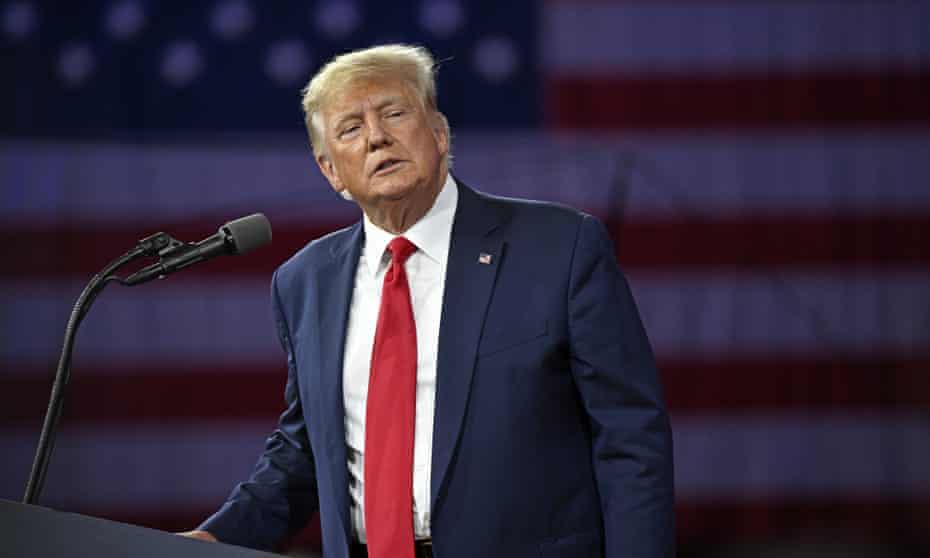
Donald Trump, the former US president, has defended his description of Russia’s Vladimir Putin as “smart” while seeking to blunt accusations that he admires the invasion of Ukraine.
Trump reiterated his false claim that the 2020 election was stolen by voter fraud as he argued that the invasion of Ukraine would never have happened if he was still in the White House.
“The Russian attack on Ukraine is appalling,” he told the Conservative Political Action Conference (CPAC) in Orlando, Florida, on Saturday night. “It’s an outrage and an atrocity that should never have been allowed to occur.
“We are praying for the proud people of Ukraine. God bless them all. As everyone understands, this horrific disaster would never have happened if our election was not rigged and if I was the president.”
Election officials, numerous judges and Trump’s own attorney general found no evidence that the election was rigged. Having retold “the big lie”, he went on to compare himself favourably with other presidents’ handling of Putin.
“Under Bush, Russia invaded Georgia. Under Obama, Russia took Crimea. Under Biden, Russia invaded Ukraine. I stand as the only president of the 21st century on whose watch Russia did not invade another country.”
Democrats dismissed the speech and condemned Trump for still cosying up to Putin. Adonna Biel, a spokesperson for the Democratic National Committee, said: “After spending four years selling out Ukraine, the defeated former president took the stage at CPAC to double down on his shameless praise for Putin as innocent Ukrainians shelter from bombs and missiles at the hands of Russia.
“This has been the theme of the Republican party all week, making clear that their party is beholden to a defeated former president who lost them the White House, House, and Senate.”
An audience of about 5,000 people at CPAC, the biggest annual gathering of grassroots conservatives, roared and whistled their approval. Some chanted: “USA! USA!”
Trump, whose “America first” approach rattled Nato allies, claimed that Russia and other countries respected the US when he was president and blamed Joe Biden for displaying weakness on the global stage.
“I have no doubt that President Putin made his decision to ruthlessly attack Ukraine only after watching the pathetic withdrawal from Afghanistan, where the military was taken out first, our soldiers were killed and American hostages, plus $85bn worth of the finest equipment anywhere in the world were left behind,” he said.
Trump, who notoriously deferred to autocrats, also responded to criticism over his description this week of Putin’s invasion of separatist areas of Ukraine as “genius”, “savvy” and “smart”.
He asserted that Putin has suffered no repercussions beyond sanctions, which he has shrugged off for 25 years. “The problem is not that Putin is smart – which of course, he’s smart – but the real problem is that our leaders are dumb. They’ve so far allowed him to get away with this travesty and an assault on humanity.”
He added: “So sad. Putin is playing Biden like a drum and it’s not a pretty thing as somebody that loves our country to watch.”
Trump’s 2016 presidential campaign had more than 100 contacts with Russia, prompting a special counsel investigation that stopped short of alleging direct collusion. As president, Trump was notoriously reluctant to condemn Putin and, at a summit in Helsinki, took the Russian leader’s word over that of his own intelligence agencies. His administration did impose some sanctions on Moscow, however.
Trump recalled on Saturday: “I was with Putin a lot. I spent a lot of time with him. I got along with him … I did a lot of things that were very tough on Russia. No president was ever as tough on Russia as I was.
“But with respect to what’s going on now, it would have been so easy for me to stop this travesty from happening. He understood me and he understood that I didn’t play games. This would not have happened. Someday, I’ll tell you exactly what we talked about. And he did have an affinity, there’s no question about it, for Ukraine. I said, never let it happen, better not let it happen.”
He added: “I also warned Nato about the danger of Russia and look at the consequences. On foreign policy, the world rightly had a healthy fear that as president I would stand strong for Americans’ priorities.”
During an 85-minute speech to a packed ballroom at CPAC, Trump, who contested the 2016 and 2020 elections, also gave his strongest hint yet that he will run for president in 2024. “We did it twice, and we’ll do it again,” he said. “We’re going to be doing it again a third time.”
There were loud cheers from the crowd, many of whom wore “Make America great again” caps and “Trump 2024” regalia. There were shouts of “Four more years!” and “We want Trump!”
The former president went on to rail against “leftwing tyranny” and “crackdowns, censorship and cancel culture”, praise protesting Canadian truckers and brand Biden’s supreme court nominee, Ketanji Brown Jackson, “a radical left zealot”. He claimed that the court’s existing justices, including conservative Brett Kavanaugh, are “terrified of the radical left” and “afraid to do the right thing”.
Trump pushed the baseless conspiracy theory that his 2016 election rival, “Crooked” Hillary Clinton, spied on him, prompting chants of “Lock her up!” And he accused Democrats of caring more about Ukraine’s borders than America’s own.
He declared: “You could take the five worst presidents in American history and put them together and they would not do the damage that Joe Biden’s administration has done in just a very short period.”
Latest Russia-Ukraine war news: Russian forces enter Kharkiv as Putin intensifies invasion - The Washington Post
Russia-Ukraine live updates Russian forces enter Kharkiv, second-largest city, as Putin intensifies invasion
"MOSCOW — Ukrainian President Volodymyr Zelensky on Sunday accused Russia of attacking civilian targets and warned that Russian crimes in Kyiv and other Ukrainian cities, towns and villages was genocide that “would lead to an international tribunal” for the perpetrators.
Speaking early Sunday, looking tired and unshaven, he said “last night was brutal” in Ukraine: “Shelling again, bombing of residential areas, civilian infrastructure again.
“Russia’s criminal actions against Ukraine have the sign of genocide,” he said. “Russia is on the path of evil,” he said, calling for Russia to be stripped of its U.N. Security Council vote.
“There is not a single — not a single — object in the country today that the occupiers would not consider a permissible target,” he said referring to Russian forces, adding that Ukraine was collecting evidence to refer to an international tribunal.
“They are fighting against everybody, they are fighting against everything alive: against kindergartens, against residential houses and even against ambulances. They use rocket artillery, rockets against entire urban areas where there is no military infrastructure and never has been.”
Speaking with visible anger he listed cities that came under indiscriminate attacks of a kind he said had not seen in Ukraine since World War II: Kyiv, Kharkiv, Vasylkiv, Chernihiv, Sumy.
Russia has denied targeting civilian infrastructure in the course of its invasion. Russia’s Defense Ministry said Sunday it launched long range cruise missiles from ships and warplanes striking “military infrastructure.”
Soon after Zelensky’s speech, Putin issued a prerecorded message of his own on the occasion of Special Operations day and congratulated the nations’ special forces for “their impeccable service” with “special gratitude to those who these days are heroically fulfilling their military duty in the course of a special operation to provide assistance to the People’s republics of Donbass.”
Zelensky addressed the citizens of neighboring Belarus as well, saying the Belarusian leader enabled Russian attacks on Ukraine from Belarusian soil.
“From your territory, Russian Federation troops are launching missiles at Ukraine. From your territory they kill our children, destroy our homes, try to blow up everything that was built over decades. And, by the way, not only by us, but also by our fathers, our grandfathers.
“You decide who you are, you decide who you will be, how you will look your children in the eyes, how you will look each other, your neighbors. And we are your neighbors. We are your neighbors, we are Ukrainians,” Zelensky said. “Be Belarus, not Russia.”
Saturday, February 26, 2022
How Republicans moved from Reagan’s ‘evil empire’ to Trump’s praise for Putin
How Republicans moved from Reagan’s ‘evil empire’ to Trump’s praise for Putin

“For decades, the Republican Party’s stance on Russia’s dictators and expansionist tactics was rock-solid: From Dwight D. Eisenhower to Richard Nixon to Ronald Reagan, Russia — then the Soviet Union — was America’s chief enemy, untrustworthy, anti-freedom. It was, in Reagan’s famous formulation, the “evil empire.”
This week, while many Republicans blasted Russian leader Vladimir Putin’s all-out assault on Ukraine, former president Donald Trump and some of his allies urged the United States to stay out of the conflict and praised Putin, even presenting him as a “peacekeeper,” as Trump put it.
“Don’t look for consistency in Republican policy,” said Craig Shirley, a Reagan biographer and longtime Republican political consultant. “The Republican Party right now is a little schizophrenic. Anti-communism and love of freedom used to be the glue that held the party together, but now the attitudes toward Russia have gotten all mixed up with domestic politics.”
In Congress, across conservative media and on the social media battlegrounds where so much of right-leaning America thrashes out its differences, Russia’s invasion of Ukraine seemed to open a gap between Trump and some of his erstwhile loyal supporters.
On Capitol Hill, GOP senators usually quick to agree with most anything Trump says issued statements that aligned with Republican reactions to Russian aggression through the past seven decades. One of Trump’s most vocal allies, Sen. Ted Cruz (R-Tex.), praised the sanctions that Trump’s successor levied against Putin. “President Biden has now taken positive steps,” Cruz said, adding that “much more still needs to be done to deter and counter the threat that Putin poses to our allies in Ukraine and across Europe.”
Sen. Todd C. Young (R-Ind.) similarly praised Biden’s sanctions and said “Putin is attacking the democratic, rules-based order that has benefited countless Americans and millions around the globe since World War II. The United States must stand with the Ukrainian people by immediately providing additional assistance, including military equipment and lethal aid.”
But other Republicans hewed closer to Trump, who on Fox News touted his “good relationship” with Putin and suggested that the Russian president had attacked Ukraine only because of the “weakness” of the Biden administration. In Ohio, Senate candidate and Trump loyalist J.D. Vance said on a podcast that “I don’t really care what happens to Ukraine one way or another,” and tweeted that “our leaders care more about Ukraine’s border than they do our own.”
Fox’s most popular host, Tucker Carlson, pooh-poohed the idea that Putin is an enemy: “Why do I hate Putin so much?” he said. “Has Putin ever called me a racist? Has he threatened to get me fired for disagreeing with him?”
“Makes your head spin, doesn’t it?” Shirley said. “The party is searching for meaning beyond just anti-Bidenism, and there’s no one position.”
A chief cause of the Republican splintering on Putin and his invasion of Ukraine is the dramatic shift in rhetoric and policy that Trump introduced into the party’s messaging, starting in his 2016 campaign and continuing through his term in the White House and his embittered post-presidency.
With his “America First” rhetoric and his policies of stepping back from NATO and other U.S. alliances with Western democracies, Trump tapped into a long-standing American discomfort with getting involved in other countries’ troubles. That attitude traces back to the founders; Thomas Jefferson warned against “entangling alliances.”
To varying degrees, that allergy to diving into foreign crises has surged periodically in U.S. history, especially in times of economic disarray and technological dislocation. Especially after the trauma of World War I — another time when a deadly pandemic deeply disrupted American life — isolationism became persistently popular. And it has remained an occasionally recurring bug in both parties, often wrapping in antagonism toward immigrants, minority groups, Wall Street and academia. Republican leaders campaigned for decades on reining in Russia, from Eisenhower’s statement that the Soviet Union represented “godless depravity in government” to GOP presidential nominee Mitt Romney’s 2012 characterization of Russia as “our number one geopolitical foe.”
The country’s establishment politicians and policymakers have generally leaned toward America playing an active role in international affairs. The United States is, as Madeleine Albright, Bill Clinton’s secretary of state, said, “the indispensable nation,” on trade, certainly, but also on securing peace, curbing extremism and spreading democracy.
But during periods of populist politics — and especially when foreign wars crop up — many Americans embrace politicians who preach a strong, if not total, focus on domestic matters. In 2013, for example, with U.S. forces seemingly bogged down in Syria, Iraq and Afghanistan, the percentage of Americans telling pollsters that the country should “mind its own business internationally” jumped to 52 percent — the first time a majority expressed that view in half a century, according to a Pew Research Center poll.
That attitude has been particularly popular among Republican voters in recent years, polls indicate.
“I have always been a Republican because of the party’s stands for freedom, free markets, limited government and strong defense,” said Joe Walsh, a former GOP congressman from Illinois who supported Trump in 2016 but then became sharply critical of him as president. “But then came Trump and his authoritarian approach, which connected with voters who really wanted a strongman to build a wall, keep Brown people out and shut down CNN. Now the party’s populist base has been radicalized and it’s metastasized beyond Trump himself.”
Walsh, now a podcaster who considers himself a man without a party, said the old Republican attitudes toward Russia still exist in the hearts “of many of my former colleagues in the House. They still believe in a Reagan internationalism, in being tough on Russia,” he said. “But they don’t say anything because they know where the base is: with Trump and Tucker Carlson, saying, ‘Putin good, Biden bad, and I don’t want my gas prices to go up.'"
The party’s division was evident as Russian missiles landed in several Ukrainian cities and Trump defended the Russian leader. “I don’t believe he wanted to do this initially,” Trump said of Putin on Fox News. A day earlier, on a conservative podcast, Trump called Putin a “genius” for declaring two regions of Ukraine to be independent countries and said “he’s gonna go in and be a peacekeeper.”
Trump’s aversion to portraying Russia and Putin as America’s enemies was evident from the start of his late-life political career. During the 2016 campaign, he moved to erase from the Republican platform any mention of protecting Ukraine from Putin’s designs. And he repeatedly praised Putin throughout his presidency.
But why did so much of the Republican political leadership and the party’s voter base so easily flip from traditional anti-communism and suspicion of Russian motives to an acceptance or even an embrace of Putin and his authoritarian ways?
Walsh argues that when he and other young Republicans were attracted to Reagan’s candidacies in the 1980s, they were wowed by “the overall idea of strength after the weakness of Jimmy Carter and by his promise to get government out of your lives. Reagan’s strong stance against the Soviet Union was never the real draw.”
“I voted for Trump in 2016 in part because he was a noninterventionist, f--- the rest of the world guy,” Walsh said. “What saddens me most is that I did not sufficiently see this embrace of authoritarianism coming.”
But others see the shift in the definition of Republicanism less driven by stances on issues than simply by the power of personalities.
“There’s always been an ebb and flow between isolationism and internationalism in the party,” said Shirley, who is also the author of “April 1945,” a history of World War II’s endgame. “It’s really based on the personalities of our presidents and the Russian leaders more than on any principles. The current crop of Republicans still says they like Reagan, but they just like his personality. They don’t share his consistent internationalist philosophy.”
The evolution of attitudes toward Russia in the Republican base has been driven not only by Trump’s popularity and the struggles of the U.S. economy, but also by a years-long effort by Russia to influence how Americans of all political stripes view the world, according to disinformation researchers who have traced Russia’s hacks, deceptive Internet posts and fake accounts on social media.
From the civil war in Syria to the separatist battles in eastern Ukraine, Russia’s intelligence services have sought to shape American views of Putin and his government. In 2016, Russia interfered in the U.S. election by hacking and disseminating sensitive Democratic Party emails, and the Internet Research Agency, run privately by a Putin ally, flooded Facebook, Twitter and other platforms with faked social media posts that helped drive Americans to polarized political positions while also supporting Trump’s presidential bid.
Russia has sought to shape American attitudes toward political issues “through a subtle, sophisticated, very long game of influence,” said Camille François, a disinformation researcher at Columbia University’s School of International and Public Affairs. “It’s a full-spectrum campaign with covert and overt elements.”
Other experts on disinformation, in contrast, argue that the impact of Russia’s efforts to alter Americans’ political perspectives is not so clear. Thomas Rid, a professor of strategic studies at Johns Hopkins University’s School of Advanced International Studies and author of “Active Measures,” a history of disinformation, said the role of Russian meddling may not be as powerful as some other domestic forces that have pushed Americans toward views so polarized that members of one party almost automatically take a position opposed to the other party’s.
“Your hatred of your own political opponent is so deep that you side with Vladimir Putin as he attacks major population centers in Ukraine, which is extraordinary,” Rid said.
Craig Timberg contributed to this report.“
Biden Picks Ketanji Brown Jackson for Supreme Court
Biden Picks Ketanji Brown Jackson for Supreme Court

“WASHINGTON — President Biden on Friday said he would nominate Judge Ketanji Brown Jackson to the Supreme Court, elevating a well-regarded federal appeals court judge who, if confirmed, would make history by becoming the first Black woman to serve as a justice.
Mr. Biden’s decision, made after a monthlong search, fulfilled a campaign promise to nominate a Black woman to the bench, and set into motion a confirmation battle that will play out in an evenly divided Senate. He announced the nomination at the White House, flanked by Judge Jackson and Kamala Harris, the first Black woman to be elected vice president.
“For too long our government, our courts, haven’t looked like America,” Mr. Biden said in remarks delivered two years to the day after he made his campaign promise in South Carolina. “I believe it is time that we have a court that reflects the full talents and greatness of our nation.”
In Judge Jackson, 51, Mr. Biden selected a liberal-leaning jurist who earned a measure of Republican support when he nominated her last year to the influential U.S. Court of Appeals for the District of Columbia Circuit — an accomplishment the president, intent on curtailing the sort of partisan rancor touched off by recent nominations, took pains to emphasize.
Judge Jackson will begin meeting with lawmakers on Capitol Hill next week. If confirmed by the Senate, she would replace Justice Stephen G. Breyer, the senior member of the court’s three-member liberal wing, who announced last month that he would retire at the end of the current court term this summer if his successor was in place.
In his remarks on Friday, Mr. Biden pointed out that Judge Jackson, a former clerk for Justice Breyer, was a jurist whose legal approach was informed by the man she hoped to replace.
“Not only did she learn about being a judge from Justice Breyer himself,” Mr. Biden said, “she saw the great rigor through which Stephen Breyer approached his work.”
While her confirmation would not change the court’s ideological balance — conservatives appointed by Republicans would retain their 6-3 majority — it would achieve another first: all three justices appointed by Democratic presidents would be women.
“If I’m fortunate enough to be confirmed as the next associate justice of the Supreme Court of the United States,” Judge Jackson said in her own set of remarks, “I can only hope that my life and career, my love of this country and the Constitution and my commitment to upholding the rule of law and the sacred principles upon which this great nation was founded, will inspire future generations of Americans.”
Judge Jackson’s nomination was praised by Democrats, but few Republicans in the Senate are expected to support her. Shortly after the White House announced Mr. Biden’s decision, conservative lawmakers and interest groupscriticized her Ivy League background and characterized her past rulings as too liberal. In a cascade of statements, some Republicans questioned Mr. Biden’s choice, but they largely avoided scorched-earth calls to oppose her nomination.
“The Senate must conduct a rigorous, exhaustive review of Judge Jackson’s nomination as befits a lifetime appointment to our highest court,” Senator Mitch McConnell of Kentucky, the minority leader, said in a statement, pointing out that he was not one of the Republicans who voted in favor of her nomination last summer.
The three Republicans who joined a 53-to-44 vote to confirm her last year — and who will be under pressure from Democrats to do so again — were Senators Susan Collins of Maine, Lindsey Graham of South Carolina and Lisa Murkowski of Alaska.
In recent weeks, Mr. Graham had been a vocal supporter of a judge from his own state, J. Michelle Childs, to replace Justice Breyer. He cast doubt on the idea that he would vote for Judge Jackson again: “The Harvard-Yale train to the Supreme Court continues to run unabated,” he wrote Friday on Twitter.
Judge Jackson was born in Washington, D.C., and grew up in Miami. She graduated from Harvard College and Harvard Law School, Justice Breyer’s alma mater. She went on to clerk for him during the 1999-2000 Supreme Court term. Four current Supreme Court justices, including two nominated by Republican presidents, went to Harvard.

In her remarks, Judge Jackson emphasized her faith and her family. Her parents were public school teachers. One of her uncles was Miami’s police chief, and another was a sex crimes detective. Her younger brother worked for the Baltimore police in undercover drug stings.
Another uncle, Thomas Brown, was sentenced to life in prison in October 1989 for possessing a large amount of cocaine with intent to distribute it. He was released in November 2017, after President Barack Obama commuted most of his remaining sentence, along with those of many others sentenced when so-called three-strikes laws sent many nonviolent drug offenders to prison for decades. Public records suggest Mr. Brown died about four months later.
“You may have read that I have one uncle who got caught up in the drug trade and received a life sentence,” Judge Jackson said. “That is true. But law enforcement also runs in my family.”
When Mr. Biden and his advisers began planning for a possible Supreme Court vacancy during the presidential transition, Judge Jackson was brought up as one of the likeliest possibilities. She was always a front-runner, people familiar with the process said, in part because she was well-known and well-liked in Washington legal circles.
During Judge Jackson’s confirmation hearing to be a Federal District Court judge in Washington in 2012, Representative Eleanor Holmes Norton, the District of Columbia’s nonvoting delegate, recounted that Justice Breyer had two words when asked about her eligibility for the post: “Hire her.”
When Judge Jackson was sworn in for the job in 2013, Justice Breyer did the honors. “She sees things from different points of view, and she sees somebody else’s point of view and understands it,” he said at the time.
Judge Jackson was chosen from a short list that also included Leondra R. Krugerof the California Supreme Court, a former law clerk on the Supreme Court whose Yale Law pedigree is shared by four of the current justices; and Judge Childs, a Federal District Court judge in South Carolina, a state whose Black voters Mr. Biden has credited with helping him win the presidency.
White House officials have pushed back on the idea that Judge Jackson was always the favorite, and according to a person who worked with another one of the candidates, White House officials were vetting other potential nominees until at least Wednesday afternoon.
As Mr. Biden continued to deliberate this week, concern grew among White House allies that waiting until the end of his self-imposed deadline at the end of the month would deprive a historic nominee of her due, sandwiched between Russia’s invasion of Ukraine and Mr. Biden’s State of the Union address, scheduled for Tuesday. Democrats in Congress worried that dragging out the announcement heightened the risk that a nominee could not be confirmed before a scheduled two-week recess in early April.
By Thursday, Mr. Biden had decided. He called Judge Jackson that evening to offer her the nomination, and she accepted. Several White House officials, including Ron Klain, the chief of staff, and Dana Remus, the White House counsel, have extensive experience with the court, and helped him make his final decision.
Judge Jackson has a substantial judicial track record, having served on federal courts longer than several of the current justices had when they were appointed. In her eight months on the federal appeals court, she has yet to produce a body of opinions that express a legal philosophy, but the two majority opinions she has issued have been detailed and methodical.
The great bulk of her opinions stem from her eight years on the Federal District Court in Washington, as a trial judge, and many of them suggest that she would be about as liberal as Justice Breyer if she is confirmed.
Her most notable decisions on the district court included blocking the Trump administration’s attempts to fast-track deportations, cut short grants for teen pregnancy prevention and shield a former White House counsel from testifying before Congress about President Donald J. Trump’s efforts to obstruct the Russia investigation.
“Presidents are not kings,” she wrote in 2019, issuing a ruling that Donald F. McGahn II, the former White House counsel, had to obey a congressional subpoena seeking his testimony about Mr. Trump’s actions. She added, “They do not have subjects, bound by loyalty or blood, whose destiny they are entitled to control.”
Plans to move her into position began last year, when Mr. Biden elevated her from the Federal District Court in the District of Columbia to the powerful federal appeals court, a traditional proving ground for potential justices.
Her background as a public defender made her an unusual, but to Mr. Biden, appealing, choice. When a Republican senator asked during the confirmation process last year whether she had been concerned that her work as a public defender could put violent criminals back on the streets, she argued that having such a background was an asset.
“Having lawyers who can set aside their own personal beliefs about their client’s alleged behavior or their client’s propensity to commit crimes benefits all persons in the United States,” she said in a written response, “because it incentivizes the government to investigate accusations thoroughly and to protect the rights of the accused during the criminal justice process.”
Judge Jackson has two daughters and is married to Patrick G. Jackson, a general surgeon at MedStar Georgetown University Hospital. She is related by marriage to Paul D. Ryan, the former House speaker and Republican vice-presidential candidate. (Dr. Jackson is the twin brother of Mr. Ryan’s brother-in-law.) At her 2012 confirmation hearing, Mr. Ryan testified in her support.
“Our politics may differ, but my praise for Ketanji’s intellect, for her character, and for her integrity, is unequivocal,” Mr. Ryan tweeted on Friday, echoing the testimony he gave on her behalf a decade ago.
Reporting was contributed by Adam Liptak and Charlie Savage from Washington, and Patricia Mazzei from Miami.“
Thursday, February 24, 2022
THE EDITORIAL BOARD No Justification for a Brazen Invasion
No Justification for a Brazen Invasion

“The editorial board is a group of opinion journalists whose views are informed by expertise, research, debate and certain longstanding values. It is separate from the newsroom.
Sign up for the Russia-Ukraine Crisis Briefing. Make sense of the conflict with the latest news and expert insight.
Explosions were reported in cities across Ukraine early Thursday morning after President Vladimir Putin of Russia vowed in a speech to “demilitarize” the neighboring nation, and any hope for a peaceful resolution to the crisis appeared all but snuffed out. On Wednesday, Ukraine declared a 30-day state of emergency, called up military reserves and warned its citizens to leave Russia. The European Union announced it was preparing to handle a large influx of refugees uprooted by war. Financial markets are bracing for the turmoil that a land war and sanctions could unleash across the global economy.
As the cause of all of this, Vladimir Putin is giving a master class in dangerous and destructive leadership and making it all the more important that President Biden and other nations stand resolutely together in the face of threats, feints and misinformation and remain disciplined and energized in confronting Mr. Putin. He is clearly playing a long game, and the West should continue to prepare for that and make clear, as Mr. Biden has done, that the Russian president is acting unacceptably and will pay consequences for his actions.
The scope of Mr. Putin’s professed ambition is alarming and bewildering for much of the world. As Mr. Biden asked, “Who in the Lord’s name does Putin think gives him the right to declare new so-called countries on territory that belonged to his neighbors?”
All this makes clear that Mr. Putin’s attack is not primarily about NATO or security. It’s all about his xenophobic, imperial and misguided notion that Ukraine was inherently an appendage of Russia, its independence a historical fluke and its rulers usurpers. His recognition of separatist states in Ukraine extended not only to enclaves controlled by pro-Russian forces but also to entire provinces, amounting to a major chunk of Ukrainian territory that includes the important port of Mariupol.
The magnitude of the Russian gambit is staggering. Whatever Mr. Putin’s ideas on how Ukraine should relate to Russia, whatever his grievances over Western encroachment on what he perceives as Russia’s sphere of influence, whatever his views on Russia’s place in Europe and the world, an unprovoked invasion of a sovereign European state is an unprovoked declaration of war on a scale, on a continent and in a century when it was thought to be no longer possible.
If nothing else, Mr. Putin should consider what this means for his people, to whom he has lied, day after day, about purported threats and slights from Ukraine and the West. There will be body bags coming home to Russia and economic dislocation and global ostracism for a nation that has suffered terribly over the past century from war and totalitarian rule.
Mr. Biden, for his part, has managed this crisis with toughness, patience, resolve and dignity, revealing regularly what American intelligence knew about Mr. Putin’s schemes. It was a novel approach to crisis management in the age of social media and probably helped harden European resolve during the ambiguous monthslong buildup of Russian forces. Mr. Putin should see that this is the resolute face of the world’s premier democracy and most powerful nation.
Secretary of State Antony Blinken canceled a meeting scheduled for this week with the Russian foreign minister, Sergey Lavrov. In a letter to Mr. Lavrov, Mr. Blinken said that diplomatic offramps exist “if Russia is prepared to take demonstrable steps to provide the international community with any degree of confidence it’s serious about de-escalating and finding a diplomatic solution.”
Mr. Biden and America’s NATO allies have properly declared going to war with Russia over Ukraine unthinkable. Ukraine, far weaker militarily than Russia, will have to bear the brunt of the attack alone, though, as Mr. Biden warned, the sanctions against Russia will have far-reaching economic costs for Europe and the United States, starting with an inevitable increase in the cost of energy.
Mr. Biden was right not to unleash the full arsenal of sanctions yet. As long as there is the slightest chance of deterring a full-scale invasion, he and his allies and partners must retain sticks and carrots, however few remain. That could include declaring Mr. Putin and his lieutenants war criminals, subject to arrest anywhere outside Russia. Many more banks can be added to the few that have been barred from the global financial system; trade in a broad array of technologies needed by Russian industry can be banned.
These sanctions will also hurt the West, especially Germany, and Russia may well retaliate through cyberattacks or other means that could shake global energy markets. Any such costs should be weighed against the gravity of what Russia has done.
Analysts and historians will long debate whether Mr. Putin’s grievances had bases in fact, whether the United States and its allies were too cavalier in expanding NATO, whether Russia was justified in believing that its security was compromised. There will also be heated questioning over whether Mr. Biden and other Western leaders could have done more to assuage Mr. Putin.
But no, there is absolutely no justification for a brazen invasion of a weaker neighbor. To answer Mr. Biden’s anguished question, nobody and nothing have given Mr. Putin the right to seize territory or decide the fate of neighboring nations. The consequences of his aggression will be terrible for Ukraine and painful for the West and will exact a huge cost on Russia in lives and stunted development. For all this, Mr. Putin carries the full responsibility.“
Wednesday, February 23, 2022
Opinion | Trump calls Putin’s invasion of Ukraine an act of ‘genius.’ So much for the notion that he’s tough on Russia. - The Washington Post
Opinion: With his praise for Putin’s invasion of Ukraine, Trump makes his apologists look foolish. Again.

"To believe this is to suffer from temporary amnesia about how Donald Trump actually acted toward Putin while he was in office. Who can forget Trump’s kowtow to Putin at Helsinki in 2018? The U.S. president rejected the findings of the United States’ own intelligence community about the hacking of the 2016 election and said: “President Putin says it’s not Russia. I don’t see any reason why it would be.” Or who can forget Trump’s use of U.S. military aid to extort the government of Ukraine into helping him politically? Or all of Trump’s anti-NATO animus? Trump mused about pulling out of the alliance, questioned its Article 5 security guarantees and ordered a withdrawal of 12,000 troops from Germany.
It is true that the Trump administration sometimes pursued tough-on-Russia policies independent of the president, but this was largely the work of officials who were purged long before the end of Trump’s term. By the end of his presidency, Trump was surrounded by people such as Secretary of State Mike Pompeo, who has recently called Putin “a very talented statesman,” “very shrewd,” “very capable,” and said, “I have enormous respect for him.”
At least Pompeo is willing to admit that Putin is the “aggressor” and the Ukrainians are his “victims.” No such censure was evident in Trump’s comments Tuesday to right-wing podcaster Buck Sexton. Putin’s aggression against Ukraine is an act of “genius,” according to Trump. He explained:
“Putin declares a big portion of the Ukraine — of Ukraine — Putin declares it as independent. Oh, that’s wonderful. ‘I said, ‘How smart is that?’ And he’s gonna go in and be a peacekeeper. ... We could use that on our southern border. That’s the strongest peace force I’ve ever seen. There were more army tanks than I’ve ever seen. They’re gonna keep peace all right. No, but think of it. Here’s a guy who’s very savvy.”
Trump went on to rhapsodize about his relationship with Putin — “He liked me. I liked him.” — and to praise him as someone with a lot of “charm and a lot of pride” who “loves his country.”
With those few words, Trump has just made a fool of every right-winger who has tried to pretend that he would have been tougher on Putin than Biden is currently being. Trump did claim that “this never would have happened with us,” but this was merely his usual rhetorical ploy of blaming Russian aggression on former president Barack Obama or on Biden rather than on Putin. Indeed, it’s hard to think of a single negative word Trump has ever uttered about the Russian tyrant.
And that’s just the way his most devoted supporters like it. It’s true that many mainstream Republicans criticize Biden for being too weak on Russia. But the hardcore MAGA base thinks that Biden has too been too hostile to Putin, who is viewed more favorably by Republican voters than Biden is.
Tucker Carlson has become Putin’s No. 1 American apologist — and a favorite of Russian state television — by incessantly arguing that the United States has no stake in Russia’s aggression against Ukraine. “Vladimir Putin does not want Belgium,” Carlson says. “He just wants to keep his western borders secure. That’s why he doesn’t want Ukraine to join NATO, and that makes sense.”
Carlson’s views are echoed by other America Firsters. Right-wing troll Candace Owens tweets: “NATO (under direction from the United States) is violating previous agreements and expanding eastward. WE are at fault.” Her fellow troll Charlie Kirk opines: “It feels as if Putin is going into places that want him … It is a family dispute that we shouldn’t get in the midst of, that’s for certain.” Ohio senate candidate J.D. Vance said, “I don’t really care what happens to Ukraine.” Fox’s Maria Bartiromo imaginatively suggested that the Biden administration’s “hysteria” about a Russian invasion of Ukraine might be a “ruse” to distract from the latest nonsensical allegations about Hillary Clinton spying on Trump.
Compare right-wing complacency about Putin’s invasion of Ukraine with their hysteriaabout Prime Minister Justin Trudeau of Canada ordering the arrests of anti-vaccine mandate protesters who were blocking major thoroughfares. Carlson claims that “Canada canceled democracy,” while ignoring the actual, existential threat to democracy in Ukraine.
This is the authentic voice of Trump’s America First movement — and it would be solidly in control of a second Trump term in a way it was not during most of his first term. Indeed, if Trump stages a comeback in 2024, he may well be counting on more political aid from Putin of the kind that he received in 2016.
So please don’t insult our intelligence by suggesting that Trump is the tough-on-Russia candidate or that his volatility would deter Putin. He’s more about Russia First than America First."