A collection of opinionated commentaries on culture, politics and religion compiled predominantly from an American viewpoint but tempered by a global vision. My Armwood Opinion Youtube Channel @ YouTube I have a Jazz Blog @ Jazz
and a Technology Blog @ Technology. I have a Human Rights Blog @ Law
Sign up for The Decision, a newsletter featuring our 2024 election coverage.
Less than a week before Election Day, Donald Trump last night called for one of his prominent political adversaries to go before a firing squad. In an onstage interview with Tucker Carlson in Arizona, Trump called Liz Cheney, the Republican former representative from Wyoming, “a very dumb individual” and “a radical war hawk.”
“You know they’re all war hawks when they’re sitting in Washington in a nice building saying, Ooh gee, well, let’s send 10,000 troops right into the mouth of the enemy,” Trump said. “Let’s put her with a rifle standing there with nine barrels shooting at her, okay? Let’s see how she feels about it, you know, when the guns are trained on her face.”
Like Trump’s hate-filled rally at Madison Square Garden last weekend, these comments are a good summation of what he would bring to the White House if reelected. His campaign is premised on violence, disregard for the rule of law, and retribution for anyone who might disagree with him.
“This is how dictators destroy free nations,” Cheney responded on X. “They threaten those who speak against them with death. We cannot entrust our country and our freedom to a petty, vindictive, cruel, unstable man who wants to be a tyrant.”
Trump’s campaign said that Trump “was talking about how Liz Cheney wants to send America’s sons and daughters to fight in wars despite never being in a war herself.” Trump isn’t wrong that Cheney has often advocated foreign military interventions. She can and should be criticized for many of her views. But Trump isn’t calling for a debate. He vividly imagined Cheney with “guns trained on her face.” Normalizing discussion of political opponents getting shot is a step in a dangerous direction.
These remarks cannot be written off as joking around, the excuse that Trump has typically used when he’s crossed lines. (He seems less concerned about disapprobation these days.) Trump didn’t laugh when he said it. Neither did Carlson or the audience. Besides, Trump has repeatedly called for the armed forces to be used against his political critics. He’s proposed deploying the military against the “enemies from within,” a group that includes “radical left lunatics” generally, but also former Speaker Nancy Pelosi and Representative Adam Schiff, both California Democrats. He’s amplified calls on Truth Social for former President Barack Obama to face a military tribunal (for what crimes, one can only guess). He has said that retired General Mark Milley, whom he appointed chairman of the Joint Chiefs of Staff, should be executed.
Yet some voters may go to the polls without a firm grasp of his rhetorical record. Trump makes so many outrageous remarks that keeping track of them all is difficult, and some parts of the press persist in toning down even his most dangerous comments. The headline in The New York Times on Trump’s Cheney remarks as of this writing was “Trump Attacks Liz Cheney Using Violent War Imagery,” which is not strictly false but misses the point.
In these comments, Trump flagrantly displayed his hypocrisy. Although the former president has remade himself as a putative dove, he once backed some of the same conflicts that Cheney did, including the war in Iraq. And although he claims he wants to avoid foreign adventurism, he spent his first term in office being talked out of attacking Venezuela, North Korea, and Syria’s Bashar al-Assad, among others. He and his allies are now proposing that the U.S. military launch attacks on cartels inside Mexico.
Trump is also proposing new uses of the military domestically, not only against his enemies but to conduct a mass deportation. He has encouraged brutal policing and vigilante attacks by citizens. Trump may hate war, but he loves violence.
Perhaps voters shouldn’t give this man command of so many people armed with rifles.“
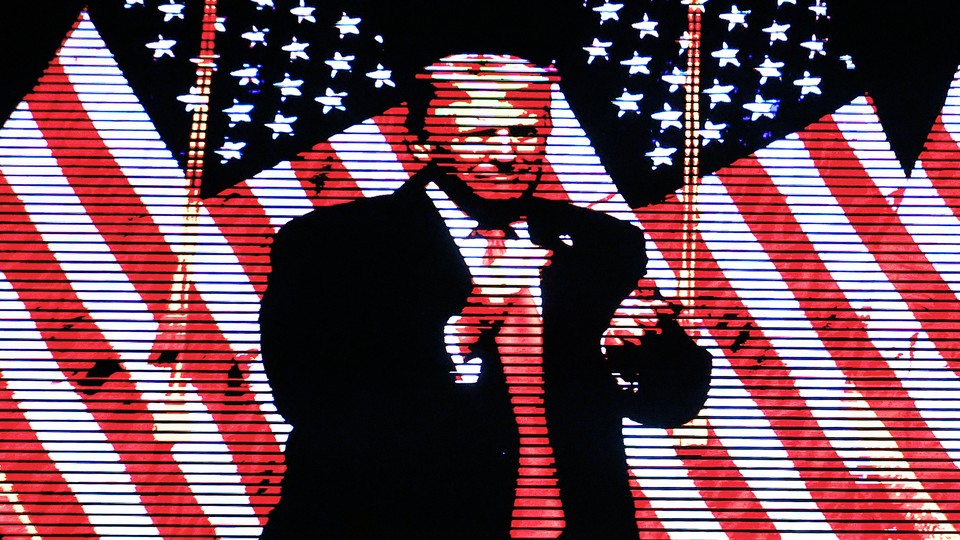
Image: Mr.Nelson design for The Verge / Getty Images
Donald Trump is a dangerous maniac who can barely complete a sentence, and it is lunacy to believe he can even recognize the existentially threatening collective action problems facing our nation, let alone actually solve them.
Collective action problem is the term political scientists use to describe any situation where a large group of people would do better for themselves if they worked together, but it’s easier for everyone to pursue their own interests. The essential work of every government is making laws that balance the tradeoffs between shared benefits and acceptable restrictions on individual or corporate freedoms to solve this dilemma, and the reason people hate the government is that not being able to do whatever you want all the time is a huge bummer. Speed limits help make our neighborhoods safer, but they also mean you aren’t supposed to put the hammer down and peel out at every stoplight, which isn’t any fun at all.
Every Verge reader is intimately familiar with collective action problems because they’re everywhere in tech. We cover them all the time: making everything charge via USB-C was a collective action problem that took European regulation to finally resolve, just as getting EV makers to adopt the NACS charging standard took regulatory effort from the Biden administration. Content moderation on social networks is a collective action problem; so are the regular fights over encryption. The single greatest webcomic in tech history describes a collective action problem.
The problem is that getting people to set aside their own selfishness and work together is generally impossible even if the benefits are obvious, a political reality so universal it’s a famous Tumblr meme.
You can sum up the history of civilization as a long fight about where the government’s authority to tell everyone what to do comes from
This is such an intractable problem that you can sum up the history of civilization as a long fight about where the government’s authority to tell everyone what to do comes from. Ancient rulers just went ahead and considered themselves gods, which made things pretty easy — anyone who lives in a neighborhood with an overzealous HOA president can see this approach in action today. Quite a few European kings decided they’d operate one layer up the stack and announced that they were empowered by God with the divine right to absolute control, which also made things somewhat easy but caused several wars and assassinations by other kings who’d gotten drunk and high enough to see Jesus.
Every so often, the world gets some bozo who decides his desire for absolute control is justified because of an emergency, which inevitably leads them to spend a lot of time convincing people that the very existence of foreigners is an emergency so they can hold onto that power forever. This is basically a hack, but it’s an effective one — there are always foreigners, after all. You know why Trump has lately taken to standing in front of backdrops that read DEPORT ILLEGALS NOW? It’s because when you put this dude under any pressure at all, he reflexively creates a Brown People Emergency to justify his authoritarian instincts.
It is extremely frustrating that the Harris campaign keeps going on about Trump being a danger to democracy without explaining why his whole deal is so deeply incompatible with America, so here’s the short version: the radical founding principle of the United States of America is the idea that the government’s authority to make laws and solve collective action problems comes from the consent of the governed. A clean rewrite, replacing centuries of architectural debt with what was, at the time, a cutting-edge foundation mostly unproven at scale. We vote for our leaders, they are given the power to tell us all what to do so that we might help each other reach better outcomes and be happier, and if they are bad at their jobs, we can simply throw the bums out. We open-sourced the authority, in other words. It was a big bet, and so far, it’s paid off.
Like any large open-source project, American democracy is kind of messy, requires a lot of volunteer effort, and often uses way too much memory. But it enables everyone to submit requests for changes so that we might better direct the power of our communities at every level toward solving our problems, and the democratic process provides an essential stability which allows people to keep buying into our country as the platform on which to build their own big ideas.
Trump doesn’t give a shit about any of this because he only cares about himself. He generally does not care to solve problems unless it benefits him personally, and the intellectual foundation of the MAGA movement that’s built up around him is the complete denial that collective action problems exist at all. The MAGA worldview is now so batshit that it requires its proponents to look at obvious failures of collective action and declare them immutable features of modern life — or, in an even stupider twist — announce them to be good things.
For example, school shootings represent a complete failure to solve a collective action problem — a uniquely American failure because not only have we not solved the problem, we have actively made it worse. Just look at this chart:
Credit: American Enlightenment Project / K-12 Shooting Database
That’s the alarming increase in school shootings since the 2008 Supreme Court ruling in District of Columbia v. Heller, which basically made any meaningful gun regulation impossible. With a bare 5–4 majority behind him, Antonin Scalia decided to fully reinterpret the Second Amendment and reset the balance of liberties in America to favor the rights of gun owners in what is now a clear tradeoff against the safety of our communities.
You can argue about this chart, or this specific tradeoff, or even that Scalia failed to foresee the rise of a wildly irresponsible gun culture that should otherwise moderate these harms but which has instead produced tactical cosplay chuds and would-be lifestyle influencer Don Jr. That’s fine! All of that would be evidence of a rational political culture: one that makes policy choices, evaluates the outcomes, and accepts the reality of the results so as to make better tradeoffs in the future.
But Trump is not rational, and Trumpism cannot abide the idea of a collective action problem. You might think that Trump’s brain is mush, but JD Vance’s weasel-like mind is constantly, actively finding ways to sanitize the chaos, and the philosophical demands of MAGA required him to look America directly in the eye at a recent rally and say that school shootings are “a fact of life.”
It should be easy for Vance to imagine a world in which school shootings don’t happen — that is the pre-Heller world he grew up in! — but fixing the problem of school shootings requires admitting that a collective action problem exists. It requires admitting that the current policy solution — sending kids to school with fucking Kevlar in their backpacks — is less effective than restricting gun ownership in any meaningful way. He cannot do that. Trump cannot do that. Trumpism cannot allow that debate to happen.
Do you want to live in a country where the vice president refers to schools as “soft targets”? That’s a vote for JD Vance. That’s a vote for Donald Trump — a vote for the line on the school shootings chart to keep going up, forever.
That’s a vote for Donald Trump — a vote for the line on the school shootings chart to keep going up, forever
It’s the same with vaccines, which are a near-perfect collective action problem — they are generally only effective if almost everyone in a community gets them, which means either everyone has to agree to get them or the government has to mandate compliance. When everyone cooperates and gets vaccinated, our vaccines can be highly effective: the measles were effectively eradicated in this country nearly a quarter-century ago.
Do you trust Donald Trump to see this tradeoff and understand this outcome? To adjust to it and use the power of the Oval Office to convince Americans that the balance of harms favors vaccinations over a rise in measles cases? He couldn’t even do it for the covid vaccines his own Operation Warp Speed produced, and Vance is now blowing anti-vax dog whistles as loudly as he can in his public speeches. It is a near certainty that Trump will just blame the next measles outbreak on immigration because at least he can shoot at brown people.
Trump simply cannot use the tools of democracy to run the country on our behalf. His brain does not work that way, even when it appears to be working. He is too selfish, too stupid, too cognitively impaired, too fucked in the head by social media — too whatever. He just can’t do it. He will make our collective action problems worse because he doesn’t even know what kind of problems they are. There is a reason he loves dictators and that all his biggest ideas involve forcing people to do things at the barrel of a gun: mass deportations, arresting his critics, sending the military into American cities to quell protests. He is unable to imagine a world where people cooperate for any reason other than the threat of violence, and so violence has become an inextricable part of his movement.
The list of massive collective action problems facing our nation is almost overwhelming to consider, and they threaten to tear us apart: our population is getting older, with a looming healthcare crisis to come. Education. Housing. Income inequality. There are so many more.
We are not doing well right now, and when I look at the problems The Vergespecifically covers and has covered for over a decade, the failures are blinding.
Solving climate change is the biggest collective action problem of our lifetimes — and nested within it, there are even more collective action problems like transitioning to EVs and rethinking our sources of power. Trump cannot concede that this problem requires collective action to solve, so the MAGA approach is to simply deny climate change exists while Trump blathers on about wanting to be a “whale psychiatrist.”
As a country, we have almost entirely failed to regulate the tech industry. There are almost no meaningful checks on its size or influence, or even requirements to be responsible with its power, even though American consumers express their clear preferences to rein in tech companies all the time. There is simply no other way to look at millions of Instagram users — including the company’sown celebrity influencers — enthusiastically posting legalistic incantations for over a decade commanding Meta to stop doing things with their content. Fundamentally, they are all trying to renegotiate the Instagram terms of service, which everyone signed without reading. But as individuals, they have no real leverage with which to drag Mark Zuckerberg to the bargaining table.
As a country, we have almost entirely failed to regulate the tech industry
This is a pure market failure. Despite this sustained, dramatic expression of consumer demand, there have been no policy changes, and there are no meaningful competitors differentiated by privacy. The industry has learned from this and imposed an ever more extractiveset of platform policies with little meaningful consequence. Resetting all this is what the government is for — a functional federal privacy law would effectively provide a baseline terms of service agreement with every platform that would protect us all, and then we could see how well it’s working and adjust.
The tech industry is also racing ahead with AI, even though it’s shown no ability to restrain itself from causing the most obvious problems: our social networks choked to death with AI slop, the death of photographic truth, and sexualized deepfakes of teenagers. These problems were all predicted and warned against in the most dire ways, and yet they have all come to pass. Solving these problems will require creative and flexible lawmaking that considers a huge balance of interests, benefits, and harms, and a rigorous approach to thinking through the tradeoffs over time.
There is no shortage of proposed legislation to solve these problems floating around, and there are other countries making laws that we might look at to evaluate the tradeoffs. But the Republican Party is so resistant to solving collective action problems that Meta has spent years saying it welcomes regulation because it knows half of our government will never allow it to happen. Hell, one of the very first tech bills passed during the first Trump administration was a rollback of rules preventing ISPs from sharing your data, and Trump signed it immediately — pure ghoul shit.
In most normal circumstances, America would slowly, incrementally figure this stuff out. States would pass some laws, there’d be some litigation, maybe some Supreme Court decisions, maybe some federal legislation in the end. But the absolutely fucked thing about the United States in 2024 — the looming dread that keeps me up at night — is that a bunch of tech billionaires have decided it would be easier if they were simply in charge of remaking society and have fallen in line behind a man they clearly despise because it’s easier for them to get what they want by manipulating the addled mind of a narcissistic monster than by winning people’s dollars in the market or votes in the ballot box.
Let’s just name some important ones: Elon Musk, Marc Andreessen, Ben Horowitz, Peter Thiel, Jeff Bezos — they have all decided to kiss the ring in various ways and sell out the very concept of America. They’d rather fly their helicopters over the burned-out husks of our cities to their private beaches and secure bunkers than participate in our democracy. They would prefer to remake our country into a broken oligarchy where they have finally ended the free market and privatized our lives into an overlapping series of enshittified subscription monopolies, and they have taken to openly wishcasting what they would do with unchecked power. “Competition is for losers” is not just a thing Peter Thiel says — it’s a worldview that’s produced the monarchy-curious JD Vance arguing that the purpose of antitrust is to regulate the speech Google distributes and Trump himself saying the company has to be careful or get shut down.
Our Silicon Valley billionaires don’t actually believe in this sloppy gloss on competition law. Rather, these men are all trying to protect or create their very own empires, and they are funding, supporting, or at least accepting of Trump’s strongman instincts because they each understand how it will benefit them individually, even though it will cost us all much more. These would-be oligarchs are a collective action problem, personified: they cannot curb their individual greed so we must all endure their furious attempts to prop up a madman who might end the American experiment.
Let’s not fool ourselves.
Kamala Harris is not a perfect candidate for president. It is possible to pick apart her policy ideas and extremely easy to criticize her unusually circular speaking patterns — she often sounds like she’s vamping until her internal search algorithm finds the right keyword and issues a preloaded response. Did you know she prosecuted transnational criminal organizations? You will.
But look beyond the locked-in message discipline to her approach to campaigning, and it is clear Harris is deeply, meaningfully committed to solving collective action problems. She has assembled a politically diverse group of people to support her that range from AOC to Liz Cheney to Mark Cuban, and most of her claims about how she’ll run the country differently than Biden come down to putting Republicans in her Cabinet and reaching across the aisle more. She has, for better or worse, made approaches to the crypto community while championing restrictions on price gouging and regulations on banks. She had antimonopoly Senator Elizabeth Warren onstage at the Democratic National Convention while having Google antitrust defense lawyer Karen Dunn serve as her debate advisor.
You might not agree with some of the depressingly averaged-out policy positions produced by this unnervingly big tent. You might have some serious problems with, say, her proximity to the current administration and its approach to the war in Gaza. But this is what happens when the other party in our two-party system can only generate policy ideas that amount to AI-generated blood libel and RETVRN memes on X. Trump and the MAGA movement have stripped the Republican Party of the ability to govern democratically, so that process has moved inside the Harris coalition.
In many ways, the ecstatic reaction to Harris is simply a reflection of the fact that she is so clearly trying. She is trying to govern America the way it’s designed to be governed, with consensus and conversation and effort. With data and accountability, ideas and persuasion. Legislatures and courts are not deterministic systems with predictable outputs based on a set of inputs — you have to guide the process of lawmaking all the way to the outcomes, over and over again, each time, and Harris seems not only aware of that reality but energized by it. More than anything, that is the change a Harris administration will bring to a country exhausted by decades of fights about whether government can or should do anything at all.
It is time to stop denying the essential nature of the problems America faces. It is time to insist that we use the power of our democracy the way it’s intended to be used. And it is far past time to move beyond Donald Trump.
A vote for Harris is a vote for the future. It is a vote for solving collective action problems. It is a vote for working together, instead of tearing our world to shreds.“
For the past several years, I’ve been telling my friends what I’m going to tell you: Throw out your black plastic spatula. In a world of plastic consumer goods, avoiding the material entirely requires the fervor of a religious conversion. But getting rid of black plastic kitchen utensils is a low-stakes move, and worth it. Cooking with any plastic is a dubious enterprise, because heat encouragespotentially harmful plastic compounds to migrate out of the polymers and potentially into the food. But, as Andrew Turner, a biochemist at the University of Plymouth recently told me, black plastic is particularly crucial to avoid.
In 2018, Turner published one of the earliest papers positing that black plastic products were likely regularly being made from recycled electronic waste. The clue was the plastic’s concerning levels of flame retardants. In some cases, the mix of chemicals matched the profile of those commonly found in computer and television housing, many of which are treated with flame retardants to prevent them from catching fire.
Because optical sensors in recycling facilities can’t detect them, black-colored plastics are largely rejected from domestic-waste streams, resulting in a shortage of black base material for recycled plastic. So the demand for black plastic appears to be met “in no insignificant part” via recycled e-waste, according to Turner’s research. TV and computer casings, like the majority of the world’s plastic waste, tend to be recycled in informal waste economies with few regulations and end up remolded into consumer products, including ones, such as spatulas and slotted spoons, that come into contact with food.
You simply do not want flame retardants anywhere near your stir-fry. Flame retardants are typically not bound to the polymers to which they are added, making them a particular flight risk: They dislodge easily and make their way into the surrounding environment. And, indeed, another paper from 2018 found that flame retardants in black kitchen utensils readily migrate into hot cooking oil. The health concerns associated with those chemicals are well established: Some flame retardants are endocrine disruptors, which can interfere with the body’s hormonal system, and scientific literature suggests that they may be associated with a range of ailments, including thyroid disease, diabetes, and cancer. People with the highest blood levels of PBDEs, a class of flame retardants found in black plastic, had about a 300 percent increase in their risk of dying from cancer compared with people who had the lowest levels, according to a study released this year. In a separate study, published in a peer-reviewed journal this month, researchers from the advocacy group Toxic-Free Future and from Vrije Universiteit Amsterdam found that, out of all of the consumer products they tested, kitchen utensils had some of the highest levels of flame retardants.
Another food product, black plastic sushi trays, had the highest level of flame retardants in the study. Children’s toys also ranked high: A single pirate-themed plastic children’s necklace was almost 3 percent flame retardant by weight. “When you’re using black plastic items, there’s going to be a risk that they could be contaminated,” Megan Liu, the science and policy manager at Toxic-Free Future and the first author on the study, told me. Those flame retardants migrate into toddlers’ saliva and into the dust in our homes and, thus, in the air we breathe. Last year, Toxic-Free Future tested breast milk taken from 50 women in the U.S. and found flame-retardant compounds in each sample.
Many of the flame-retardant compounds that showed up in the tests that Liu and her co-authors conducted should no longer be in the product stream. Brominated flame retardants have mostly been phased out of products in the U.S. and Europe, including from many electronics. In the U.S. and elsewhere, some of the most harmful flame-retardant compounds are now illegal for use in most consumer goods. Massachusetts banned a list of 11 flame retardants in 2021. Starting this year, a New York bill restricts the use of organohalogen flame retardants—one large class of the compounds—in electronic casings, and a similar Washington State ban will go into effect in 2025.
But these compounds keep coming back. The sushi tray tested in Liu’s study contained 11,900 parts per million of decaBDE, also called BDE-209, which she described as a “really alarming” level of a chemical that was banned from most U.S. commerce in 2022 and largely phased out of production long before that. Because plastic recycling is a global economy with scant oversight, patchwork legislation may do little to keep these compounds out of the supply chain. “You send your electronic waste abroad, and you just haven’t got a clue what happens to it,” Turner told me. “I think the assumption is that it gets handled safely and it’s disposed of properly. But, you know, it comes back in the form of things that we don’t want.”
For a consumer, this problem would be simpler to handle if it was clear that only certain black plastic products posed a risk, or that all of them did. But Turner found that products were contaminated with flame retardants at random. Not all of the black plastic he tested in his 2018 study contained the compounds, and in those that did, “the amount of chemicals in the black plastic varied hugely,” he said. Some items would have the same chemical profile of what you’d expect from, say, the flame-retardant plastic housing of a television or a cellphone. Other objects would have just a trace of flame retardant, or none at all. Of the more than 200 black plastic products Liu bought at retail stores for her study, hardly any were labeled as being made from recycled materials, she said. Consumers have no way to tell which black plastics might be recycled e-waste and which aren’t. “It’s just a minefield, really,” Turner said.
Putting your black plastic in the recycling bin might seem like the right thing to do, but recycling isn’t a solution to the most noxious qualities of plastics. “I personally have been throwing out my black plastic takeout containers,” Liu told me, because if they are contaminated, “it’s scary to think that those might be reentering other products with the same flame retardants.” Until flame retardants and any dubious compounds that arise to replace banned ones are eliminated from the supply chain, reusing black plastic will perpetuate a potential health hazard. In her view, “the onus shouldn’t fall on consumers to have to make these daily changes in their lives.” Ultimately, federal bans or more ubiquitous state laws that go beyond single-compound phaseouts are the only way to keep flame retardants out of takeout containers and other black plastic intended for use in things such as foodware and toys. Until manufacturers use safer flame-retardant compounds and laws effectively prohibit recycled electronics material from entering consumer products, these chemicals will continue circulating through our kitchens, arising and re-arising like toxic zombies.
But that doesn’t mean we need to consume them by way of our kitchen utensils. Replacing a black plastic spatula with a steel or silicone option is an easy way to cut down on at least part of one’s daily dose of hormone disruptors. I’ve also taken this news as a reason to coax myself into carrying a reusable coffee mug more often, if only to avoid the black plastic lids on disposable cups—heat plus plastic equals chemical migration, after all. It’s a minefield of random hazards out there, as Turner said. Most of the time we’re trying to navigate without a map. But in at least some areas, we can trace a safer path for ourselves.
About the Author
Zoë Schlanger is a staff writer at The Atlantic. She is the author of The Light Eaters, about the world of plant-behavior-and-intelligence research.“
Over the past several years, there has been a rise in alcohol-related deaths and a steady wave of news about the health risks of drinking. Calls for people to drink only in moderation have become more urgent. But what, exactly, does that mean?
“Tongue in cheek, people have defined it as not drinking more than your doctor,” said Tim Stockwell, a scientist at the Canadian Institute for Substance Use Research.
More officially, in the United States, moderate drinking is defined as one drink or less per day for women and two drinks or less per day for men. But other countries define moderate drinking, also called low-risk drinking, differently, and recent research around alcohol’s health harms has raised questions about current guidelines.
How are the guidelines set?
Experts used to think that low or moderate amounts of alcohol were good for you. That assumption was based on research showing that people who drank in moderation lived longer than those who abstained or drank excessively. The longevity benefit disappeared around two drinks a day for women and three drinks a day for men, Dr. Stockwell said.
But many researchers now think that those conclusions were based on data analyses that had “all kinds of methodological problems,” said Elizabeth Mayer-Davis, a professor of nutrition and medicine at the University of North Carolina, Chapel Hill.
For example, one issue was that many people who abstained from alcohol did so because they had existing health problems, while people who drank moderately were more likely to have healthy lifestyle habits. It created “really what was an illusion of health benefits with low to moderate amounts of drinking,” Dr. Mayer-Davis said.
A new method for establishing risk looks just at deaths from conditions directly related to alcohol, such as liver cirrhosis, alcohol poisoning, pancreatitis and certain types of cancer. “It’s much less biased and confounding if you just focus on alcohol-caused conditions,” Dr. Stockwell said.
Using this method, experts have found that low-risk drinking entails less alcohol than what many nations, including the United States, currently advise. But the precise level at which alcohol consumption starts to harm health, and what is considered an acceptable level of risk, is still up for debate.
A few countries have adjusted their recommendations. Australia and Francenow advise that both sexes consume no more than 10 drinks per week. (That’s down from two a day for men and women in Australia and three a day for men, and two for women, in France.) Canada’s latest guidelines, which Dr. Stockwell advised on, are more stringent: Low-risk drinking is defined as no more than two drinks total per week, regardless of sex.
For the most recent American guidelines, issued in 2020, an advisory committee led by Dr. Mayer-Davis recommended that men and women consume no more than one drink per day. That guidance incorporated the latest research that “there was no amount of alcohol that benefited health,” Dr. Mayer-Davis said. “But we’re not going to go so far as to say everybody needs to stop drinking, because that’s not realistic,” she added.
The U.S. Department of Agriculture and the Department of Health and Human Services, which set the official guidelines, rejected the committee’s advice. When asked why, a representative for the U.S.D.A. stated in an email that “the emerging evidence noted in the committee’s report does not reflect the preponderance of evidence at this time.” The next set of dietary guidelines are scheduled to be released in 2025; it remains to be seen if, and how much, they will change.
Should men and women have different limits?
Despite the trend to establish one limit for both sexes, some experts say that having separate guidelines makes sense.
That’s because it takes less alcohol to negatively affect women’s health than it does men’s, including a greater risk of alcohol-related liver damage, heart disease and certain types of cancer, said Aaron White, the senior scientific adviser to the director at the National Institute on Alcohol Abuse and Alcoholism.
Some of that greater risk may stem from size differences. But even if “a woman and a man who are the same age, same weight drink the exact same amount of alcohol, the woman will have a higher blood alcohol concentration than the man,” said Sherry McKee, the director of the Yale Program for Sex Differences in Alcohol Use Disorder.
One potential reason is that alcohol does not enter fat tissue, and women tend to have a higher proportion of fat than men. That means there’s less space for alcohol to distribute throughout the body, resulting in higher concentrations. Women also don’t metabolize alcohol as easily as men do, so more alcohol stays in their bodies for longer, which can result in more damage.
The changing and inconsistent recommendations can “frustrate the heck out of the public,” Dr. Mayer-Davis said. “But that’s the best we can do, is to make recommendations based on science with the available literature and the available knowledge.”
While the specifics remain unsettled, there is one thing most experts have come to agree on. “Less is more; less is better,” Dr. Stockwell said. “Drink less; live longer.”
Dana G. Smith is a Times reporter covering personal health, particularly aging and brain health.More about Dana G. Smith“


:format(webp)/cdn.vox-cdn.com/uploads/chorus_asset/file/25693283/247224_Election_Package__Mr.Nelson_design_Trump.jpg)