Contact Me By Email

Contact Me By Email

Thursday, February 27, 2025

Opinion | There Is Nothing Normal About Any of This - The New York Times

David French

There Is Nothing Normal About Any of This

An illustration of military medals featuring President Trump in profile.
George Douglas

"There is nothing normal or acceptable about Donald Trump’s decision to fire a slew of senior military leaders in the Pentagon. It’s a direct attack on the integrity of the American military.

(This is what happens when utterly stupid people elect a 34 times convicted felon and a man found liable of sexual assault as well as a man who led a insurrection against the United States. We really have some stupid Americans.)

I’m not arguing that presidents shouldn’t fire generals. There are times when it’s necessary — wise, even. Before he found his way to Ulysses S. Grant, Abraham Lincoln fired a number of Union commanders for poor performance.

Harry Truman fired Gen. Douglas MacArthur after MacArthur defied Truman during the most dangerous days of the Korean War. Barack Obama fired the commander of U.S. forces in Afghanistan, Gen. David McKiernan, early in his first term, and then fired his replacement, Gen. Stanley McChrystal, after McChrystal’s team was openly disrespectful of the president in interviews with a Rolling Stone reporter.

But in each of these cases, you could see a clear reason, the most obvious (and common) being poor battlefield performance or insubordination.

But that’s not what happened last Friday at the Pentagon. The Trump administration fired Gen. Charles Q. Brown Jr., chairman of the Joint Chiefs of Staff, Adm. Lisa Franchetti, the chief of naval operations, Gen. James Slife, vice chief of staff of the Air Force, and — most ominously — the officers who served as the top lawyers of the Army, Air Force and Navy.

None of those individuals were insubordinate and none were leading a failing war. General Brown’s chief sin appeared to be endorsing the military’s diversity efforts. For example, after George Floyd’s murder, General Brown recorded a four-minute video reflecting on his experiences as a Black Air Force officer. Pete Hegseth, the former Fox News host turned secretary of defense, had previously questioned whether Brown had been promoted to chairman because he was Black.

Hegseth, for his part, has long expressed disdain for the role of military lawyers. In his 2024 book, “The War on Warriors,” he derisively referred to them as “jagoffs” and blamed them for restrictive rules of engagement and for war crimes prosecutions of American service members.

Trump’s unconventional firing was supplemented by an unconventional hiring. He replaced General Brown with Gen. Dan “Razin” Caine, a retired three-star Air Force general who has never held a major combatant command like the Central Command, which controls American forces in the Middle East, to give one example, or been a service chief.

Trump has long expressed a fondness for General Caine. He says that Caine told him in his first term that the fight against ISIS could be finished in one week. Trump has also claimed that Caine said he “loved” Trump, would “kill” for Trump, and that he put on a MAGA hat in front of Trump.

Others dispute Trump’s story. In a CNN profile, a former colleague of General Caine’s described him as a humble man of integrity. The story quotes a “military official who served with Caine” as saying that he “doesn’t have a MAGA hat” and that “he’s never put one on.”

But regardless of Caine’s personal integrity, Trump’s actions perfectly fit the pattern of Trump’s presidency so far — he fires better-qualified people, hires unusual, less-qualified replacements and then declares that the era of “D.E.I.” is over.

The problem is much more serious than a downgrading of qualifications. To understand why Trump might want to fire senior officers and replace them with people he perceives to be loyalists, you have to remember his first term and all the ways in which senior military officials actively resisted Trump’s worst and most brutal impulses.

For example, Gen. James Mattis resigned as secretary of defense after Trump abandoned our Kurdish allies in northern Syria and ordered a precipitous withdrawal of American troops. Russian mercenaries later occupied abandoned American positions and posted videos taunting the retreating Americans.

Trump’s next secretary of defense, Mark Esper, infuriated Trump in 2020 by publicly opposing the invocation of the Insurrection Act, which permits the president to deploy active duty troops to impose order in American cities. He also resisted Trump’s demand that law enforcement shoot protesters who were demonstrating outside the White House.

Esper recalls Trump saying in June 2020, inside the Oval Office: “Can’t you just shoot them? Just shoot them in the legs or something?”

Trump also repeatedly suggested shooting unarmed immigrants who were crossing the border, treating people seeking asylum in the United States as if they were part of an invading army.

Trump harbors a special hatred for Gen. Mark Milley, the man Trump himself selected to be chairman of the Joint Chiefs of Staff during his first term. Milley’s alleged sins included apologizing for appearing, in uniform, at a photo op with Trump at an Episcopal church after federal law enforcement violently cleared Lafayette Square of protesters. Trump famously walked across the park with Milley and Esper right behind him.

During the 2024 campaign, Trump suggested that Milley might deserve execution for calling his Chinese counterpart, Li Zuocheng, twice, in the closing months of Trump’s first presidency. Milley made the first call to assure China that the United States was not planning to strike China, a nuclear power, after Milley received reports that China believed America was planning an attack.

A second call came after Jan. 6, 2021, when Milley sought to assure China that the United States remained stable. He told Li that the United States was “100 percent steady.”

Senior military officials also objected to a wild order that Trump issued in the waning days of his first term. He directed a complete withdrawal from Afghanistan and Somalia before the end of his term. He also ordered a complete withdrawal of American troops from Germany.

Those orders triggered intense pushback from within the administration, both from military brass and from Trump’s own appointees, including the national security adviser, and Trump eventually relented. There was no sudden withdrawal.

Let’s stop for a minute to think about each of those incidents — the professional military was pushing back against abandoning allies all over the world, deploying troops to shoot civilians and the use of military leadership in political photo ops. They weren’t disobeying Trump. They were advising him, but they were giving him advice he did not like, to put it mildly.

Not all the military’s actions were appropriate. As Jonathan Swan and Zachary Basu reported in Axios in 2021, there were Pentagon officials who “deliberately deceived” Trump by understating troop levels in Syria. They quote Jim Jeffrey, Trump’s envoy to Syria, as saying “We were always playing shell games to not make clear to our leadership how many troops we had there.”

That’s entirely inappropriate and insubordinate, and any official who participated in the deception should be fired, but there’s no indication that the military leaders Trump fired last week had any role at all in that.

Trump’s decision to fire the JAG generals gives the game away. I served as a JAG officer in the United States Army Reserve and deployed to Iraq during the surge in 2007. I also served in South Korea during Operation Key Resolve in 2010, a military exercise in which American and South Korean forces responded to a simulated North Korean attack.

I’m intimately familiar with the role of JAG officers in the military. We serve as advisers to commanders. We do not command troops in combat. But legal standards are directly relevant to combat operations. They can dictate the tactics soldiers use, the weapons commanders deploy and the treatment of prisoners we capture.

Dismissing JAG officers doesn’t change the rules, but it can degrade the quality of the legal advice that commanders receive. If military lawyers are afraid to provide good-faith advice for fear that it will anger the nation’s political leadership, then the chances that American forces will make a catastrophic mistake skyrocket.

We are not stronger if we are more vicious and vindictive. American mistreatment of prisoners at Abu Ghraib prison in Iraq hurt our war effort. Inflicting civilian casualties hurt our war effort. Nor are we taking care of our own troops if we embrace a more ruthless way of war. The moral injury of indiscriminate violence hurts the souls of our soldiers.

I’ll give you an example. In one of our deployment’s worst moments, a young soldier opened fire on a truck that was driving toward a checkpoint at high speed. The truck matched the description of a truck that our intelligence told us had been modified to serve as a vehicle-borne I.E.D. When the truck wouldn’t stop, the soldier pulled the trigger.

The man behind the wheel wasn’t Al Qaeda. He was a father of six who was taking his sheep to market. He wasn’t trying to blow up our combat outpost. He simply wasn’t paying much attention to the road.

The bullet hit him between the eyes, killing him instantly. The truck rolled over into a ditch, killing all the family’s sheep (and thus most of its wealth) and wounding a passenger, a family friend who was riding in the truck.

I’ll never forget consoling the soldier who fired the fatal shot. He was utterly distraught. He had done nothing wrong — he followed the rules of engagement perfectly — but the pain of taking an innocent life was overwhelming.

Our rules — as imperfect as they are — are intended to protect soldiers from that pain. They’re intended to allow them to fight with honor. A true warrior ethos strives to protect the innocent.

Trump is surrounding himself with sycophants. That’s dangerous in virtually every circumstance, but it’s particularly dangerous in the military. He is in command of the most powerful military force that has ever existed.

If that military had immediately indulged his base instincts during his first term, we could have seen the most terrible scenes unfold — soldiers opening fire on protesters, military occupation of American cities, bloodshed on the border and catastrophic military retreats abroad.

The military is obligated to follow the president’s lawful orders. It is not obligated to simply salute and say, “Yes sir” at every order he gives, and it should provide professional military advice if it believes an order is unwise.

This is part of the culture of the American military. I’ve seen subordinates offer respectful pushback when they believed commanders were making mistakes. I’ve never met a good commander who didn’t welcome the honest counsel of his subordinates; the best commanders sought it out.

Providing honest counsel is fundamental to American military culture, but it is not part of Russia’s culture, and if there’s a theme to Trump’s second term so far, it’s not Make America Great Again; it’s Make America Into Russia. The Russian military is brutal and unthinkingly obedient — and that’s exactly what the president wants.


Some other things I did

In my Sunday column, I stepped back and took a look at the big picture of the first month of Trump’s presidency. There were many strands, but they were all part of the same cord. Trump governs with one idea in mind: Trump’s enemies are now America’s enemies. There is one standard of justice for his friends and another one for everyone else:

America has endured dangerous periods of democratic backsliding before. The Compromise of 1877 ended Reconstruction and helped plunge the South into the darkness of Jim Crow. Woodrow Wilson was a racist authoritarian who segregated the Civil Service and prosecuted thousands of Americans who objected to U.S. entry into World War I.

But I cannot recall a moment in which a president broke free of the bounds of law and morality so quickly and comprehensively. In one month, Trump has endorsed Russian propaganda, switched sides in the Ukraine war, threatened our closest allies, attacked the constitutional order and begun imposing a two-tiered system of justice.

This state of affairs is unrecognizable to most Americans. But Putin recognizes it. So does Xi Jinping. In Trump, they can plainly see a version of themselves. He is doing their work for them. He is damaging American democracy, diminishing American power, and destroying American alliances with an energy and an efficiency that must exceed their wildest dreams.

On Monday, we published my conversation with Kori Schake, the director of foreign and defense policy studies at the American Enterprise Institute, a conservative think tank. She also worked at the State Department, the Department of Defense and the National Security Council.

We focused on Ukraine, but I also asked her if the Republican Party was united behind a MAGA foreign policy, or if Reagan Republicans had any fight left in them. Here was her response:

Boy, I hope and believe the fight isn’t over. I think Republicans are beginning to find their footing after the disorientation of the number of ways in which President Trump and his administration have overturned traditional conservative positions and policies.

But I have to say, David, sometimes I feel like a saber-toothed tiger in a tar pit, as a Reagan Republican. I do worry, though, that foreign policy is one area where the president has the widest autonomy.

There are very few ways that Congress or civil society can prevent a president from making foreign policy decisions. Where Congress, especially Republicans in Congress, have stronger leverage is on defense policy. That’s where the authorities belong to Congress and that’s where the money belongs to Congress.

The last thing I’ll say about the foreign policy debate in Congress is that I was more hopeful before Republican senators voted to confirm Tulsi Gabbard, a clear counterintelligence vulnerability for our country, to lead the 18 intelligence agencies. And before so many Republicans voted to confirm Pete Hegseth as secretary of defense."

Opinion | There Is Nothing Normal About Any of This - The New York Times

Wednesday, February 26, 2025

Elon Musk fights back as some Trump aides resist DOGE push - The Washington Post

Musk fights back as some Trump aides resist intensifying DOGE push

"Billionaire Elon Musk pushed Tuesday to overcome resistance from within the Trump administration to the orders of his U.S. DOGE Service, intensifying a remarkable high-level power struggle over the fate of the federal workforce.

Over the last several days, more than a dozen federal agencies, primarily led by Trump-appointed Cabinet secretaries, told employees that they did not need to comply with a Musk directive to email a list of what they had done in the past week. The rebuke was the most striking display yet of internal dissatisfaction with DOGE’s moves across the federal government, reflecting the desire of many Trump officials to reassert control over agencies that Musk has tried to gut, in some instances without their explicit permission.

But Musk has fought back, publicly condemning those who resisted and calling for federal employees to face a second order to explain their work accomplishments. His DOGE team, meanwhile, escalated its multipronged assault on the bureaucracy, preparing for a new round of even more sweeping layoffs and moving to cancel additional grants and other forms of federal spending, according to interviews with more than three dozen government officials who spoke on the condition of anonymity to reflect private deliberations."

Elon Musk fights back as some Trump aides resist DOGE push - The Washington Post

Elon Musk’s business empire is built on $38 billion in government funding - Washington Post

Elon Musk’s business empire is built on $38 billion in government funding

"Elon Musk and his cost-cutting U.S. DOGE Service team have been on a mission to trim government largesse. Yet Musk is one of the greatest beneficiaries of the taxpayers’ coffers.

Over the years, Musk and his businesses have received at least $38 billion in government contracts, loans, subsidies and tax credits, often at critical moments, a Washington Post analysis has found, helping seed the growth that has made him the world’s richest person.

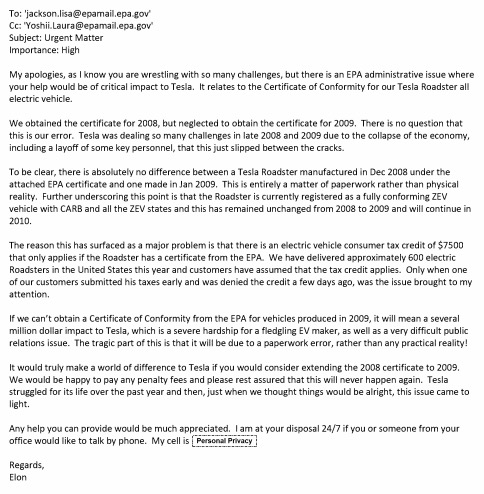
The payments stretch back more than 20 years. Shortly after becoming CEO of a cash-strapped Tesla in 2008, Musk fought hard to secure a low-interest loan from the Energy Department, according to two people directly involved with the process, holding daily briefings with company executives about the paperwork and spending hours with a government loan officer.

When Tesla soon after realized it was missing a crucial Environmental Protection Agency certification it needed to qualify for the loan days before Christmas, Musk went straight to the top, urging then-EPA Administrator Lisa Jackson to intervene, according to one of thepeople. Both people spoke on the condition of anonymity for fear of retribution.

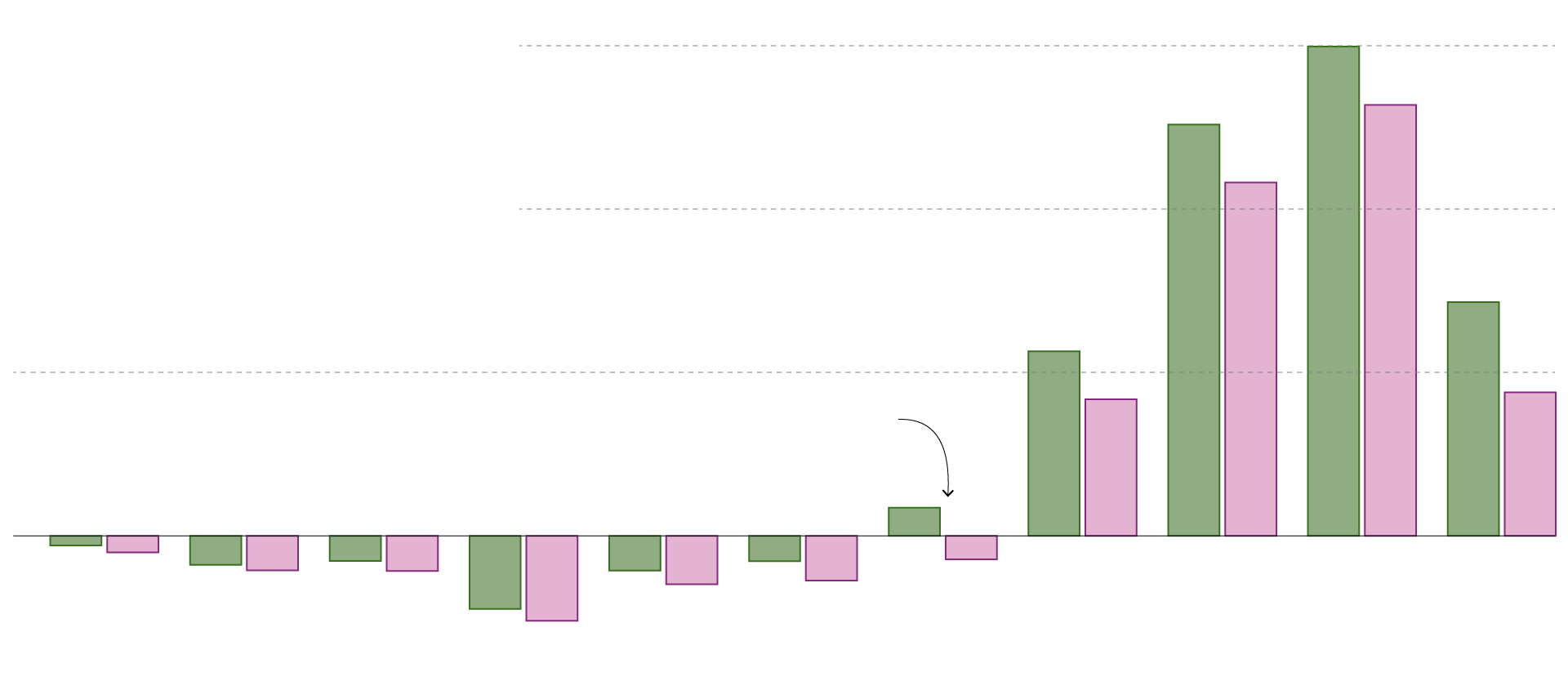
Nearly two-thirds of the $38 billion in funds have been promised to Musk’s businesses in the past five years.

In 2024 alone, federal and local governments committed at least $6.3 billion to Musk’s companies, the highest total to date.

In 2014, Nev. pledged $1.3B to Tesla to build a factory

SpaceX contracts soared as NASA steps up moon program

Musk’s companies have received billions from the government

Total contracts, loans, subsidies and tax credits by company

Note: Business Oregon committed nearly $6 million to X Corp.

The total amount is probably larger: This analysis includes only publicly available contracts, omitting classified defense and intelligence work for the federal government.SpaceX has been developing spy satellites for the National Reconnaissance Office, the Pentagon’s spy satellite division, according to the Reuters news agency. The Wall Street Journal reported that contract was worth $1.8 billion, citing company documents.

The Post found nearly a dozen other local grants, reimbursements and tax credits where the specific amount of money is not public.

An additional 52 ongoing contracts with seven government agencies — including NASA, the Defense Department and the General Services Administration — are on track to potentially pay Musk’s companies an additional $11.8 billion over the next few years, according to The Post’s analysis.

Government contracts to SpaceX from NASA and the Defense Department make up the majority of funds. Tesla has earned $11.4 billion in regulatory credits from federal and state programs aimed at boosting the electric-car industry, and experts say its sales have been bolstered by a federal $7,500 electric-vehicle tax credit for consumers. Musk has called for an end to that consumer credit, arguing his competitors need the incentive more than Tesla.

DOGE, which stands for Department of Government Efficiency, has sought to cut staff, slash budgets or cut contracts at all seven of the agencies where Musk’s companies have ongoing contracts. That includes the General Services Administration, Defense Department and Transportation Department.

Musk’s relationships with government agencies have at times been mutually beneficial: His ventures have pioneered new markets that have advanced U.S. government goals, including space exploration and the expansion of electric vehicles. And while many of the government programs Musk has benefited from are open to others in the electric-vehicle industry, no other company has gone on to achieve Tesla’s market dominance.

“Not every entrepreneur at this scale has been this dependent on federal money — certainly not Nvidia, not Microsoft, nor Amazon, nor Meta,” said Jeffrey Sonnenfeld, professor at the Yale School of Management, who noted that much of the funding has come during Democratic administrations. “With DOGE, there does seem to be a paradox there. He has been a big beneficiary of national industrial policy, especially Democrat industrial policy, through government funding.”

Government funding also provided key early infusions to Musk’s ventures. NASA and the Defense Department nurtured SpaceX in its earliest years with contracts that helped it build infrastructure, while the agency tolerated the company’s failure to meet required milestones on time, according to congressional investigators.

The $465 million Energy Department loan, which arrived in 2010, helped fuel Tesla’s meteoric rise: With that money, the company engineered and assembled its luxury electric sedan — the Model S — and bought a factory in Fremont, California, according to the agency. Tesla went public six months later.

A Tesla employee works on a Model S in Fremont, California, in 2015. (Jeff Chiu/AP)

“Tesla would not have survived without the loan,” said a former high-level Tesla employee familiar with the company’s finances, who spoke on the condition of anonymity for fear of retribution. “It was a critical loan at a critical time.”

Musk himself noted the challenges facing the company at the time, according to emailspublished by the Free Beacon, imploring Jackson, then the EPA chief, to help. “Tesla struggled for its life over the past year and then, just when we thought things would be alright, this issue came to light,” he wrote. “I am at your disposal 24/7,” Musk added, including his cellphone number.

Jackson declined to comment through a representative at Apple, where she now works. SpaceX, Musk and Tesla did not respond to requests for comment.

NASA spokesperson Cheryl Warner said the agency has invested more than $15 billion in SpaceX for its work on numerous space programs.

“NASA is working with partners like SpaceX to build an economy in low Earth orbit and take our next giant leaps in exploration at the Moon and Mars for the benefit of all,” Warner said in an email.

White House spokesman Harrison Fields said that Musk’s business interests would not conflict with his work at DOGE. “Any contracts connected to Elon Musk’s very successful companies will comply with every government ethics rule as it pertains to potential conflicts of interests,” Fields said in an email.

As much as Tesla executives valued the government support, Musk paid off the 2010 low-interest loan within a matter of years. In a 2013 news release announcing that he had done so, Musk thanked the Energy Department and Congress, and “particularly the American taxpayer from whom these funds originate.”

“I hope we did you proud,” he said.

______________________

Tesla flourished on a wave of state aid

Since its 2003 Silicon Valley founding, Tesla has benefited from billions in rebates and tax credits from California. The state’s governor, Gavin Newsom (D), has claimed that “there was no Tesla without California’s regulatory bodies, and regulation.” Tesla has said it invested more than $5 billion in the state since 2016 and employed more than 47,000 people locally.

About a third of Tesla’s $35 billion in profits since 2014 has come from selling federal and state regulatory credits to other automakers. The credits are given to automakers that meet certain standards, including selling a certain percentage of zero-emission vehicles. Tesla is the largest seller of these credits to automakers that don’t meet the standards and want to avoid paying a fine.

These credits played a crucial role in the company’s first profitable quarter in 2013 and its first full year of profitability in 2020, according to Securities and Exchange Commission filings. Without the credits, Tesla would have lost more than $700 million in 2020, marking a seventh-consecutive year with no profits, according to an analysis of SEC filings.

With the credits, the company instead reported a $862 million profit.

While Musk has advocated for ending the EV tax credit for consumers, he has said little about these regulatory credits.

“They would have been totally in the red if it were not for the incentives,” said Alan Jenn, an assistant professor at the Electric Vehicle Research Center at the Institute of Transportation Studies. “That is the thing that has really kept them afloat.”

The company has also benefited from the $7,500 federal tax credit for EV buyers, which helped make Tesla’s cars — which can cost upward of $80,000 — more affordable for consumers who may not have bought them otherwise.

Nearly a tenth of government money that has benefited Musk’s companies comes from agencies in eight states, including California. Since 2007, state and local governments have given Musk companies at least $1.5 billion in tax credits, grants and reimbursements, while various government agencies at multiple levels contributed another $2.1 billion, much of it to drive the development of Tesla and the batteries it relies upon, according to data from the advocacy group Good Jobs First.

Tesla’s funding from federal, state and local agencies

Contracts, loans, subsidies and tax credits, 2007 to present

Automotive regulatory credits

Tesla sold credits to other automakers that did not meet the zero-emission vehicles standards established by federal and state governments.

Nevada Governor's Office of Economic Development

Nevada (multiple sources)

Local and state governments’ incentive package awarded to Tesla to build, with Panasonic, a battery “gigafactory” outside Reno.

New York (multiple sources)

Multiple New York state government agencies awarded money to Musk’s SolarCity company.

In Nevada, local and state governments awarded a $1.3 billion incentive package to Tesla so the carmaker and Panasonic would erect a lithium battery “gigafactory” outside Reno, according to the state.

Not all the agreements met their goals. Under then-Gov. Andrew M. Cuomo (D), New York state ponied up $750 million in 2014 incentives to Musk’s SolarCity company, with Musk agreeing to invest heavily in production, bringing hundreds of high-end manufacturing jobs to Buffalo. Instead, hiring fell well below the state’s expectations, and Musk had Tesla acquire the company two years later.

And despite receiving billions from the state of California, Musk relocated Tesla’sheadquarters from Palo Alto to Austin in 2021, citing unhappiness with the business environment.

In interviews, Musk has brushed off the company’s dependence on subsidies, while acknowledging that the assistance helped accelerate the speed with which Tesla was able to grow.

“If I cared about subsidies, I would have entered the oil and gas industry,” Musk told the Los Angeles Times in 2015.

Musk later railed against President Joe Biden’s 2022 Inflation Reduction Act bill, even though it made Tesla reeligible for the $7,500 electric vehicle tax credit: “I’m literally saying get rid of all subsidies,” he said in a 2021 interview with the Wall Street Journal. “Tesla’s made basically twice as many electric vehicles as the rest of [the] industry combined. And we don’t need the $7,500 tax credit.”

Musk’s support for slashing subsidies across “all industries” comes as Tesla dominates the U.S. electric-vehicle industry, according to a January Kelly Blue Book report, though its share has dropped in recent years. In response to a question in July about what impact striking the tax credit and other incentives would have on Tesla, Musk — who donated at least $277 million to President Donald Trump’s reelection — said it would hurt the company in the short term but would be “devastating for our competitors.”

John Helveston, a professor at George Washington University who studies electric vehicles, said Tesla is a prime example of the success that can come from government investment in nascent industries, though government assistance alone is not a guarantee for success.

By pushing to cut subsidies across all industries, Helveston said Musk is strangling a potential lifeline for smaller companies — and his competitors.

“Pretty much every aspect [of Tesla] has benefited from direct government subsidy or financing,” he said. “It’s not a weird phenomenon for Tesla to benefit from this, but it is certainly hypocritical.”

_______________________________

NASA gave SpaceX boost

Musk’s rocket company — which aimed from the beginning to put astronauts on Mars — received an early infusion from a major client: the Defense Department.

After founding SpaceX in 2002, Musk developed a close and at times adversarial relationship with NASA and the Defense Department. The company filed lawsuits and lobbied aggressively to gain access to government-funded space programs cornered by established aerospace giants Lockheed Martin and Boeing.

Although the company was founded with $100 million from Musk’s own fortune, SpaceX benefited from government advice and money long before it sent anything into orbit, according to public contract documents and statements from the company’s leaders.

The Pentagon’s specialized research arm, known as DARPA, started paying SpaceX in 2003 for early conceptual work.

SpaceX’s funding from federal, state and local agencies

Contracts, loans, subsidies and tax credits, 2003 to present, for SpaceX’s rocket business and Starlink, its satellite internet service

National Aeronautics and Space Administration

Export-Import Bank of the U.S.

U.S. Agency for International Development

The agency later agreed to purchase the inaugural launch of the company’s first rocket, Falcon 1, which ended in failure in March 2006 when its engines stopped firing less than a minute into the flight. But the Pentagon signed on to support more launch attempts.

Though SpaceX had yet to successfully reach space, NASA awarded the company a $278 million contract in 2006 as part of a program to ferry supplies to and from the International Space Station. Just months after SpaceX’s Falcon 1 successfully reached orbit in 2008, NASA awarded the company a much larger, $1.6 billion contract.

SpaceX had already started building its next rocket, Falcon 9, and NASA paid the company in installments for successive milestones and covered some engineering and development work, according to a NASA contract document.

SpaceX's Crew Dragon spacecraft and Falcon 9 rocket at NASA's Kennedy Space Center in Florida in 2018. (AP)

The company received hundreds of millions of dollars before Falcon 9 reached orbit. Moreover, NASA kept the money flowing although SpaceX repeatedly missed milestone deadlines by up to two years, according to a 2011 report from the Government Accountability Office, a congressionally funded watchdog agency.

The money helped SpaceX ramp up its infrastructure, allowing it to build and launch rockets for NASA and other clients. Falcon 9 became a keystone of SpaceX’s business, launching about once every three days carrying a mix of government spy satellites, satellites for competitors and small satellites for the Starlink internet service that now accounts for the lion’s share of SpaceX revenue, according to industry analysts.

In 2016, SpaceX’s success in securing federal contracts prompted rival Jeff Bezos, founder of Blue Origin (and owner of The Washington Post), to say in a company meeting: “Elon’s real superpower is getting government money,” The Post reported. “From now on, we go after everything that SpaceX bids on.”

SpaceX, which reuses its rockets, is able to charge dramatically less than competitors for each launch, ultimately benefiting the Pentagon and NASA, analysts say. At an investment conference in November, SpaceX President Gwynne Shotwell acknowledged the company has received billions of dollars in U.S. government contracts, adding that the company has delivered. “We earned that,” she said. “It’s not a bad thing to serve the U.S. government with great capability and products.”

Over time, some analysts say, SpaceX has become less dependent on government business as subscriptions for its Starlink internet service have boomed. The investment bank Morgan Stanley estimated in a January report that SpaceX made $9.3 billion from Starlink in 2024 alone.

But SpaceX’s numerous launches with classified cargo make it hard to accurately estimate the value of its black-budget contracts — or calculate how important government work is to the company’s overall revenue, said American Enterprise Institute analyst Todd Harrison.

Shotwell, however, has credited NASA’s early funding for building SpaceX, noting in a 2013 interview at SpaceX’s headquarters that the company would “probably be limping along” without the agency’s support.

“I don’t know what the world would look like without that program for SpaceX. It would look very different,” she said. “We wouldn’t have this beautiful factory; we wouldn’t have this lovely conference room with these incredibly comfortable chairs. Yes, this is as much NASA as it is SpaceX here.”

About this story

Editing by Alexis Sobel Fitts and David Fallis. Data editing by Meghan Hoyer. Graphics editing by Kate Rabinowitz. Design editing by Christian Font. Copy editing by Carey L. Biron.

The Post identified direct and indirect government payments in the form of contracts, grants, loans and tax credits made to companies owned by Musk.

Government payments to Tesla Inc., its predecessor Tesla Motors, Space Exploration Technologies (known as SpaceX) and X Corp. were drawn from the federal spending tracker USAspending.gov, the Federal Procurement Data System and Good Jobs First, an organization that tracks federal, state and local grants, subsidies and tax credits, as well as filings from the Securities and Exchange Commission. These payments span more than 20 years: The first publicly available payment included is a 2003 contract between the Defense Department and Space Exploration Technologies. Payment records are updated through Feb. 18, 2025. The data includes more than 400 federal contracts, nearly 90 federal and local grants, more than two-dozen tax credits or property tax abatements, and six loans. California and Colorado have also reimbursed Tesla and SpaceX for employee training programs.

USAspending.gov data of government purchase contracts showed that $22.5 billion was paid to Space Exploration Technologies and Tesla Inc. A small portion of this included reimbursements to outside companies for their subscriptions to Starlink internet services, which The Post has classified as revenue for Space Exploration Technologies. The Post also included a 2021 classified contract for $1.8 billion from the Defense Department to Space Exploration Technologies based on reporting by the Wall Street Journal.

To find the ongoing contracts in USAspending data, The Post identified those that had not reached their potential end date. The remaining value of the ongoing contracts is the amount that has yet to be completed and paid for.

Data from Good Jobs First includes payments made by various city and state governments, the Treasury Department and the Energy Department. Federal payments listed in Good Jobs First were included only if they were not listed in USAspending. Good Jobs First data accounted for nearly $4.5 billion paid to Musk companies, including $1.9 billion from state and local governments. Eleven payments from Arizona, California, Michigan and Texas are for undisclosed amounts, so are not in The Post’s total.

Automakers of zero-emission vehicles receive federal and state government credits that can be sold to other manufacturers needing help to meet emissions targets. SEC filings show that Tesla earned $11.4 billion from the sale of regulatory credits since 2014. While the government doesn’t directly pay Tesla, federal and state laws allow electric-vehicle companies to profit from these sales. Tesla Inc.’s revenue and profits after taxes going back to 2014 were acquired from their publicly available SEC filings.

The Post searched USAspending.gov and the Good Jobs First databases for government payments to Neuralink and the Boring Company, two other Musk-owned companies, butfound no contracts or subsidies."

Elon Musk’s business empire is built on $38 billion in government funding - Washington Post

Tuesday, February 25, 2025

Rachel Maddow Rips Own Network After MSNBC Fires Joy Reid

This Is Who SHOULD BE Leading Dems

Roland breaks down MSNBC firing of Joy Reid, and the need to support Bla...

‘Tesla Takedown’ wants to hit Elon Musk where it hurts | The Verge

‘It’s a Psyop’: Inside Elon Musk’s Empty Ultimatum

Trump’s billionaire enforcer told federal workers they needed to justify themselves—or else. Then the administration changed its mind.

Elon Musk's face in a computer display
Illustration by The Atlantic. Sources: Kevin Lamarque / AFP / Getty; Alfred Gescheidt / Getty.

"Shortly before 11 a.m. on Sunday, the 80,000 physicians, health scientists, disease detectives, and others tasked with safeguarding the nation’s health received instructions to respond to an email sent the day before asking them, “What did you do last week?”

The email arose from a Saturday dispatch issued by President Donald Trump on the social-media platform he owns, Truth Social. “ELON IS DOING A GREAT JOB, BUT I WOULD LIKE TO SEE HIM GET MORE AGGRESSIVE,” he wrote.

The response from Elon Musk arrived seven hours later on the social-media platform he owns, X. The billionaire Trump confidant leading the effort to slash the federal workforce wrote that afternoon that he was acting on Trump’s “instructions” and ensuring that “all federal employees will shortly receive an email requesting to understand what they got done last week.”

The result was a government-wide email directing federal workers to detail their accomplishments over the previous week, in five bullet points. Musk wrote on X: “Failure to respond will be taken as a resignation.”

The directive sent agencies scrambling to tell their employees what to do. Some instructed them not to respond. Others made clear that a reply was mandatory. And then there was the Department of Health and Human Services—an epicenter of the chaos engulfing Washington.

“This is a legitimate email,” read Sunday morning’s instructions from HHS, which advised employees to respond by the deadline set for 11:59 p.m. ET on Monday.

But later that day, the directions changed. Employees were told to “pause” answering the email, according to new guidance sent Sunday at 5 p.m., which pointed to concerns about the sensitivity of department business. HHS promised that updated guidance would arrive Monday at noon.

By late afternoon on Monday, many federal health workers had left their offices with no new guidance, uncertain about whether to respond to the email and whether ignoring it would jeopardize their jobs.

They didn’t know that the federal government’s main personnel agency, which had sent Saturday’s government-wide email, had quietly instructed agencies midday Monday that a response was voluntary. Those instructions effectively rescinded Musk’s threats.

For Musk, the episode was a setback. For federal workers struggling to get their bearings, they told us, it was just one more reason to feel both fury and fear.

“This whole administration is a fucking train wreck,” a federal health official said.


The shifting and contradictory instructions divided Trump’s Cabinet, and for the first time, created daylight between Musk and the White House. Even before the administration formally conceded that responses were voluntary, Trump advisers had privately signaled support for agency heads who told their employees not to reply to the email, owing to the sensitivity of their work.

Most of the early guidance not to reply to the Musk directive came from the country’s national-security agencies, including the CIA, the FBI, and the Department of Homeland Security. A senior official at NASA, which advised employees not to respond, called the request an “unprecedented ask and unprompted attack on our workforce” in a weekend email to employees that was described to us. A deputy commander at the Navy told people in his chain of command, “Please do NOT respond at this time,” accenting his order using bold red text.

The cascading series of contradictory guidance reflected the unusual balance of power between Trump and Musk, and the unpredictable consequences for millions of federal workers. “It’s a psyop,” said a senior official at the Department of Veterans Affairs, referring to a psychological operation, in this case intended to intimidate federal workers. “It’s a form of harassment. But there’s no one to complain to, because no one knows exactly where it’s coming from or who’s behind it.”

The president’s Saturday morning post spurred Musk to confer with his deputies at the Department of Government Efficiency and develop the hastily written email, according to a White House official. The email was sent by the Office of Personnel Management, now staffed at senior levels by Musk’s deputies. They told agency employees that they intended to use artificial intelligence to analyze the responses and develop reports about further changes to the federal workforce, according to an OPM official familiar with their comments.

Two senior administration officials said that the haphazard nature of Musk’s directive rankled some in the West Wing, as concerns grow that the billionaire’s authority is encroaching on the power of Cabinet secretaries.

Trump, for his part, publicly backed Musk’s effort. “I thought it was great because we have people that don’t show up to work and nobody even knows if they work for the government,” the president told reporters during an appearance Monday with French President Emmanuel Macron. “What he’s doing is saying, ‘Are you actually working?’ And then if you don’t answer, you’re sort of semi-fired or you’re fired, because a lot of people are not answering, because they don’t even exist.”

White House Press Secretary Karoline Leavitt also defended the actions: “This was the president’s direction to Elon, and it is being carried out as planned,” she said. “Everyone at the White House knew very well that it was coming.”

The same can’t be said for other parts of the federal government, where agency heads were caught off guard and many recipients mistook the email for phishing. Employees on leave or on vacation feared that they would lose their job. At HHS, department leadership was given just a five-minute warning before the email went out, a senior official at the Centers for Disease Control and Prevention told his staff on Monday, according to people familiar with his account. HHS did not respond to a request for comment.

Some of the agencies that advised employees to respond to Musk’s email sought to justify the request in guidance issued on Monday. John W. York, a senior counselor to Treasury Secretary Scott Bessent, told employees, “The OPM message reflects an effort to increase accountability by the federal workforce, just as there is in the private sector. Given the voluminous and extremely important work that Treasury staff perform on a daily basis, we expect that compliance will not be difficult or time-consuming.”

Around 5 p.m. Monday, HHS finally issued new guidance affirming that a reply was not mandatory but warning employees who did detail their professional activities to protect sensitive data. “Assume that what you write will be read by malign foreign actors and tailor your response accordingly,” the guidance stated.

Meanwhile, there were signs that OPM was working to make parts of the Musk directive permanent, at least within the agency. In an email to employees Monday evening, OPM’s acting director wrote that he had asked the chief human capital officer to “operationalize this exercise” so that employees continue to “submit weekly accomplishment bullets.”

In certain corners of the federal government, workers made light of the Musk request. One Pentagon official told a colleague that his reply would include time spent on Fox News, Truth Social, and X—more reliable sources of information about the terms of his employment than his own bosses.

“Who are we taking orders from?” the Pentagon official said. “No one really knows.”

‘Tesla Takedown’ wants to hit Elon Musk where it hurts | The Verge