Contact Me By Email

Contact Me By Email

Friday, September 29, 2023

Trailblazing California Sen. Dianne Feinstein dies at 90

Trailblazing California Sen. Dianne Feinstein dies at 90

Dianne Feinstein, who became California's first female senator and went on to serve six terms, the longest of any woman in Senate history -- and whose political career was forever changed by the assassination of two colleagues -- has died. She was 90.

Her office said in a statement that she died on Thursday night at her home in Washington. The cause was not disclosed. She had voted as recently as earlier that day.

"There are few women who can be called senator, chairman, mayor, wife, mom and grandmother," her chief of staff, James Sauls, said in a statement. He called Feinstein "a force of nature who made an incredible impact on our country and her home state."

"She left a legacy that is undeniable and extraordinary. There is much to say about who she was and what she did," Sauls said, "but for now, we are going to grieve the passing of our beloved boss, mentor and friend."

Senate Majority Leader Chuck Schumer seemed at varying points to choke back tears as he memorialized Feinstein in remarks from the chamber on Friday morning, hailing her as "one of the most amazing people to ever grace the Senate." In memoriam, her Senate desk appeared to be draped in black cloth beneath a vase bursting with white roses. Flags outside the Capitol were also lowered to half-staff.

President Joe Biden, in his own statement, called Feinstein a "pioneering American," a "true friend" and "a role model for so many."

Over her three decades in the Senate, Feinstein transformed from a barrier-breaking member of the Democratic Party's liberal vanguard, championing the legalization of same-sex marriage and a ban on assault-style weapons, to one of the Washington's establishment members, esteemed by lawmakers on both sides of the aisle but increasingly criticized by outside progressives who argued that she refused to step aside for the next generation.

In her final years, her work on Capitol Hill had also begun to be overshadowed by concern about her mental and physical health even as she insisted she remained a robust public servant, despite her hospitalizations, reports of episodes of confusion and other issues.

In announcing earlier this year that she planned to retire at the end of her latest term, in 2025, Feinstein said: "Each of us was sent here to solve problems. That's what I've done for the last 30 years, and that's what I plan to do for the next two years. My thanks to the people of California for allowing me to serve them."

California Gov. Gavin Newsom, a fellow Democrat, will now appoint someone to serve out the remainder of Feinstein's term, ahead of the 2024 race to succeed her. He has committed to naming a Black woman -- who would then be only the third such senator in history -- but has also said he will not pick any of the candidates in the current Democratic primary race, which includes Rep. Barbara Lee.
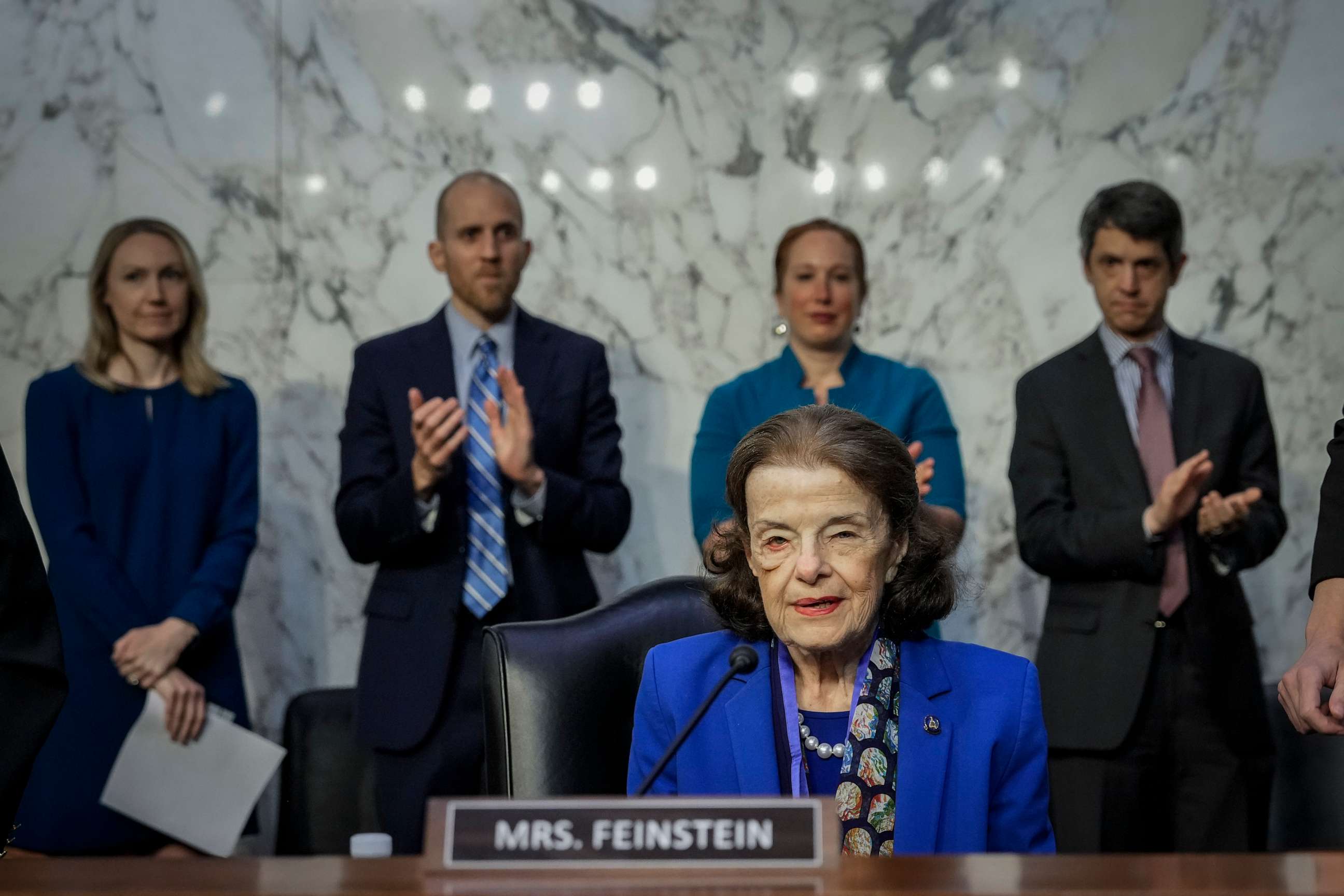
PHOTO: Sen. Dianne Feinstein takes her seat at a business hearing of the Senate Judiciary Committee on Capitol Hill May 11, 2023 in Washington.

Sen. Dianne Feinstein takes her seat at a business hearing of the Senate Judiciary Committee on Capitol Hill May 11, 2023 in Washington.

Drew Angerer/Getty Images

Journalist Rebecca Traister, who profiled Feinstein at length for New York magazine, told ABC News for this obituary that she believes Feinstein's approach to politics was less tethered to an absolutist ideology than to defending and supporting the importance of rules and order.

Feinstein's political positions changed over time, but what didn't was how she saw her job: "as somebody who was within these institutions to uphold the rules," Traister said.

She said what she found most surprising about Feinstein was that devotion to the institution -- outside of politics.

She cited how, in the early 1960s, before Roe v. Wade, Feinstein determined punishments for abortion providers during her time on a women's sentencing board, where Feinstein later said she saw "not medical people -- these were truly the coat-hanger type of abortions." As a pro-abortion access supporter in college, Feinstein reportedly helped a woman get to Mexico where abortion was legal, Traister said.

"She believed in civic and political control and order, and I would say that is the defining feature of her life in politics," Traister said, adding, "Sometimes that led her to positions that were on the left and sometimes it led her to positions that were on the right."

Feinstein's early life and path to the Senate

Born Dianne Emiel Goldman in 1933 in San Francisco, the first years of Feinstein's life were filled with hardship. Jerry Roberts, author of the Feinstein biography "Never Let Them See You Cry," described Feinstein's mother, Betty, as an alcoholic who frequently beat her and her two sisters, citing in his book moments where she chased Feinstein with a knife and once nearly drowned one of Feinstein's sisters in a bathtub.

"Their mother was both emotionally and physically abusive. She [Feinstein] was very much the matriarchal figure in terms of protecting her younger sisters and taking the brunt of things," Roberts said.

Feinstein's surgeon father, Leon, was just as instrumental in shaping her. A barrier-breaker himself, he was the first Jewish chair of surgery at the University of California at San Francisco's medical school.

"She really identified with her father and his kind of propriety and status," said Traister. "But it's certainly true that as the oldest sibling in that household, she really developed a passion for how to keep things in line and under control that I think you can see working its way through her political life."

After serving six years on California women's sentencing board, Feinstein ran for -- and won -- a race to be on the San Francisco Board of Supervisors, beginning the first of three terms in 1970.

Her third term as a supervisor was her last and, as she suggested to reporters on the morning of Nov. 27, 1978, it was intended to be her final chapter in politics. She had lost two mayoral bids, was facing health problems and recently lost her second husband to cancer.

Then tragedy struck.

Later that November day, a former colleague on the board, recently resigned Supervisor Dan White, fatally shot Mayor George Moscone and Supervisor Harvey Milk, California's first openly gay elected official.

It was Feinstein who found Milk's body, subsequently recalling how her fingers slipped through a bullet hole in his body as she went to take his pulse. With TV cameras rolling, she was the one to tell a shocked city about the slayings. As the president of the Board of Supervisors, she became the city's first female mayor.

PHOTO: Senator Dianne Feinstein (D-CA) speaks with reporters outside the Senate on Jan. 21, 1999, during the sixth day of Senate impeachment trial proceedings against President Bill Clinton.

Senator Dianne Feinstein (D-CA) speaks with reporters outside the Senate on Jan. 21, 1999, during the sixth day of Senate impeachment trial proceedings against President Bill Clinton.

Luke Frazza/AFP via Getty Images, FILE

"It sounds like it was scripted in a movie. She leans in, tells reporters she's leaving politics -- you can't make up something like that," said Los Angeles Times columnist Mark Barabak, who covered Feinstein going back to her San Francisco days.

She went on to win two terms as mayor.

Barabak said Feinstein "held up the city on her shoulders ... the city was really on edge." She was "thrust in the middle of it" and "really rallied and really helped keep the city together," he said.

As mayor, she enacted a handgun ban and survived a recall attempt over it, foreshadowing a decadeslong fight over the same issue when she served in the Senate.

Her profile grew quickly. She was on Democratic presidential nominee Walter Mondale's vice presidential short list in 1984. After losing her own race for governor of California in 1990, she successfully ran in a 1992 special election to serve out the remainder of Republican Pete Wilson's term -- becoming the first women elected from the state to serve as a senator.

PHOTO: Sen. Dianne Feinstein, D-Calif., at the Senate Rules Hearing, on May 20, 1993.

Sen. Dianne Feinstein, D-Calif., at the Senate Rules Hearing, on May 20, 1993.

Laura Patterson/CQ Roll Call via Getty Images, FILE

In Washington

More firsts followed: Feinstein became one of the first two women to join the Senate Judiciary Committee, with the support of then-Chairman Biden. She made it her mission to pass a ban on assault-style weapons, telling The Los Angeles Times that Biden was "ultimately supportive but initially skeptical," fearing that the measure might stymie a broader bill focused on crime. But he nonetheless thought it would be a good "lesson" for her if she wanted to give it a shot.

The opposition was fierce. Idaho Republican Sen. Larry Craig was one of the people who challenged her, saying, "The gentlelady from California needs to become a little bit more familiar with firearms and their deadly characteristics."

Feinstein replied, "I am quite familiar with firearms. I became mayor as a product of assassination. I found my assassinated colleague and put a finger through a bullet hole trying to get a pulse. I was trained in the shooting of a firearm when I had terrorist attacks, with a bomb in my house, when my husband was dying, when I had windows shot out. Senator, I know something about what firearms can do."

The ban, which included some exemptions and came with a sunset date of 10 years, to bolster its support, became law in 1994. Feinstein continued to push for similar laws in her remaining time in office.

She was also known for championing same-sex marriage and in 1996 was one of 14 senators who voted against the Defense of Marriage Act -- the law, later overturned, that prevented the federal government from recognizing same-sex marriage -- nearly two decades before the Supreme Court ruled that same-sex marriage was a constitutional right.

Barbarak said her extensive time in San Francisco likely shaped her ideas on the issue. "The gay community was very large and influential in San Francisco, in a way that really it wasn't in any other city in the country," he said. "And that was just part of the political culture. It was just part of being mayor of San Francisco."

But the accomplishment that she told reporters was the most important work of her career was during her time as chairman of the Senate Intelligence Committee. Feinstein called for a full investigation of the CIA's detention and interrogation program after Sept. 11.

Because of her push for further transparency under both the Bush and Obama administrations, Senate investigators said that the CIA repeatedly misled the public and mismanaged the program, which was "far more brutal" than the agency previously had conveyed, with torture ranging from waterboarding prisoners often dozens of times to severe sleep deprivation, including a detainee who was chained to the concrete floor and appeared to die from hypothermia, ABC News reported at the time.

The subsequent, Feinstein-backed report from the Intelligence Committee, released in 2014, found the methods used on more than 100 detainees were "not effective."

Probing the CIA's tactics was risky for Feinstein, in part because she was challenging her own party. "There was an enormous amount of opposition including from the [Obama] administration to not make this stuff public," Traister said.

PHOTO: San Francisco Mayor and Dem. gubernatorial hopeful Dianne Feinstein speaking at podium during campaign Biltmore Hotel on Sept. 3, 1990.

San Francisco Mayor and Dem. gubernatorial hopeful Dianne Feinstein speaking at podium during campaign Biltmore Hotel on Sept. 3, 1990.

Kim Komenich/Getty Images, FILE

But that doggedness was consistent with "how seriously she took the violation of norms that she so believes in," Traister said.

"When she discovered that they had been behaving outside of the expectations ... it was like hellfire. She really went after them hard," Traister said.

Annette Bening went on to play Feinstein in the 2019 drama about the CIA probe, "The Report."

"I just think that's real legacy stuff, which she did there because nobody wanted that report out ... certainly the CIA didn't," said Roberts, her biographer. "That was, I think, a demonstration of her independence and her determination and her ability to fight."

But her independence was often seen in more recent years as too moderate compared to other Democrats, especially as a representative of one of the country's most reliably blue states.

During the Supreme Court confirmation hearings for Amy Coney Barrett, liberal groups criticized Feinstein for hugging Republican Sen. Linsey Graham and praising him for running "one of the best hearings I've participated in." Then-Senate Minority Leader Schumer later told reporters they had a "long, serious talk" about it.

And the way she dismissed school children who urged her to support the progressive "Green New Deal" to address climate change went viral after she told them, "I've been doing this for 30 years. I know what I'm doing. You come in here and you say it has to be my way or the highway. I don't respond to that ... I was elected by almost a million-vote plurality and I know what I'm doing."

The interaction was satirized on "Saturday Night Live."

PHOTO: Democratic Senator Diane Feinstein of California questions a witness during a Senate Energy and Natural Resources Committee hearing on oil leaks at BP Plc's oil pipeline in Alaska, Sept. 12, 2006 in Washington, D.C.

Democratic Senator Diane Feinstein of California questions a witness during a Senate Energy and Natural Resources Committee hearing on oil leaks at BP Plc's oil pipeline in Alaska, Sept. 12, 2006 in Washington, D.C.

Bloomberg via Getty Images, FILE

PHOTO: Senator Dianne Feinstein (D-CA) raises victory "V's" after officially nominating Senator John F. Kerry for the presidency during the third session of the Democratic National Convention in Boston, July 28, 2004.

Senator Dianne Feinstein (D-CA) raises victory "V's" after officially nominating Senator John F. Kerry for the presidency during the third session of the Democratic National Convention in Boston, July 28, 2004.

Emile Wamsteker/Bloomberg via Getty Images, FILE

Final years and service amid decline

In the final years of her political career, some voices in Feinstein's own party grew louder in saying that she should retire. Her defenders, too, often spoke up for her. In 2017, then-House Speaker Nancy Pelosi called her a "strong voice and a staunch advocate for the people of California."

During Feinstein's last and final campaign for Senate, the California Democratic Party backed challenger Kevin de León instead. At the time, León said he was offering "a new voice, a new change represented in California of today, not of the past."

Feinstein still won by a landslide -- by roughly a million votes. But the discontent continued.

In April 2022, Feinstein's home paper, The San Francisco Chronicle, published a piece citing multiple anonymous staffers and Senate colleagues who said Feinstein's memory was "rapidly deteriorating. They said it appears she can no longer fulfill her job duties without her staff doing much of the work required to represent the nearly 40 million people of California."

Feinstein pushed back in an interview with the Chronicle's editorial board. "I meet regularly with leaders. I'm not isolated. I see people. My attendance is good. I put in the hours," she said then, echoing what she told The Los Angeles Times in 2020: "I don't feel my cognitive abilities have diminished. ... Do I forget something sometimes? Quite possibly."

In February 2023, Feinstein announced she would not be seeking reelection, telling reporters soon after, "The time has come."

Schumer said during a closed-door lunch meeting when she made her announcement, "She got a standing ovation that lasted minutes and minutes and minutes. One of the longest I've ever seen, which shows the love that our caucus and our country have for this wonderful, wonderful leader and legend."

Feinstein's pending retirement was soon eclipsed by her health struggles. For three months in 2023, she remained at home in California to recuperate from shingles, which also caused her to suffer brain inflammation and Ramsay Hunt syndrome, which affects facial nerves.

That absence also temporarily halted Democrats' ability to confirm nominees through the Judiciary Committee on which Feinstein sat.

California congressman Ro Khanna and some others called for her to step down. But she never left her job.

She is survived by a daughter, Katherine. Her third husband, the wealthy investor Richard Blum, whom she married in 1980, died in 2022 after being diagnosed with cancer.

Feinstein's tenacity, Barabak said, fueled her success as much as the controversy at the end of her career.

"She's very determined. She's very stubborn. She's very dogged," he said, adding, "She's shown, time and again and again and again, [she] is not someone who is going to be pushed around. I think that this is pretty consistent with who she has been her whole career, her whole public life."

ABC News' Isabella Murray, Allison Pecorin and Benjamin Siegel contributed to this report.“

Jim Jordan’s dishonest argument of wrongdoing by Biden

Jim Jordan’s dishonest argument of wrongdoing by Biden

Rep. Jim Jordan (R-Ohio) delivers remarks during a House Oversight Committee hearing about the impeachment inquiry into President Biden. (Drew Angerer/Getty Images)

“Rep. Jim Jordan (R-Ohio) has a well-honed persona that he presents on Capitol Hill. He wears a suit jacket as infrequently as possible, a performative demonstration of his unfancy approach to things. He speaks quickly and aggressively, presenting his comments as though he’s merely the conduit of universal truths who must offer them to the public as rapidly as possible. It comports with his well-known background as a wrestler and wrestling coach.

This has served him well, helping boost his authority within the Republican caucus and contributing to his elevation to lead the House Judiciary Committee. It was in that role that he appeared at Thursday’s initial hearing focused on finding evidence that might lead to the impeachment of President Biden.

And, with characteristic bluster and the characteristic lack of a jacket, Jordan made a sharp allegation of wrongdoing by Biden that was quickly revealed as unsubstantiated.

“This is a tale as old as time: Politician takes action that makes money for his family and then he tries to conceal it,” Jordan began.

“Never forget four fundamental facts,” he continued. First, that Joe Biden’s son Hunter Biden was appointed to the board of the Ukrainian energy company Burisma. Second, Jordan continued, Hunter Biden was “not qualified” for that role — something that he claimed Hunter Biden had himself admitted. When Jordan made similar comments last week, CNN pointed out that his articulation was misleading.

“Fact number three,” Jordan continued, “the executives at Burisma asked Hunter Biden to weigh in and help them with the pressure they are under from the prosecutor in Ukraine. Fact number four, Joe Biden goes to Ukraine on December 9th, 2015, gives this speech attacking the prosecutor that starts the process of getting that guy fired.”

He went on to suggest that these “facts” lent credence to a secondhand allegation of bribery against Biden that was recorded in an FBI document that “the Justice Department didn’t want to let this committee see.” That’s also not true; the Justice Department didn’t want to release the form documenting the allegation publicly out of concern that it might expose their informant — and because it was unsubstantiated. They made the document available to members of the House Oversight Committee this year.

The important arguments, though, are Jordan’s third and fourth points. Witness Michael Gerhardt, a professor at the University of North Carolina School of Law, pointed this out.

“I listened to Congressman Jordan, whom I respect a great deal, when he said there are four facts,” Gerhardt said. He began by noting that the first two weren’t related to Joe Biden at all.

“Third,” Gerhardt continued, “there were executives who asked Hunter Biden for help. Again, not yet any proof about any kind of complicity of President Biden. And lastly, Joe Biden gave a speech.”

“If that’s what exists as basis for this inquiry, it is not sufficient,” he continued. “I say that with all respect and I think that that is part of the problem I think, and many Americans think may, exist with respect to these proceedings.”

It’s actually worse than what Gerhardt asserts.

Jordan’s claim about Burisma asking Hunter Biden for help is established first in his appointment to the board, clearly and admittedly a function of his last name. It was also addressed in testimony from Hunter Biden’s business partner Devon Archer. Archer told Oversight investigators that there was “constant pressure” on Burisma executives and that, particularly after a board meeting in Dubai in 2015, those executives appealed to Hunter Biden to do what he could.

What Archer didn’t say, though, was that this pressure was coming from the “prosecutor in Ukraine,” a man named Viktor Shokin. In fact, Archer testified that “Shokin wasn’t specifically on my radar as being an individual that was targeting” Burisma’s founder, Mykola Zlochevsky. In fact, Shokin blocked a British probe into Zlochevsky by failing to turn over evidence.

More importantly, Joe Biden’s speech in December 2o15 was not what “start[ed] the process” of getting Shokin fired. Jordan is implying — as he did without pushback on Fox News earlier this year — that the Joe Biden speech on Dec. 9 of that year followed directly from the Dubai meeting, which was a few days before. But the trip to Ukraine was scheduled weeks earlier and Biden’s speech wasn’t the first push the U.S. government had made to have Shokin removed.

U.S. Ambassador Geoffrey Pyatt had called out Shokin’s failure to address corruption in a speech that September. That came months after international actors here and in the European Union had begun discussing how to deal with Shokin’s failures to address corruption.

“I know how the idea to have Shokin fired came up, and it wasn’t Biden,” one former Treasury official told the Financial Times in 2019. “His direct involvement came late in the game.”

The process was underway before December 2015. Biden’s speech that month was not a function of Burisma’s efforts to get Hunter Biden engaged. And that engagement wasn’t a response to Shokin.

But other than that, Mr. Jordan, how’d you enjoy the play?

Gerhardt’s dismissal of Jordan’s “four facts” prompted the legislator to offer a rejoinder — however tangential.

“It wasn’t just a speech,” Jordan insisted. Biden also “leveraged $1 billion of American tax money, and he did so at a time when our government was supportive of the prosecutor.” Jordan pointed to official comments from State Department official Victoria Nuland in June 2015 expressing support for Shokin and an October memo backing the loan guarantee that Biden would later use as leverage for Shokin’s ouster.

Here’s The Washington Post’s fact-checker on Nuland’s June 2015 praise:

“But in July, key prosecutors under Shokin, including his former driver, were caught with stashes of diamonds and incriminating documents in their homes, causing an uproar in Ukraine. Nuland said Shokin was perceived to be protecting them.”

“The most telling evidence is what his business partner said,” the Ohio representative said. “Devon Archer, when we deposed him under oath just two months ago, said this — here’s the question: ‘The request was help from the United States government to deal with the pressure they were under from their prosecutor?’ You know what Mr. Archer’s response was? ‘That’s correct.’”

“Next question: ‘What did Hunter Biden do after he was given that request?’” he continued. “‘He called his dad.’ That’s what we’re investigating.”

A few minutes later, Rep. Daniel S. Goldman (D-N.Y.) sought to introduce into evidence another part of Archer’s testimony — in which Archer denied that Joe Biden had taken any action on behalf of Burisma.

Hunter Biden “did not provide the Burisma executives with actual access to his father. The access to his father was an illusion of access to his father. Is that right?” Goldman asked Archer.

“Right,” Archer replied. He’d previously admitted that he didn’t actually know whether Hunter Biden had called his father in December 2015 — and, in fact, that he only knew that a call had been placed to “D.C.,” where Burisma had consultants whom Hunter Biden had helped engage.

It’s also useful to note that all of this was occurring at a moment when both the Wall Street Journal and New York Times were seeking comment about Hunter Biden’s work for Burisma.

Goldman sought to have this testimony entered into the record. Republicans denied the request, though House Oversight Committee Chairman James Comer (R-Ky.), leading the hearing, later allowed it under unanimous consent.

Jordan and others have focused heavily on Joe Biden’s threat to withhold the loan guarantee as proof of his corruption. It’s a weird argument, as it was years ago when it was first debunked. That Biden later boasted about the ploy is presented as somehow a huge error, an admission he’d done something wrong.

But given that Shokin was not applying pressure to Burisma — in fact, Archer testified that he was told Shokin’s firing was bad for Burisma — and given that there’s no evidence Hunter Biden asked Joe Biden to take any action on Burisma’s behalf, there’s a more obvious conclusion. Joe Biden, we can assume, was doing what he said he was doing: using American power to effect a policy change sought by the American government.

Jordan should know all of this. This argument about the loan guarantee, his comments about the December 2015 trip, two of his four “facts”: All have been revealed to be inaccurate in multiple places. But by outward appearances, Jordan is not interested in conveying accurate information. He seemingly is using the impeachment inquiry to undermine Biden politically before the 2024 election, in which the incumbent president is likely to face former president Donald Trump, whom Jordan has endorsed.

There was a point in the hearing when Jordan did his own fact-checking, by the way. Democrats had pointed out that the amount of money received by Hunter Biden paled next to the amount vacuumed up by Trump’s son-in-law Jared Kushner after leaving the White House.

“I would just add to the gentleman’s remarks that Jared Kushner was a key player in the historic Abraham Accords!” Jordan interjected.“

Our System Makes It Clear That Some Voices Are More Equal Than Others

Our System Makes It Clear That Some Voices Are More Equal Than Others

The Capitol Dome seen through a security fence, with a blue sky behind it.
Joshua Roberts/Reuters

“Here are three instances in American history, out of many, when the rules of our system preserved a failed or suboptimal status quo against the views — and the votes — of a majority of Americans and their representatives.

In 2021, 232 members of the House of Representatives voted to impeach President Donald Trump for his role in summoning and provoking the mob that attacked and ransacked the United States Capitol building on Jan. 6. Not long after, 57 members of the Senate voted to convict Trump. But because the Constitution demands a two-thirds supermajority for conviction in an impeachment trial, the considered decision of a substantial majority of Congress — backed by a substantial majority of the public — was thwarted by the veto of a self-interested, partisan minority.

A couple of generations earlier, between 1971 and 1972, the vast majority of lawmakers in Congress — 354 members of the House and 84 members of the Senate — voted to pass the Equal Rights Amendment and send it to the states. Most Americans, according to surveys at the time, wanted to make the E.R.A. the 27th amendment to the Constitution. And within five years of passage in Washington, legislatures in 35 states — which constituted a majority of the nation’s legislators — had voted for ratification. But 35 states was three short of the three-fourths needed for the amendment to succeed. By the time the deadline for ratifying the E.R.A. came in 1982, the amendment was essentially dead in the water.

Decades before that, in 1922, the Dyer Anti-Lynching Bill passed the House, 230 to 119. It was supported by President Warren G. Harding, a Republican, as well as the large Republican majority in the Senate. But that majority was not large enough to overcome a Democratic filibuster — spearheaded by Jim Crow lawmakers from the South — and the bill died before it could come to a vote. It would take a full century after the death of the Dyer bill for Congress to pass, and the president to sign, an anti-lynching bill into law.

The American political system — with its federalism, bicameralism and separation of powers — consists of overlapping majoritarian and counter-majoritarian institutions designed to promote stability and continuity at the expense of popular government. Not content to build structural impediments to change, the framers of the Constitution also insisted on supermajority thresholds for a number of key actions: executive and judicial impeachment, ratification of foreign treaties and the passage and ratification of constitutional amendments. The Constitution also allows for the legislature to make its own rules regarding its conduct and both chambers of Congress have, at different points in their histories, adopted de facto supermajority rules for passing legislation.

Americans are so accustomed and acculturated to these supermajority rules that they often treat their value as self-evident — a natural and necessary part of American constitutionalism. No, we don’t want to subject our every political decision to simple majority rule. Yes, we want to raise the highest possible barrier to removing a president or changing the rules of the game.

Defenses of supermajority rules tend to rest on claims related to what appears to be common sense. The argument goes like this: Supermajority rules stabilize our political institutions, encourage deliberation, secure consensus for change and protect minorities from the tyranny of overbearing majorities. But as the political theorist Melissa Schwartzberg argues in her 2014 book, “Counting the Many: The Origins and Limits of Supermajority Rule,” the story isn’t so simple, and the actual value of supermajority rules isn’t clear at all.

It is certainly true that supermajority rules promote stability of institutions and the norms that are supposed to govern them. There is a reason, after all, that the United States Constitution has only been amended 27 times in 235 years. But, Schwartzberg asks, “How can we determine which norms are worth stabilizing” since “for any given political community, different institutional arrangements could ensure security of expectations and make ordinary political life possible — even the set of rights and their scope could vary.”

Do we defer to the wisdom of the framers? What if, in our estimation, they got something critical wrong? And even if they didn’t, should the dead hand of the past so strongly outweigh the considerations of the present? Do we defer to wisdom and tradition under the assumption that stability is de facto evidence of consent?

But here’s where we come to the Catch-22, because the stability of our system rests on supermajority rules so strong that they stymie all but the broadest attempts to change that system. And who is to say that stability is such a paramount goal? In a dynamic society, which is to say in a human society, promoting stability with little institutional recourse for reform might ultimately be more disruptive because it creates friction, and thus energy, that will be released one way or another.

What of the claim that supermajority rules — like the filibuster or the ones that structure the constitutional amendment process — promote consensus? Here again, Schwartzberg says, we have to think carefully about what we mean. If by consensus we mean the aggregate opinions of the community, then there might be a basis for supporting supermajority rules, although that raises another question: What is the threshold for success? The two-thirds demand for impeachment in the Senate, for example, is essentially arbitrary. So is the three-fourths of states threshold for ratifying a constitutional amendment. There is no rational standard to use here, only a feeling that “most” people want something.

In which case, if what you want is some general sense that a specific outcome is what the community or legislative body generally wants, then it’s not clear that supermajority rules are the optimal solution. Consider what Schwartzberg calls an “acclamatory” conception of consensus. In this version, what the community believes is true or prudent is what it is “willing to let a belief stand as the group’s view,” even if there is a significant minority that disagrees.

Not every American may believe, to use Schwartzberg’s example, that “freedom of the press ought to be unlimited,” but they are “willing to accept that the view of the United States is that Congress should not restrict the ability of newspapers to publish as they see fit.” As citizens, Schwartzberg writes, “they recognize they are implicated in this view, even if as private individuals they may disagree with it.”

If what we want out of a decision to remove a president or pass an amendment is an acclamatory consensus of this sort, then rather than set a supermajority rule — which would permit a minority to preserve a status quo that no longer commands the acclamatory support of the group — what we might use instead, Schwartzberg suggests, is a system that privileges serious and long-term deliberation, so that the minority on a particular question feels satisfied enough to consent to the view of a simple majority, even if it still disagrees.

As for the question of minority protection from majority tyranny, one of the quirks of nearly all supermajority rules is that they make no distinction between different kinds of minorities. This means that they are as likely to protect and strengthen privileged and powerful minorities as they are to empower and defend weak ones. Looking at the American experience, we see much more of the former than we do of the latter, from the arc of the “slave power” in antebellum America to the specific case of the Dyer Anti-Lynching Bill to recent efforts to protect the civil rights of more vulnerable Americans.

This gets to the most powerful point Schwartzberg makes about the impact of supermajority rules on democratic life. Democracy, she writes, “entails a commitment to the presumption of epistemic equality among its citizens.” Put another way, democracy assumes an equal capacity to judge one’s interests — or at least what an individual believes is her interest. This epistemic equality is “manifested institutionally in formally equal voting power.” In a democracy, our political institutions should affirm the fact that we are equal.

In the United States, ours do not. The rules of the game here tend to elevate the views and judgments of some citizens over others, to the point where under certain circumstances small, factional minorities can rule with no regard for the views of the majority in their communities. Whether it is the supermajority rules of the Senate or the counter-majoritarianism of the Electoral College and the Supreme Court, our system makes it clear that some voices are more equal than others.

One might say, even so, that the wisdom of the framers and of past generations holds true. But as Americans struggle against their own counter-majoritarian institutions and supermajoritarian rules to stop the ascendance of a wannabe authoritarian, I am not so sure that wisdom holds true.

Jamelle Bouie became a New York Times Opinion columnist in 2019. Before that he was the chief political correspondent for Slate magazine. He is based in Charlottesville, Va., and Washington. @jbouie

How West Africa Can Reap More Profit From the Global Chocolate Market

How West Africa Can Reap More Profit From the Global Chocolate Market

“Resource-rich countries like Ghana are often cut out of lucrative parts of the business like manufacturing. The “fairchain movement” wants to change that.

Two workers in hairnets, masks and protective gloves stand in front of sparkling machinery in a factory.
Workers inspect production at the Fairafric chocolate factory in Ghana, which is one of the largest exporters of cocoa.Francis Kokoroko for The New York Times

Sign up for Your Places: Global Update.   All the latest news for any part of the world you select.

The first leg of the 35-mile journey from Ghana’s capital city, Accra, to the Fairafric chocolate factory in Amanase on the N6 highway is a quick ride. But after about 30 minutes, the smoothly paved road devolves into a dirt expanse without lanes. Lumbering trucks, packed commuter minivans, cars and motorcycles crawl along craggy, rutted stretches bordered by concrete dividers, muddy patches and heaps of rock.

The stopgap roadway infrastructure is one of the challenges Fairafric has had to navigate to build a factory in this West African country. The area had no fiber-optic connection to Ghana’s telecommunications network. No local banks were interested in lending the company money. And it required the personal intervention of Ghana’s president before construction could even begin in 2020.

The global chocolate industry is a multibillion-dollar confection, and Africa grows 70 percent of the world’s raw cocoa beans. But it produces only 1 percent of the chocolate — missing out on a part of the business that generates the biggest returns and is dominated by American and European multinationals.

A building with solar panels on the roof and surrounded by farmland.
The Fairafric chocolate factory powered by solar energy in Amanase, Ghana. The company aims to create stable, well-paying jobs.Francis Kokoroko for The New York Times

Capturing a bigger share of the profits generated by chocolate sales and keeping them in Ghana — the second-largest cocoa exporter behind Ivory Coast— is the animating vision behind Fairafric. The aim is to manufacture the chocolate and create stable, well-paying jobs in the place where farmers grow the cocoa.

Many developing countries are lucky to have large reserves of natural resources. In Ghana, it’s cocoa. In Botswana, it’s diamonds. In Nigeria and Azerbaijan, it’s oil. But the commodity blessing can become a curse when the sector sucks up an outsize share of labor and capital, which in turn hampers the economy from diversifying and stunts long-term growth.

“Look at the structure of the economy,” Aurelien Kruse, the lead country economist in the Accra office of the World Bank, said of Ghana. “It’s not an economy that has diversified fully.”

The dependency on commodities can lead to boom-and-bust cycles because their prices swing with changes in supply and demand. And without other sectors to rely on during a downturn — like manufacturing or tech services — these economies can crash.

“Prices are very volatile,” said Joseph E. Stiglitz, a former chief economist at the World Bank. In developing nations dependent on commodities, economic instability is built into the system.

Workers wearing white hair coverings and face masks prepare chocolate in a factory.
Workers making the chocolate products. By keeping manufacturing in Ghana, Fairafric supports other local businesses.Francis Kokoroko for The New York Times
A batch of chocolate bars being inspected on a production line with a hand with a blue glove in the foreground.
A batch of chocolate bars being inspected . . .Francis Kokoroko for The New York Times
Packets of yellow and brown branded chocolate bars being packaged up on a production line.
. . . and packaged at the Fairafric chocolate factory.Francis Kokoroko for The New York Times

But creating industrial capacity is exceedingly difficult in a place like Ghana. Outside large cities, reliable electricity, water and sanitation systems may need to be set up. The suppliers, skilled workers, and necessary technology and equipment may not be readily available. And start-ups may not initially produce enough volume for export to pay for expensive shipping costs.

Fairafric might not have succeeded if its founder and chief executive — a German social-minded entrepreneur named Hendrik Reimers — had not upended the status quo.

The pattern of exporting cheap raw materials to richer countries that use them to manufacture valuable finished goods is a hangover from colonial days. Growing and harvesting cocoa is the lowest-paid link in the chocolate value chain. The result is that farmers receive a mere 5 or 6 percent of what a chocolate bar sells for in Paris, Chicago or Tokyo.

Mr. Reimers’s goal is aligned with the “fairchain movement,” which argues that the entire production process should be in the country that produces the raw materials.

The idea is to create a profitable company and distribute the gains more equitably — among farmers, factory workers and small investors in Ghana. By keeping manufacturing at home, Fairafric supports other local businesses, like the paper company that supplies the chocolate wrappers. It also helps to build infrastructure. Now that Fairafric has installed the fiber optic connections in this rural area, other start-up businesses can plug in.

A pile of yellow, green and orange cocoa pods sits on a rainforest bed of leaves in Ghana.
Cocoa pods harvested in a cocoa farm in Ghana.Francis Kokoroko/Reuters
A man standing amid a cocoa farm with trees and greenery.
A worker from Fairafric chocolate factory visiting a cocoa farm in the Budu community.Francis Kokoroko for The New York Times

The last few years have severely tested the strategy. Ghana’s economy was punched by the coronavirus pandemic. Russia’s invasion of Ukraine fueled a rapid increase in food, energy and fertilizer prices. Rising inflation prompted the Federal Reserve and other central banks to raise interest rates.

In Ghana, the global headwinds exacerbated problems that stemmed from years of excessive government spending and borrowing.

As inflation climbed, reaching a peak of 54 percent, Ghana’s central bank raised interest rates. They are now at 30 percent. Meanwhile, the value of the currency, the cedi, tumbled against the dollar, more than halving the purchasing power of consumers and businesses.

At the end of last year, Ghana defaulted on its foreign loans and turned to the International Monetary Fund for emergency relief.

“The economic situation of the country has not made it easy,” said Frederick Affum, Fairafric’s accounting manager. “Every kind of funding that we have had has been outside the country.”

Even before the national default, Ghana’s local banks were drawn to the high interest rates the government was offering to attract investors wary of its outsize debt. As a result, the banks were reluctant to invest in local businesses. They “didn’t take the risk of investing in the real economy,” said Mavis Owusu-Gyamfi, the executive vice president of the African Center for Economic Transformation in Accra.

A man sitting in a blue shirt and pants, being interviewed.
“The economic situation of the country has not made it easy,” said Frederick Affum, accounting manager at Fairafric.Francis Kokoroko for The New York Times

Fairafric started with a crowdsourced fund-raising campaign in 2015. A family-owned chocolate company in Germany bought a stake in 2019 and turned Fairafric into a subsidiary.

In 2020, a low-interest loan of 2 million euros from a German development bankthat supports investments in Africa by European companies was crucial to getting the venture off the ground.

Then the pandemic hit, and President Nana Akufo-Addo closed Ghana’s borders and suspended international commercial flights. The shutdown meant that a team of German and Swiss engineers who had been overseeing construction of a solar-powered Fairafric factory in Amanase could not enter the country.

So Michael Marmon-Halm, Fairafric’s managing director, wrote a letter to the president appealing for help.

“He opened the airport,” Mr. Marmon-Halm said. “This company received the most critical assistance at the most critical moment.”

Both Ghana and Ivory Coast, which account for 60 percent of the world cocoa market, have moved to raise the minimum price of cocoa and expand processing inside their borders.

In Ghana, the government created a free zone that gives factories a tax break if they export most of their product. And this month, Mr. Akufo-Addo announcedan increase in the minimum price that buyers must pay farmers next season.

Green cocoa pods at a cocoa farm hanging off a tree.
Cocoa pods at a cocoa farm in the Budu community . . .Francis Kokoroko for The New York Times
A person holding freshly cut yellow cocoa beans, showing the white fleshy interior of the bean, at a farm.
. . . which reveal a pulpy white bean when cracked open.Francis Kokoroko for The New York Times

Fairafric, which buys beans from roughly 70 small farmers in the eastern region of Ghana, goes further, paying a premium for its organically grown beans — an additional $600 per ton above the global market price.

Farmers harvest the ripe yellow pods by hand, and then crack them open with a cutlass, or thick stick. The pulpy white beans are stacked under plantain leaves to ferment for a week before they are dried in the sun.

On the edge of a cocoa farm in Budu, a few minutes from the factory, a bare-bones, open-sided concrete shed with wooden benches and rectangular blackboards houses the school. Attendance is down, the principal said, because the school has not been included in the government’s free school feeding program.

The factory employs 95 people. They have health insurance and are paid above the minimum wage. Salaries are pegged to the dollar to protect against currency fluctuations. Because of spotty transportation networks, the company set up a free commuter van for workers. Fairafric also installed a free canteen so all the factory shifts can eat breakfast, lunch or dinner on site.

Mr. Marmon-Halm said the company was looking to raise an additional $1 million to expand. He noted that the chocolate industry generated an enormous amount of wealth.

But “if you want to get the full benefit,” he said, “you have to go beyond just selling beans.”

Water from a stream flows over the legs of two people who are sitting on flat rocks next to the stream.
Students by a stream in the Budu community, a cocoa farming village.Francis Kokoroko for The New York Times

Patricia Cohen is the global economics correspondent based in London. Since joining The Times in 1997, she has also written about theater, books and ideas. She is the author of “In Our Prime: The Fascinating History and Promising Future of Middle Age.” More about Patricia Cohen