Wednesday, September 29, 2021


Fate of Biden’s economic agenda at stake as House faces crucial vote Biden cancels trip as Democrats seek unity over two key bills, with vote on infrastructure measure due on Thursday
Fate of Biden’s economic agenda at stake as House faces crucial vote
“Biden cancels trip as Democrats seek unity over two key bills, with vote on infrastructure measure due on Thursday
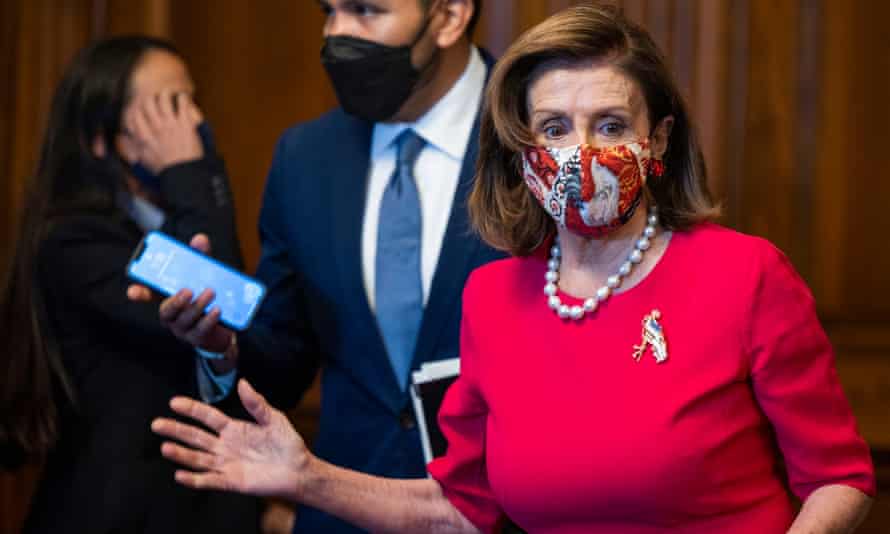
Democrats are on the verge of a make-or-break moment – one that will determine the fate of Joe Biden’s ambitious economic agenda – as they rush to bridge the internal divisions threatening to derail passage of the sweeping social policy package and a smaller infrastructure bill.
Failure would be disastrous for the president and his party’s political prospects next year, but success was far from certain with less than 48 hours left before a consequential vote in the House on Thursday. In a sign of the stakes, Biden canceled a scheduled trip to Illinois to remain in Washington and “continue working on advancing these two pieces of legislation”, according to a White House official.
“This is a big week for the American people. It’s a big week for President Biden. It’s a big week for House and Senate Democrats,” the New York congressman Hakeem Jeffries, a member of House leadership, told reporters. “We’re not running away from that. We’re leaning into it. We embrace it. We understand that we’ve been given the opportunity to govern for the people, to build back better, that’s exactly what we are committed to doing.”
Democratic leaders publicly projected confidence as they toiled behind the scenes to craft a compromise proposal that satisfies the many demands and competing interests that have put its passage in jeopardy, notably the dogged opposition of two Democratic senators. With Republicans unified in their opposition, they will need the vote of every Democrat in the Senate and nearly every Democrat in the House.
“In the next day or so we hope to come to a place where we can all move forward on that,” the House speaker, Nancy Pelosi, told reporters on Tuesday at the Capitol. “We will pass both bills.”
Democrats broadly share Biden’s vision for his “Build Back Better” agenda, which includes a once-in-a-generation expansion of the nation’s social safety net and an overhaul of the tax code. But disputes remain over the particulars of the legislation, from its overall size to key measures combating climate change and expanding healthcare.
At the center of the uncertainty was a deal Pelosi made with moderates and progressives, to tie the infrastructure bill, which passed the Senate with bipartisan support and would fund roads, broadband and other infrastructure projects, to the far larger policy proposal, that would spend $3.5tn over the next decade on Democratic priorities such as climate change, healthcare and childcare.
After promising to hold a vote on both measures at the same time, Pelosi told her caucus that the House should proceed with passage of the infrastructure billwhile the Senate attempts to reach a consensus on the spending plan, after a pair of moderate holdouts balked at its price tag. As they rushed to trim the bill, Pelosi indicated that the House would not take up a bill that didn’t have the support of all 50 Democrats in the Senate.
“The change in circumstance regarding the reconciliation bill has necessitated a change in our Build Back Better legislation but not in our values,” Pelosi wrote in a letter to Democrats on Tuesday.
Nevertheless, she signaled that the House would move forward with a vote on the infrastructure bill on Thursday.
Progressives were furious about the change of strategy, with some calling it a “betrayal”. Several members of the Congressional Progressive Caucus said the planned to oppose the infrastructure bill on Thursday unless there was also a vote on the the $3.5tn legislation.
“Progressives will vote for both bills, but a majority of our members will only vote for the infrastructure bill after the president’s visionary Build Back Better Act passes,” congresswoman Pramila Jayapal of Washington, the caucus chairwoman, said in statement after surveying her 96 members on Tuesday.

Progressives in the Senate were also frustrated, saying that they only supported the infrastructure bill because of the understanding that the measures would be tied together in the House. Urging House progressives to hold the line, Senator Bernie Sanders warned that allowing the bills to advance separately would “end all leverage that we have to pass a major reconciliation bill”.
“That means there will be no serious effort to address the long-neglected crises facing the working families of our country, the children, the elderly, the sick and the poor,” he said. “It also means that Congress will continue to ignore the existential threat to our country and planet with regard to climate change.”
If Democrats can pull it off, the legislation has the potential to be transformative for millions of American families. It would extend the child tax credit, establish universal pre-k, create a federally paid family and medical leave system, in addition to an array of programs to combat climate change and transition the country toward renewable energy. The plan would be paid for by trillions of dollars in tax increases on the wealthiest Americans and corporations.
Biden has said that the total cost of the bill is actually “zero” since it will be offset by an increase in tax revenue over several years.
Republicans have decried the scale of Biden’s spending and tax plan, saying that it would stifle economic growth and worsen the nation’s debt.
“This spending is on a scale not seen before in our country,” said the Republican senator John Barrasso of Wyoming, hoisting a copy of the 2,465-page draft legislation. “This bill represents Bernie Sanders’ socialist dream.”
Amid the impasse, Biden held a series of meetings at the White House on Tuesday with Senators Joe Manchin of West Virginia and Kyrsten Sinema of Arizona over their objections to the cost of his agenda.
“There was no commitments made at all,” Manchin told reporters on Capitol Hill, after his meeting with the president. “Just good negotiations.” He said he had not given Biden a proposed topline figure.
“This is clearly a pivotal moment,” the White House press secretary, Jen Psaki, said, describing the president as “deeply engaged” with Democratic leaders and members to pass his agenda.
“He’s working together in lockstep with Speaker Pelosi and Leader Schumer to get this done,” she said. “And they are all clear-headed … about the challenge of what we are pressing to achieve this week.”
With Biden’s economic agenda hanging in the balance, Democrats are also scrambling to avert a government shutdown and avoid a financial crisis with the national debt, after Republican senators blocked a measure that would have funded the federal agencies and raised the country’s borrowing limit.
Speaking on Capitol Hill on Tuesday, the treasury secretary, Janet Yellen, warned lawmakers that the consequences of failing to raise or suspend the debt limit would be “catastrophic”. Without congressional action, she said the treasury department will struggle to pay its bills on 18 October.
Hours later, Senate Republicans rejected a second attempt by Democrats to raise the debt ceiling, this time using a procedural maneuver to avoid a filibuster.
Can Democrats salvage Biden’s agenda, keep the federal government open and avert fiscal calamity?
“You know me, I’m a born optimist,” Biden said on Monday, as he rolled up his sleeve to receive a Covid-19 booster shot. “We’re gonna get it done.”
Liberals Dig In Against Infrastructure Bill as Party Divisions Persist They doubled down on a promise to oppose the infrastructure bill until Congress acts on a far more expansive domestic policy package.
Liberals Dig In Against Infrastructure Bill as Party Divisions Persist
“They doubled down on a promise to oppose the infrastructure bill until Congress acts on a far more expansive domestic policy package.

WASHINGTON — Liberal Democrats dug in on Tuesday against voting for a $1 trillion bipartisan infrastructure bill this week, angrily rejecting a decision by Speaker Nancy Pelosi to push the bill forward before the party could resolve bitter disagreements over a sprawling social policy and climate package.
The day after Ms. Pelosi signaled she would follow through with a Thursday vote on the infrastructure plan, the backlash reflected deep mistrust in the Democratic ranks that is threatening to derail President Biden’s domestic policy agenda.
At the heart of the impasse was a lack of clarity from moderate and conservative Democrats about what they would accept in the broader social safety net package, which has hamstrung negotiations led by Mr. Biden and Democratic congressional leaders to unify the party around a plan that can pass both chambers. Without a compromise, progressives say they cannot support the smaller, Senate-passed infrastructure plan, which omits many of their top priorities.
“Let me be clear: bringing the so-called bipartisan infrastructure plan to a vote without the #BuildBackBetter Act at the same time is a betrayal,” Representative Rashida Tlaib, Democrat of Michigan, said on Twitter on Tuesday. “We will hold the line and vote it down.”
Ms. Pelosi initially said the House would not take up the infrastructure plan until after the broader bill had passed. But in recent days, she has effectively decoupled the two bills, saying the party needed more time to resolve its differences over the proposed $3.5 trillion social policy plan, which conservative-leaning Democrats have called too costly.
“There was an intervention, as you know, in the past week or 10 days, of saying, ‘Well, we can’t go there,’” Ms. Pelosi said after a morning meeting with her caucus. “We’ll see what that is, and hopefully it will measure, it will reach the level that we need in order to pass both bills.”
“We will pass both bills,” she concluded.
Mr. Biden has been negotiating privately with some of the prime holdouts and met at the White House on Tuesday with two of them, Senators Kyrsten Sinema of Arizona and Joe Manchin III of West Virginia. In the evening, the president canceled a Wednesday trip to Chicago, which was intended to promote Covid-19 vaccinations, so he could remain focused on brokering an agreement on his economic agenda.
Democrats are pushing through the social safety net package using the fast-track reconciliation process to shield it from a filibuster. But with slim margins of control in both chambers and Republicans unified in opposition, Democratic leaders must keep all their senators united in favor, and they can afford to lose as few as three votes in the House.
Senior White House officials worked feverishly on Tuesday to unite Democrats around both the infrastructure bill and the reconciliation plan, meeting with key lawmakers and staff members in an attempt to forge a compromise between moderates and progressives. Mr. Biden held a series of meetings at the White House, as well as calls with progressives, an administration official said.
A White House adviser said Mr. Biden and his team were working through the often competing positions that Democrats in various factions have staked out. On Capitol Hill, moderate Democrats remained confident that enough Republicans would support the infrastructure bill to allow it to clear the House, sending the legislation to Mr. Biden’s desk.
But liberals held firm, and received some high-profile encouragement from across the Capitol. Senator Bernie Sanders, the Vermont independent who leads the Budget Committee, issued a fiery statement encouraging liberals to remain united in their stance.
“If there was a framework that addressed the major issues that we are fighting for in reconciliation, if there was a serious top line — I believe of $3.5 trillion — and Manchin and Sinema were 100 percent in agreement they would support that as we work out the fine details, that’s one thing,” Mr. Sanders said in an interview. “We’re not there yet, and it is upsetting to me that, as I understand it, they go to the White House and still nothing is happening. So I think it’s premature at this point to be passing the infrastructure bill.”
Lawmakers in both chambers have said they hope to quickly iron out the remaining differences between the moderate and liberal factions of their party, although many of the specific demands from the holdouts remain unclear. Ms. Pelosi has privately reiterated that she would not take up a reconciliation bill that could not pass the Senate.
But she told Democrats that she wanted to leave time for continued negotiations on it and as of Tuesday afternoon, it did not appear that a vote on the bipartisan infrastructure legislation would be delayed. That bill includes $550 billion in new funds over 10 years and maintains a series of key transportation programs set to lapse with the end of the fiscal year on Thursday.
“Man, holding one hostage over the other is not fair — it’s not right, it’s not good for the country,” Mr. Manchin said after his afternoon meeting at the White House, when pressed on his position and the vote conundrum in the House.
“You have to have trust a little bit, you know. Everybody’s not going to get what they want,” he added. “But let’s find out what the country needs.”
Both Mr. Manchin and Ms. Sinema have become a main target of liberal ire, having refused to publicly commit to an overall price tag after openly opposing a final $3.5 trillion package. Moderates in the House have also raised a wide variety of reservations about the scope of the legislation, leaving Democratic leaders with a complex web of issues that have frustrated efforts to reach a deal.
Ms. Sinema, for example, has privately expressed concern about current proposals for tax increases on wealthy people and corporations, while Mr. Manchin and others have floated the possibility of trimming back some of the spending.
“I think we just need them to say what’s the top line over there, which there’s always been a bit of reticence about saying,” said Representative Richard E. Neal of Massachusetts, the chairman of the Ways and Means Committee.
Without assurances from Senate moderates that they would embrace key components of the reconciliation legislation, progressives said they would not be comfortable backing the infrastructure measure.
“I think we’re in a situation where there’s a lot of needless hostage-taking — we can support everyone’s agenda here,” said Representative Alexandria Ocasio-Cortez, Democrat of New York. “The idea that we must split them apart or have them on different dates is an artificial construct in order to take people’s child care away.”
“Realigning these two votes will bring our party together,” she told reporters.
Even as they worked to keep both pieces of Mr. Biden’s agenda on track, Democratic leaders were confronting two more urgent fiscal deadlines: the lapse of government funding at midnight on Thursday and the breach of the federal debt ceiling, which would cause a default. Janet L. Yellen, the Treasury secretary, informed lawmakers on Tuesday that the deadline to avoid a default could come as early as Oct. 18, narrowing the window of time for Congress to act.
Senate Republicans on Monday blocked an emergency spending bill that would have lifted the statutory limit on federal borrowing, forcing Democratic leaders to consider a new strategy for averting a fiscal crisis. On Tuesday, they blocked another procedural attempt by Senate Democrats to avoid a filibuster and raise the debt ceiling.
Republicans have demanded that Democrats use the reconciliation process to raise the debt ceiling. But the maneuver, which Republicans have repeatedly demanded, would be complex and time-consuming, and House Democrats were considering taking up a separate bill raising the debt limit as early as Wednesday to continue pressuring the G.O.P. on the issue.
Jim Tankersley and Catie Edmondson contributed reporting.“
Tuesday, September 28, 2021
GOP Launches Fundraising Frenzy Off Biden Vax Mandates
GOP Launches Fundraising Frenzy Off Biden Vax Mandates

Photo Illustration by Sarah Rogers The Daily Beast / Photos Getty
"When President Joe Biden announced his administration would require vaccines or weekly COVID tests for federal workers and businesses with 100 or more employees, Republicans pounced—as the saying goes—into fundraising mode.
The day after the announcement, the Republican National Committee began blasting out emails and text messages asking supporters to reach into their pockets to help fund a coming legal challenge against the supposedly “authoritarian” mandate.
“WE WILL SUE BIDEN TO END HIS AUTHORITARIAN VACCINE MANDATE,” the first of the emails read, claiming Americans risk losing their freedoms “like never before.”
“We’re calling on EVERY Patriot to step up and help fund our efforts. Are you going to join us or will you sit on the sidelines?” email asked, and suggested a $45 donation.
The solicitations went out almost daily for the next two weeks, and grew increasingly Orwellian in tenor. Texts attacked Biden as “UN-AMERICAN” and a “TYRANT,” and emails played up fears of “fascist” overreach.
“You MUST step up RIGHT NOW and fund our efforts against Biden to end this EVIL vaccine mandate or all will be lost!” read an email sent Sunday, Sept. 12. Another sent around the same time reminded recipients that “lawsuits like this are expensive,” and again suggested a $45 contribution would be sufficient to back the effort.
The solicitations ramped up the next week. Between Monday and Saturday, the GOP sent at least 10 emails riding the controversy, according to a databasecompiled by SendView.
The mandate is the latest front to open in the long-running political clash over how to manage the COVID pandemic, with many leaders, mostly Democrats, struggling to persuade the far-right Republican base to adhere to the guidance of public health officials. The clash has been supercharged on a local level with vaccine misinformation and conspiracy theories, which have in turn fed on a paranoia in far-right circles about Democratic leadership. That rhetoric appears in the emails, pitting potential donors in an existential “with us or against us” battle against the Democratic administration over a policy that enjoys roughly 60 percent public support.
The RNC was not the only group threatening a courtroom challenge. In the days following the announcement, two dozen Republican attorneys general threatened litigation, decrying the mandate as “unconstitutional” executive overreach.
Most of that litigation, however, is still pending. RNC Chairwoman Ronna McDaniel said the committee won’t file its suit until the Occupational Safety and Health Administration implements the mandate in coming weeks and other state leaders are also waiting until then, when the official language will be set.
Biden, who in his announcement declared his patience with vaccine resistance had “worn thin,” has dismissed the legal threats, daring his challengers to “have at it” during a Sept. 10 visit to a D.C.-area middle school. “I am so disappointed that, particularly some Republican governors, have been so cavalier with the health of these kids, so cavalier with the health of their communities,” he said.
It’s not clear whether those challenges will meet with success. The order hangs on a rarely invoked workplace rule—temporary emergency powers allocated to OSHA if employees are in “grave danger.” But lawsuits, even doomed ones, have become a favorite political fundraising tactic for the GOP in the wake of the post-election court challenges from ex-President Donald Trump and an array of fringe MAGA allies. While those legal efforts failed, they also baited hundreds of millions of dollars in contributions. This summer, the RNC leaned on Trump’s new lawsuit against social media companies to rake in quick cash.
The anti-mandate emails appear to have dropped off after about two weeks, replaced with more standard fare such as promotions for Trump’s latest rally and broadsides against Biden’s immigration policies at the southern border. But the GOP saber-rattling may have proved intimidating enough—or inspirational—for the Democratic National Committee to respond. Only one DNC email in the SendView database references the mandate, and specifically in the context of the pending Republican lawsuits, asking recipients to take a poll to show their support.
The surge in fundraising pleas and rhetorical blitzes on vaccine “freedom” have only intensified this summer across the Republican Party—whether it’s among the heavyweights in conservative media, top contenders in GOP primaries ahead of the 2022 midterms, or prominent Republicans on Capitol Hill and the party’s leader, Trump.
One Fox News insider succinctly described the anti-COVID-mandate segmentsand vaccine-resistant commentary as “great for ratings.” Another current Fox employee said the numbers clearly demonstrated that there are vanishingly fewer subjects these days that get “our viewers more excited or engaged than” those kinds of segments.
As for the campaign trail, four different longtime Republican strategists told The Daily Beast that they have encouraged various 2022 GOP candidates who they’re each advising to lean heavily into anti-COVID-mandate messaging, viewing it as perhaps the winning issue with the conservative and Trump base of voters.
This strategy, however, comes at a time when the publicly available data show COVID-19 deaths and infections have exploded—including in months after the vaccines became widely available in the United States—in many areas that broke heavily for Trump in the last presidential contest. Even with the breakthroughs in safe, effective vaccinations, the U.S. is rapidly approaching 700,000 recorded deaths from the virus, with large weekly body counts still piling up in the country.
Trump’s political operation has also found the anti-mandate message as a handy fundraising tool. More and more frequently, Trump’s desire to claim credit for the production of the vaccines and to promote them has been steamrolled by his commitment to reassuring his fans that he champions their “freedoms” to refuse vaccination, masking, and mandates. To those who have spoken directly to the ex-president about this topic, Trump’s self-interested motivation is crystal clear: he doesn’t want to upset his base, and he’s told confidants who’ve urged him to launch a major vaccination push that too many of “my people” simply don’t want the shots.
But in the recent weeks of his post-presidency, Trump’s fundraising apparatus has sent out several appeals to donors and supporters declaring, “FREEDOM PASSPORTS > VACCINE PASSPORTS,” as one recent ask blared.
Naturally, Trump and his team are riding this pandemic-era trend so that they can sell T-shirts.
“BREAKING: Biden just MANDATED Covid vaccines,” the Trump operation mass-texted supporters on the evening of Sept. 16. “FIGHT BACK with President Trump’s new FREEDOM PASSPORT shirt.”
“Get yours NOW,” the sales pitch concludes.
—with additional reporting by Justin Baragona"