A collection of opinionated commentaries on culture, politics and religion compiled predominantly from an American viewpoint but tempered by a global vision. My Armwood Opinion Youtube Channel @ YouTube I have a Jazz Blog @ Jazz
and a Technology Blog @ Technology. I have a Human Rights Blog @ Law
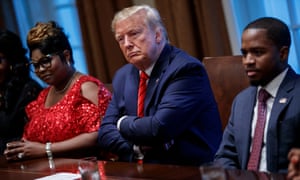
"Just two months ago in the Cabinet Room of the White House, sitting at a table surrounded by a handful of his black supporters, Donald Trump once again praised his job creation record. “Black people right now are having the best, statistically, the best numbers that you’ve ever had, and it’s really an honor,” he said. “Nobody has done more for black people than I have. Nobody has done more.”
That was 27 February and Trump was also still claiming he had done an “incredible job” with the looming coronavirus pandemic. Now the virus has led 26 million Americans to file for unemployment. While the US Bureau of Labor Statistics will not release unemployment figures broken down by race until the beginning of next month, economists are certain that black Americans are suffering the brunt of Covid-19’s economic impact and will probably suffer the most dramatic consequences of the looming recession.
Even before Covid-19 hit the US in full force and as the overall unemployment rate hit record lows, black Americans had an unemployment rate that was almost twice the national rate.
In February 2020 when the overall unemployment rate was 3.5%, a 50-year-low, the black unemployment rate was 5.8%. The white unemployment rate was 3.1%.
“The usual relationship that we see between the national unemployment rate and the black unemployment rate is typically really close to a two to one,” said Valerie Wilson, director of the Economic Policy Institute’s program on race, ethnicity and the economy.
“Whatever is being projected for the national unemployment rate, in most instances, we expect to see something close to twice that for black Americans.”
This was true for unemployment figures during the Great Recession. The overall unemployment rate peaked at 9.6% in 2010. For black Americans, it was 16%.
William Rodgers, former chief economist at the US Department of Labor, has estimated that the real unemployment rate for African Americans may have reached 19% in March.
“The reason why African Americans bear the brunt of downturns more is that when firing decisions start to occur the least educated and those with the least experience tend to be let go first. There is also continued discrimination in the workplace,” Rodgers said.
Economists who focus on race have long said that this “last hired, first fired” phenomenon dramatically affects black Americans more than any other group in the US due to the country’s history of racism and segregation of black Americans in the work sector.
Workers of color, particularly black Americans, have long been overrepresented in the lowest-paying service and domestic occupations, such as taxi drivers and restaurant servers. Working in these fields leads to lower wages – black Americans have the lowest median wage of any racial group in the US – and the jobs are often seen as the most expendable during an economic downturn.
Those who got to keep their jobs during the last recession saw little relief even after the recession’s recovery period. Even with a low unemployment rate, wage growth for low-wage workers, especially for black workers, has been slow. Black Americans have seen the slowest wage growth compared with other groups of Americans, reaching a growth rate that was four times slower at certain wage distribution levels, according to a 2018 Economic Policy Institute report.
“Even though overall on aggregate we were in a better position, many of the underlying weaknesses of our economy were still there – inequality both on class and race,” Wilson said.
A policeman directs a citizen where to pick up an unemployment form in Miami, Florida, earlier this month. Photograph: Michele Eve Sandberg/Rex/Shutterstock
Low wages have a ripple effect on a family’s ability to save money and build wealth.
For Yolanda Murray of Detroit, Michigan, not having savings meant weeks of panic trying to figure out how she was going to pay the bills that came on 1 April after she was furloughed from her job at a hotel.
“You got the rent, the bills, you got the car insurance, you got groceries and disinfectant supplies … It’s like how am I going to maintain all of this?” Murray said. Weeks after she filed her application for unemployment insurance, payments started coming in and Murray was able to pay her bills again.
But Murray has long-term concerns about what an upcoming recession could mean for her. Just a year and a half ago, in October 2018, Murray and her unionized co-workers spent 28 days striking for higher wages and better healthcare. At the time, workers at the hotel had not had wage rises since before the last recession, and healthcare costs were so expensive that Murray could only afford to cover herself, leaving her two children out of her plan.
The workers reached a deal with the hotel, and she was able to get her children under her healthcare plan, but Murray is worried about what an economic downturn would mean for her and her co-workers. “I just don’t want to see us go backwards right now,” she said.
Trump’s repeated claims that he has been the best president for African Americans was repeatedly pegged to falling unemployment numbers. But those numbers only tell a partial story, as work by Rodgers and others has shown.
Black families are especially vulnerable to economic downturns because they lack the savings that can act as a buffer against unexpected layoffs or lost wages. And during the last recovery they lost ground against their white peers.
The median net worth of black families is $17,600, compared with $171,000 for white families. A white family is likely to have $10 for every $1 a black family has. The percentage of black families that have a net worth at or below zero dollars is 10 points higher than the percentage of white families in the same financial situation – 19% compared with 9%, respectively. And the black homeownership rate is the lowest of any racial group in the US and has consistently been about 30% lower than the white homeownership rate over the years, even as the economy was getting stronger.
“Wealth allows you to respond to that unexpected health emergency, that broken hole in the tire you have to replace. It also allows you to buy a home, put your kids through school,” said Danyelle Solomon, vice-president of the race and ethnicity program at the Center for American Progress.
Having less wealth also has some dire health consequences. Experts agree that being poor has costly effects on a person’s health: for adults living in extreme poverty, being poor can cost up to 15 years of life expectancy.
It is no surprise, then, that black Americans – who are less likely to be insured and more likely to have existing health conditions than their white counterparts – have seen higher death rates due to Covid-19 compared with any other group in the US. Black Americans made up 25% of deaths from Covid-19 in the US though they make up a little under 13% of the US population.
“National emergencies, pandemics, epidemics, what they do is they spotlight inequality,” Solomon said. “What we see in Covid-19 is no different. It’s highlighting racial disparities at every single level that have been with our society for a very long time.”
"With closer cooperation among nations, the head of the United Nations argues, we could stop a pandemic faster and slow climate change.
Mr. Guterres is the secretary general of the United Nations. Before that, he was the United Nations high commissioner for refugees.
Smoke and steam polluting the air over Poland in 2018 from PGE’s Bełchatów power station, Europe’s largest power plant fired by lignite, also called brown coal.
The Covid-19 pandemic is the biggest test the world has faced since World War II. There is a natural tendency in the face of crisis to take care of one’s own first. But true leadership understands that there are times to think big and more generously. Such thinking was behind the Marshall Plan and the formation of the United Nations after World War II. This is also such a moment. We must work together as societies and as an international community to save lives, ease suffering and lessen the shattering economic and social consequences of Covid-19.
The impact of the coronavirus is immediate and dreadful. We must act now and we must act together. Just as we must act together to address another urgent global emergency that we must not lose sight of — climate change. Last week, the World Meteorological Organization released data showing that temperatures have already increased 1.1 degrees centigrade above preindustrial levels. The world is on track for devastating climate disruption from which no one can self-isolate.
Now, on every continent and in every sea, climate disruption is becoming the new normal. Human conduct is also leading to severe biodiversity loss, changing animal-human interaction and distorting ecosystem processes that regulate our planetary health and control many services that humans depend on. Science is screaming to us that we are close to running out of time — approaching a point of no return for human health, which depends on planetary health.
Addressing climate change and Covid-19 simultaneously and at enough scale requires a response stronger than any seen before to safeguard lives and livelihoods. A recovery from the coronavirus crisis must not take us just back to where we were last summer. It is an opportunity to build more sustainable and inclusive economies and societies — a more resilient and prosperous world. Recently the International Renewable Energy Agency released data showing that transforming energy systems could boost global G.D.P. by $98 trillion by 2050, delivering 2.4 percent more G.D.P. growth than current plans. Boosting investments in renewable energy alone would add 42 million jobs globally, create health care savings eight times the cost of the investment, and prevent a future crisis.
I am proposing six climate-positive actions for governments to consider once they go about building back their economies, societies and communities.
First: As we spend trillions to recover from Covid-19, we must deliver new jobs and businesses through a clean, green transition. Investments must accelerate the decarbonization of all aspects of our economy.
Second: Where taxpayers’ money rescues businesses, it must be creating green jobs and sustainable and inclusive growth. It must not be bailing out outdated polluting, carbon-intensive industries.
Third: Fiscal firepower must shift economies from gray to green, making societies and people more resilient through a transition that is fair to all and leaves no one behind.
Fourth: Looking forward, public funds should invest in the future, by flowing to sustainable sectors and projects that help the environment and climate. Fossil fuel subsidies must end and polluters must pay for their pollution.
Fifth: The global financial system, when it shapes policy and infrastructure, must take risks and opportunities related to climate into account. Investors cannot continue to ignore the price our planet pays for unsustainable growth.
Sixth: To resolve both emergencies, we must work together as an international community. Like the coronavirus, greenhouse gases respect no boundaries. Isolation is a trap. No country can succeed alone.
The Paris Agreement on climate change and the Sustainable Development Goals laid out by the United Nations in 2015 provide the blueprint and the tools for a better recovery. While Britain and Italy have sensibly decided to postpone this year’s annual international climate conference until 2021, we cannot afford to waver on climate action or scale down ambition. Governments must honor their commitments to present new national climate plans and longer-term strategies to reach net zero greenhouse gas emissions by 2050.
I urge the European Union to place the Green Deal presented last year at the heart of its economic response to the pandemic and to maintain its commitment to submit a new and more ambitious climate plan and long-term strategy consistent with getting to climate neutrality by 2050. I make a similar appeal to all G20 countries, which collectively account for more than 80 percent of global emissions and over 85 percent of the global economy. We cannot solve the climate crisis without the G20’s coordinated leadership.
I welcome the leadership shown by countries like South Korea, which has managed the pandemic in an exemplary manner and supported other countries in doing so, and now is looking at leading the way with its own Green New Deal. It is also encouraging to see Japan’s Mizuho Financial Group announcing it would stop new financing for coal-fired power plants, and other organizations like the Simitomo Misui Financial Group moving in that direction
And just last week, the smallest and most vulnerable members of our United Nations family, the small island nations, recommitted to climate ambition even in the midst of the Covid disaster. Their leadership should serve as an inspiration to all.
Young people the world over have been demanding stronger, faster and more ambitious climate action because they understand that it is the only way to secure their future. Similarly, many influential business leaders tell us that climate action and sustainable development are the only ways to protect and strengthen their bottom lines.
For years, we have failed our young by damaging the planet and failing to protect the people most vulnerable to crises. We have a rare and short window of opportunity to rectify that — by rebuilding a better world, not reverting to one that is good for only a minority of its citizens.
We must act now to tackle the coronavirus globally for all of our sakes — and, at the same time, pursue immediate ambitious climate action for a cleaner, greener, more prosperous and equitable world.
António Guterres, the ninth secretary general of the United Nations, took office in 2017.
"The president and senior officials manipulated Americans and played down the severity of the pandemic.
Mr. Goodman is a professor at New York University School of Law, where Ms. Schulkin is a student.
The strongest critics of the Trump’s administration’s handling of the coronavirus pandemic point to its flat-footedness and the consequences of time lost.
But the full account looks worse. Over the last five days of February, President Trump and senior officials did something more sinister: They engaged in a cover-up.
A look at this window of time gives insight into how several members of the president’s team were willing to manipulate Americans even when so many lives were at stake.
The recent reports that the president wanted to fire the Centers for Disease Control and Prevention’s top expert on viral respiratory diseases, Dr. Nancy Messonnier, during this period helps put the pieces of the puzzle together.
What was her offense to the president?
In a conference call with reporters on the final Tuesday of the month, Dr. Messonnier spoke frankly. “We want to make sure the American public is prepared,” she said, then put it in personal terms by saying what she told her children that morning: “We as a family ought to be preparing for significant disruption to our lives.”
At the time, senior officials knew the coronavirus was an extreme threat to Americans. Thanks to information streaming in from U.S. intelligence agencies for months, officials reportedly believed that a “cataclysmic” disease could infect 100 million Americans and discussed lockdown plans. The warnings were given to Mr. Trump in his daily brief by the intelligence community; in calls from Alex Azar, the secretary of health; and in memos from his economic adviser Peter Navarro.
The same day that Dr. Messonnier spoke, the military’s National Center for Medical Intelligence raised the warning level inside the government to WATCHCON1, concluding that the coronavirus was imminently likely to develop into a full-blown pandemic.
But the White House did not want the American public to know.
The president’s stated concerns were specific. He didn’t want to upset the markets or China during trade talks, and it appears he may have also simply been in denial, counting on his personal hunches and luck.
So the president’s top advisers took to the airwaves with a united purpose: to deny the truth.
That Tuesday afternoon, Mr. Azar appeared at a news briefing, public health professionals including Dr. Anthony Fauci behind him, and discussed Dr. Messonnier’s comments. “We’re trying to engage in radical transparency with the American public as we go through this,” he declared. But within 20 seconds of that statement, he uttered state propaganda. “Thanks to the president and this team’s aggressive containment efforts,” he said, coronavirus “is contained.”
That same day, Larry Kudlow, the president’s National Economic Council director, in direct response to Dr. Messonnier’s comments, told CNBC: “We have contained this. I won’t say airtight, but pretty close to airtight.”
The following day, Defense Secretary Mark Esper spoke to the military. In a video conference with American commanders around the world, he instructed them to give notice on decisions made about how to protect their personnel from the virus if doing so might “run afoul of President Trump’s messaging,” according to a New York Times report.
(A Pentagon spokesman denied this, and when Mr. Esper later appeared before Congress, he called the article “completely wrong.” Yet as The Hill reported, Mr. Esper “seemed to confirm key details” of the Times report at the hearing by saying he asked for a “heads-up” on such decisions to make sure the administration was “integrated across the interagency” — including the White House.)
That Wednesday, the president used the day’s news conference by the coronavirus task force, with Dr. Fauci alongside him, to lie to the public. “You have 15 people, and the 15 within a couple of days is going to be down to close to zero. That’s a pretty good job we’ve done,” he told the American public. He and Mr. Azar would continue to make such assurances over the next two days — Mr. Azar in remarks before lawmakers and the president in statements from the White House and bellowed at political rallies.
At the end of the five days, Dr. Fauci spoke on the “Today” show in public messaging that would later become controversial. The question was put to him in terms Americans could easily appreciate: “So, Dr. Fauci, it’s Saturday morning in America. People are waking up right now with real concerns about this. They want to go to malls and movies, maybe the gym as well. Should we be changing our habits and, if so, how?” Dr. Fauci offered a nuanced reply: “No. Right now, at this moment, there’s no need to change anything that you’re doing on a day by day basis. Right now the risk is still low.” He added, however, that this could change.
Dr. Fauci might now regret how he tried to thread the needle, but he also knew to expect the question and he repeated the party line.
In effect, for five days, the president along with some of his closest senior officials disseminated an egregiously false message to Americans. The messaging would continue well beyond those days until the stark images of refrigerated morgue trucks and spiked lines on colored graphs showed the escalating numbers of cases and dead.
Understanding this playbook is not only important in its own terms. It goes to the heart of whether Americans can trust this administration in the months ahead when they must make life-or-death decisions about how to protect their health and when to reboot the economy.
Ryan Goodman, editor in chief of Just Security, is a professor at New York University School of Law, where Danielle Schulkin is a third-year student."
At least a dozen U.S. states forged ahead with a variety of strategies to ease restrictions. The C.D.C. expanded the list of symptoms associated with the virus. The relief program for small businesses faltered again.
RIGHT NOW
Detected infections of the coronavirus in the United States approached one million. More than 50,000 have died"
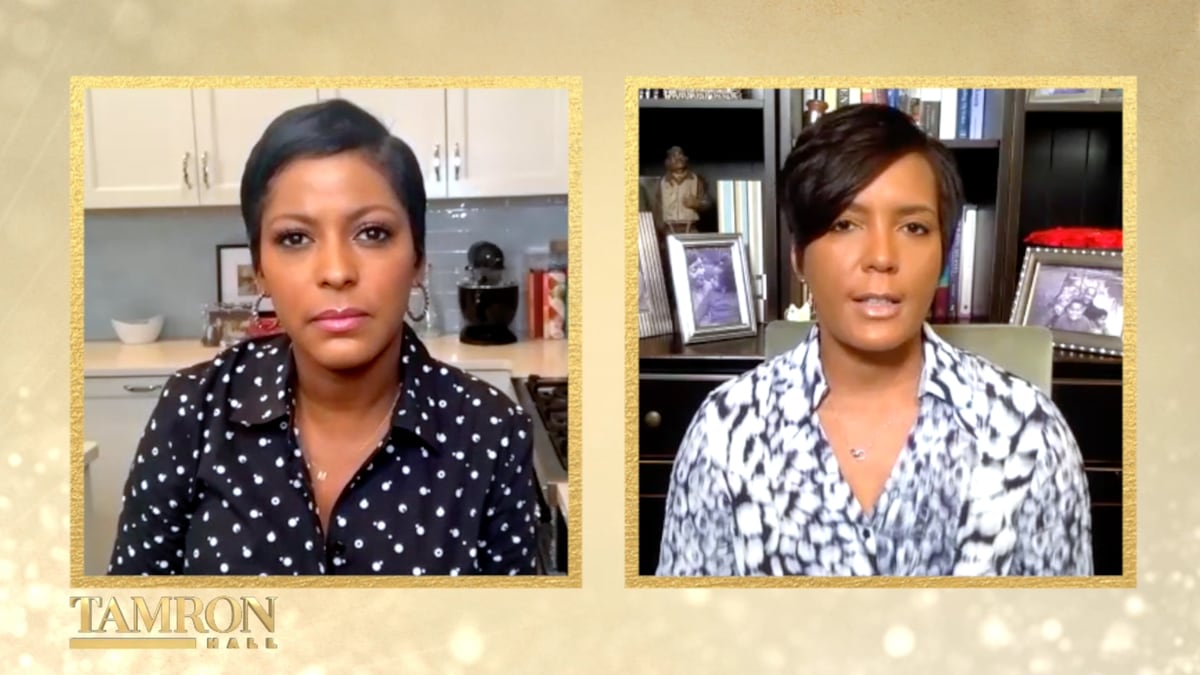
"ATLANTA — As businesses like hair salons and restaurants begin to reopen across Georgia, Atlanta Mayor Keisha Lance Bottoms spoke with talk show host Tamron Hall on Monday about Gov. Brian Kemp’s order to start the first phase of reopening parts of the state.
Kemp announced last week that tattoo parlors, salons, barber shops, bowling alleys and a handful of other businesses could reopen Friday with strict social distancing measures in place. Then on Monday, Kemp allowed the reopening of restaurants for dine-in services, again with strict social distancing requirements.
Hall asked the mayor if she was tracking what businesses were reopening.
“We are not tracking them yet, but what I can say, anecdotally, I'm hearing from a lot of restaurant owners and business owners in the city who are saying they will not open yet,” Bottoms said.
Bottoms told Hall that she has formed an advisory council with small business owners and Fortune 500 companies to figure out how and when to reopen businesses once things get back to normal.
“I know one report, there was a hair salon that reportedly booked appointments a few weeks out as a result of the opening. Are you surprised by those who are deciding, even though it’s right now a minority of businesses, are you surprised by those who have decided it is worth the risk to reopen?” Hall asked Bottoms.
“When I saw that hair salon, it made my heart sink. Because we all know what that means. It means that you're going to have people close to each other, you're going to leave those hair salons, go back to their families and to their communities and potentially spread this virus. It is so surprising to me that people have such a disregard for the science and the data, especially when you look at the African American community, where there is a barbershop and hair salon on every single corner,” Bottoms said."
Amazon may have violated federal safety standards for providing "inadequate" protections to warehouse workers in New York, the state attorney general's office says. In a letter to Amazon obtained by NPR, the office of New York's top lawyer Letitia James says the company may have also broken the state's whistleblower laws for firing a warehouse worker who helped organize a protest in Staten Island. "While we continue to investigate, the information so far available to us raises concerns that Amazon's health and safety measures taken in response to the COVID-19 pandemic are so inadequate that they may violate several provisions of the Occupational Safety and Health Act" and other federal and state guidelines, James's staff wrote in the letter, dated April 22.”


/https%3A%2F%2Fi.guim.co.uk%2Fimg%2Fmedia%2F72b3a7ee270f21d1c16cd75ec5cceaf97ebef309%2F0_158_4763_2860%2Fmaster%2F4763.jpg%3Fwidth%3D300%26quality%3D85%26auto%3Dformat%26fit%3Dmax%26s%3D2c6c884158d37b19b5b4fe9cbbf42f47)
/https%3A%2F%2Fstatic01.nyt.com%2Fimages%2F2020%2F05%2F22%2Fopinion%2F28Guterres%2F28Guterres-articleLarge.jpg%3Fquality%3D75%26auto%3Dwebp%26disable%3Dupscale)