Contact Me By Email

Contact Me By Email

Saturday, July 27, 2019

How the Watergate crisis eroded public support for Richard Nixon | Pew Research Center

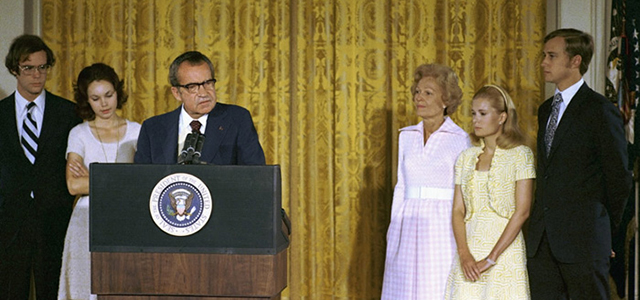
President Richard Nixon delivers remarks to the White House staff on his final day in office, Aug. 9, 1974. Credit: White House photo, courtesy Richard Nixon Presidential Library


"Forty years ago today, Richard Nixon announced his resignation from the nation’s highest office, making that decision in the face of almost certain impeachment by the House and plummeting public support, as a majority of Americans called for his removal from office. But it happened in stages.
Nixon had won reelection in 1972 by a landslide and began his second term with a lofty 68% Gallup Poll approval rating in January 1973. But the Watergate scandal — which started with an effort to bug the Democratic National Committee office at the Watergate Hotel and subsequent efforts to cover it up — quickly took a heavy toll on those ratings, especially when coupled with a ramp-up in public concerns about inflation. By April, a resounding 83% of the American public had heard or read about Watergate, as the president accepted the resignations of his top aides John Ehrlichman and H.R. Haldeman. And in turn, Nixon’s approval ratings fell to 48%.
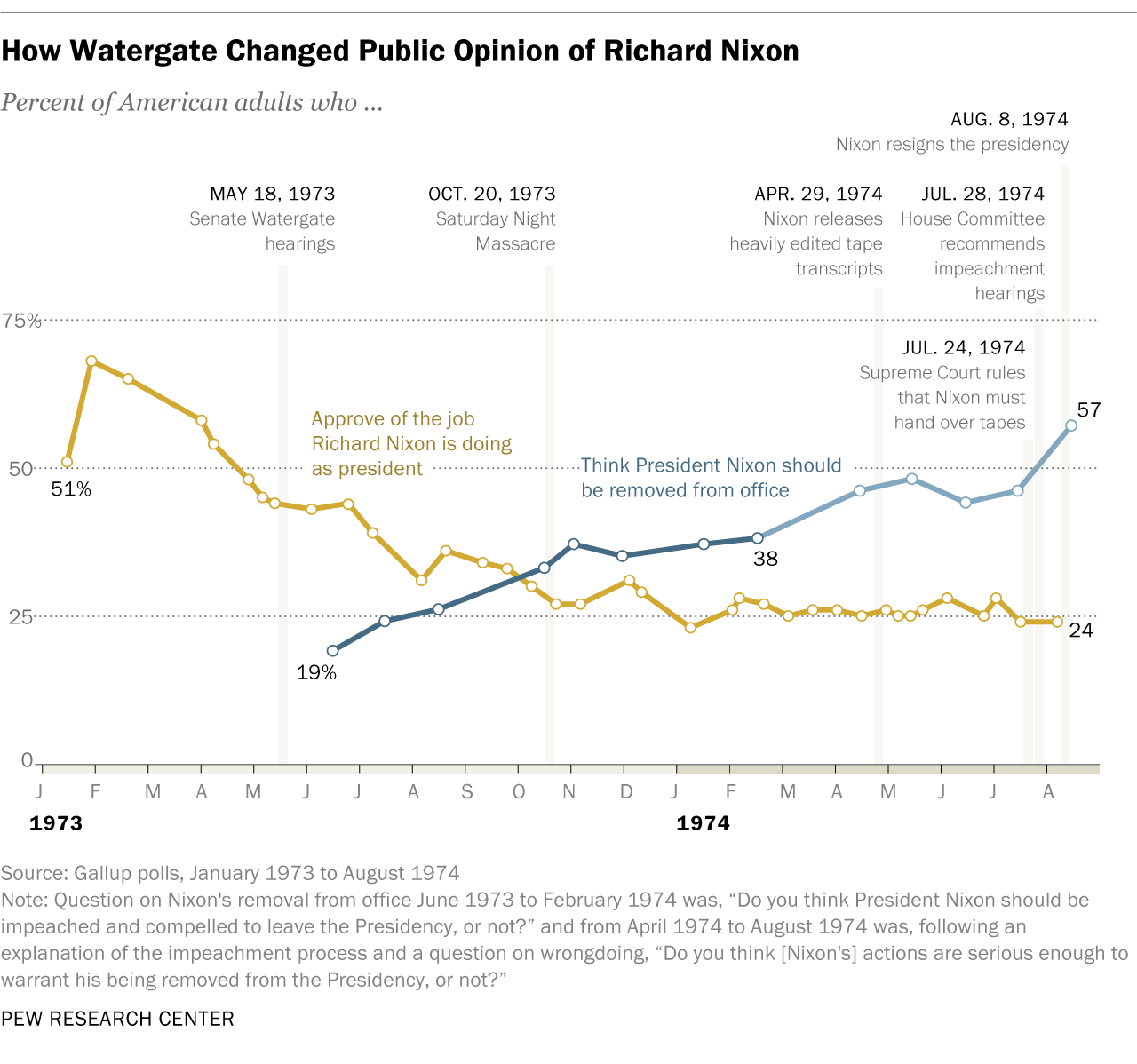
How Watergate Changed Public Opinion of Richard NixonBut that was just the beginning of the toll the scandal would take on the president that year. The televised Watergate hearings that began in May 1973, chaired by Senator Samuel Ervin, commanded a large national audience — 71% told Gallup they watched the hearings live. And as many as 21% reported watching 10 hours or more of the Ervin proceedings. Not too surprisingly, Nixon’s popularity took a severe hit. His ratings fell as low as 31%, in Gallup’s early August survey. 
The public had changed its view of the scandal. A 53% majority came to the view that Watergate was a serious matter, not just politics, up from 31% who believed that before the hearings. Indeed, an overwhelming percentage of the public (71%) had come to see Nixon as culpable in the wrongdoing, at least to some extent. About four-in-ten (37%) thought he found out about the bugging and tried to cover it up; 29% went further in saying that he knew about the bugging beforehand, but did not plan it; and 8% went all the way, saying he planned it from beginning to end. Only 15% of Americans thought that the president had no prior knowledge and spoke up as soon as he learned of it.
Yet, despite the increasingly negative views of Nixon at that time, most Americans continued to reject the notion that Nixon should leave office, according to Gallup. Just 26% thought he should be impeached and forced to resign, while 61% did not.
A lot of key scandal events were to follow that year and into 1974, but public opinion about Watergate was slow to change further, despite the high drama of what was taking place. For example, October 1973 was a crucial month as the courts ruled that the president had to turn over his taped conversations to special prosecutor Archibald Cox, and subsequently Nixon ordered for the dismissal of Cox in what came to be known as the Saturday Night Massacre. The public reacted, but in a measured way. In November, Gallup showed the percentage of Americans thinking that the president should leave office jumping from 19% in June to 38%, but still, 51% did not support impeachment and an end to Nixon’s presidency.
In the spring of 1974, despite the indictment of top former White House aides, and Nixon’s release of what were seen as “heavily edited” transcripts of tapes of his aides plotting to get White House enemies, the public was still divided over what to do about the president. For example, by June, 44% in the Gallup Poll thought he should be removed from office, while 41% disagreed.
Only in early August, following the House Judiciary Committee’s recommendation in July that Nixon be impeached and the Supreme Court’s decision that he surrender his audio tapes, did a clear majority – 57% – come to the view that the president should be removed from office.
But once he was gone, the Americans were not quick to forgive and forget. In September, a 58% majority said Nixon should be tried for possible criminal charges. And they took the view that he should not be let off the hook easily, if found guilty. By a margin of 53% to 38%, the public thought that President Ford should not pardon Nixon, if he was found guilty.


The latter sentiment of course, would carry on, and be crucial to the outcome of the next presidential election. Ford did pardon Nixon in September, an act that was followed by a plummet of his own poll numbers, and later was seen as a factor in his loss to Democrat Jimmy Carter in the 1976 presidential election."
How the Watergate crisis eroded public support for Richard Nixon | Pew Research Center

Will support grow for impeaching Trump? Data on Nixon offers a clue. - The Washington Post

"If you’ve closely followed the debate among Democrats over whether to launch an impeachment inquiry on President Trump, chances are that you’ve heard this number: 19.

As many who support impeachment hearings have pointed out, in early 1973, Gallup polling showed that only 19 percent of Americans supported removing President Richard M. Nixon. By the summer of 1974, when Nixon resigned, support had climbed to the high 50s — which illustrates that on impeachment, public opinion can be moved in a big way, including, presumably, on Trump.
I’ve obtained from Gallup a detailed partisan breakdown of these numbers, and they tell a more complicated story. In some ways, this breakdown lends even more support to the idea that public sentiment can be shifted on impeachment, though there are still cautionary notes.

As Democrats return from recess, they are puzzling over how to draw more public attention to special counsel Robert S. Mueller III’s findings, which could build support for an impeachment inquiry.
Democratic leaders continue to insist that they must win the public over first. Rep. James Clyburn (S.C.), the No. 3 House Democrat, told CNN: “We think that we have to bring the public along.”
So now let’s look at what happened with Nixon in that regard. Gallup provided me with this breakdown of four of its national polls on impeachment (the question wording shifts midway through):

Gallup polling on Nixon and impeachment (Gallup/Gallup)
As you can see, among Republicans, support for impeachment or removal moved from 6 percent in June of 1973, to 31 percent in August 1974.
Among independents, those numbers moved from 18 percent to 55 percent. And among Democrats, they moved from 27 percent to 71 percent.

In some ways, this offers more grist for believing that public opinion can be shifted again. Note that the shift was more substantial among independents, eventually amounting to a solid majority, than it was among Republicans.
Right now, independents are a key reason public support for impeachment is low. A recent Post-ABC News poll, which found that only 37 percent of Americans support beginning impeachment proceedings while 56 percent oppose it, also found that among independents, those numbers are 36 percent to 59 percent.
The Gallup numbers on Nixon suggest that big shifts among independents are possible and show that a substantially larger percentage of independents now support impeachment hearings than at the outset in Nixon’s day.
In other words, it might be possible to build majority support for an impeachment inquiry on Trump, even if Republican voters don’t ever move much on this question.

How support grew for impeaching Nixon
Princeton historian Julian Zelizer, the co-author of a new book on U.S. history, points out that some jumps in support for impeaching Nixon came after high-profile events.
For instance, Zelizer noted, the jump in July 1974 came after the House Judiciary Committee launched impeachment hearings in May 1974, and the subsequent jump in August 1974 came after the Committee approved articles of impeachment in July of that year.
“It’s clear from the data that impeachment proceedings provided the jolt that shook the public, among independents in particular,” Zelizer told me. “An independent by nature is not going to make a quick decision. Impeachment proceedings and then the approval of articles of impeachment are what ended up moving independents.”
“This wasn’t Congress waiting on the public,” Zelizer added. “It was the other way around — Congress provided guidance to the public.”

Democratic leaders insist an impeachment inquiry must have bipartisan support, meaning Republicans must come around. If that doesn’t happen, goes this argument, the Senate will acquit, so an impeachment inquiry will rip the country apart and potentially alienate swing voters while resulting in no serious consequences for Trump.
But if anything, this new data casts doubt on that approach. It raises the possibility that public opinion can be shifted in the middle regardless of whether Republicans ever support an inquiry in large percentages. What’s more, note that Republican support for impeaching Nixon never even reached one-third even at the end of the process.
And given current realities — deep partisan polarization, and the massive media propaganda apparatus Trump enjoys that Nixon never had — it’s plausible that Republicans could never come around in even those numbers. “Republican voters might be much less movable than in 1974,” Zelizer noted.
Here’s Gallup’s data on Nixon’s approval over the same period:

Gallup data on Nixon's approval
Try to imagine Trump’s approval among Republicans falling to 50 percent, and you get the idea.

It’s possible that because of this polarization, Republican-leaning independents might also be less movable, but we cannot know this in advance. And it’s also true that in Nixon’s day, there was far more time in advance of the next election to build support, but that perhaps argues for more prompt action now.
The bottom line is that insisting that even an impeachment inquiry can’t happen until Republicans support one, and Senate acquittal is no longer preordained, might be tantamount to giving bad-faith lockstep Republican support for Trump — and the power of Trump’s disinformation network, which is rendering Republican voters unreachable — total veto power over whether our political system ever even begins to formally consider the question of whether Trump’s corruption and misconduct amount to the high crimes and misdemeanors that merit removal.
That is likely tantamount to saying it can never happen at all. If that’s the real point, Democratic leaders should say so.

The Democratic argument
In fairness, Democratic leaders argue that pushing forward with oversight outside impeachment will shed light on Trump’s misdeeds, and that if this builds support for an inquiry, it might then be appropriate.
Look: If Democrats score multiple oversight wins in court, and new light is being shed on Trump’s corruption, it would be somewhat understandable if they then refrained from an inquiry, though the case for one has already been strong for many months.
But as many legal experts have pointed out, an inquiry would strengthen Democrats’ hands in these very same oversight battles, making success more likely. And if Democrats lose a bunch of them, and we find ourselves in the fall, and Democrats don’t want to launch one due to the looming election, then what?
If you oppose an inquiry, but also want Trump held accountable, you should at least engage with the risks embedded in this scenario — and with the fact that the current conduct of Democrats could dramatically influence public opinion on the impeachment question. It’s not enough to simply declare that opinion tilts against an inquiry. Democrats don’t lack agency here."
Will support grow for impeaching Trump? Data on Nixon offers a clue. - The Washington Post

Friday, July 26, 2019

US-born high school student detained for weeks by CBP. Only in America

Mueller Testimony Deepens Democratic Divide on Impeachment


"By Ilhan Omar


Throughout history, demagogues have used state power to target minority communities and political enemies, often culminating in state violence. Today, we face that threat in our own country, where the president of the United States is using the influence of our highest office to mount racist attacks on communities across the land. In recent weeks, he has lashed out unprompted against four freshman Democrats in the House of Representatives: Alexandria Ocasio-Cortez of New York, Ayanna Pressley of Massachusetts, Rashida Tlaib of Michigan, and me, from Minnesota.

Last week, as President Trump watched the crowd at one of his rallies chant “Send her back,” aimed at me and my family, I was reminded of times when such fearmongering was allowed to flourish. I also couldn’t help but remember the horrors of civil war in Somalia that my family and I escaped, the America we expected to find and the one we actually experienced. 

The president’s rally will be a defining moment in American history. It reminds us of the grave stakes of the coming presidential election: that this fight is not merely about policy ideas; it is a fight for the soul of our nation. The ideals at the heart of our founding — equal protection under the law, pluralism, religious liberty — are under attack, and it is up to all of us to defend them.

Having survived civil war in my home country as a child, I cherish these values. In Somalia’s capital, Mogadishu, I saw grade-school children as young as me holding assault rifles in the streets. I spent four years in a refugee camp in Kenya, where there was no formal schooling or even running water. But my family and I persevered, fortified by our deep solidarity with one another, the compassion of others and the hope of a better life in the United States.

The America we arrived in was different from the one my grandfather had hoped to find. The land of opportunity he imagined was in fact full of challenges. People identified me in ways that were foreign to me: immigrant, black. I learned that these identities carried stigmas, and I experienced prejudice as a visibly Muslim woman.

But the beauty of this country is not that our democracy is perfect. It’s that embedded in our Constitution and democratic institutions are the tools to make it better. It was in the diverse community of Minneapolis — the very community that welcomed me home with open arms after Mr. Trump’s attacks against me last week — where I learned the true value of democracy. I started attending political caucuses with my grandfather, who cherished democracy as only someone who has experienced its absence could. I soon recognized that the only way to ensure that everyone in my community had a voice was by participating in the democratic process.

Today, that basic promise is under threat. Our democratic institutions have been weaponized. The Trump administration has sought to restrict people from exercising their voting rights. It has sought to undermine the basic checks and balances of our Constitution by not respecting subpoenas from Congress. And the president has used overtly racist rhetoric to strike fear and division in communities of color and religious minorities across the country.

The idea — explicitly expressed by this president and enshrined into law by executive order — that people from certain Muslim-majority countries cannot enter this country is not just bad policy; it is a direct threat to liberal democracy. The chants of “Jews will not replace us,” shouted at a rally in Charlottesville in 2017 by white supremacists, whom this president tacitly accepted, are a direct attack on the values of religious freedom central to the founding of our nation.

The reasons for weaponizing division are not mysterious. Racial fear prevents Americans from building community with one another — and community is the lifeblood of a functioning democratic society. Throughout our history, racist language has been used to turn American against American in order to benefit the wealthy elite. Every time Mr. Trump attacks refugees is a time that could be spent discussing the president’s unwillingness to raise the federal minimum wage for up to 33 millionAmericans. Every racist attack on four members of Congress is a moment he doesn’t have to address why his choice for labor secretary has spent his career defending Wall Street banks and Walmart at the expense of workers. When he is launching attacks on the free press, he isn’t talking about why his Environmental Protection Agency just refused to ban a pesticide linked to brain damage in children.

His efforts to pit religious minorities against one another stem from the same playbook. If working Americans are too busy fighting with one another, we will never address the very real and deep problems our country faces — from climate change to soaring inequality to lack of quality affordable health care.

The only way to push back is to be unequivocal about our values. It is not enough to condemn Mr. Trump’s racism. We must affirmatively confront racist policies — whether the caging of immigrant children at the border or the banning of Muslim immigrants or the allowing of segregation in public housing. It is not enough to condemn the corruption and self-dealing of this administration. We must support policies that unmistakably improve working people’s lives, including by strengthening collective bargaining, raising the minimum wage and pursuing a universal jobs guarantee.

The consequences of this fight will not just be felt here at home but around the world. Right-wing nationalism in Hungary, Russia, France, Britain and elsewhere is on the march in ways not seen in decades. America has been a beacon of democratic ideals for the world. If we succumb to the fever of right-wing nationalism, it will have consequences far beyond our borders.

The proudest moments in our history — from the Emancipation Proclamation to the civil rights movement to the struggle against fascism — have come when we fight to protect and expand basic democratic rights. Today, democracy is under attack once again. It’s time to respond with the kind of conviction that has made America great before. "


Mueller Testimony Deepens Democratic Divide on Impeachment

Mueller Testimony Deepens Democratic Divide on Impeachment


"WASHINGTON — Robert S. Mueller III’s long-awaited testimony has inflamed divisions among Democrats over impeachment, with some senior lawmakers pushing on Thursday to begin formal impeachment hearings soon, and vulnerable moderates pleading that the party needed to rest its case against President Trump.

Liberal House members who have been agitating for impeachment were buoyed by Mr. Mueller’s nearly seven hours of testimony, asserting, despite modest viewership numbers and no dramatic revelations, that the former special counsel’s words confirmed their case that Mr. Trump had tried to obstruct justice. They showed signs of momentum.
Representative Jerrold Nadler of New York, the chairman of the Judiciary Committee, has gradually become convinced that his panel should proceed with impeachment hearings and do so as expeditiously as possible, though he has not stated so publicly, according to lawmakers and aides familiar with his thinking. In a closed room of lawmakers on Wednesday evening after the hearing, he broached the idea that House committees could soon begin contemplating articles of impeachment, though Speaker Nancy Pelosi has pushed back on the idea of quick action.
On Thursday, four more House Democrats came out for beginning impeachment proceedings, including the highest ranking one yet: Representative Katherine M. Clark of Massachusetts, the vice chairwoman of the House Democratic Caucus. That pushed the total above 90.
“The case for impeachment based on the Mueller investigation has been now publicly crystallized and articulated,” said Representative Jamie Raskin, Democrat of Maryland and a leading impeachment advocate on the Judiciary Committee. “The evidence is overwhelming: 10 different episodes of presidential obstruction of justice and the Trump campaign’s enthusiastic embrace of the Russian attack on our elections.”
The majority of the Democratic caucus remains skeptical about what it sees as a politically perilous push that would lead to an almost certain acquittal in the Senate and further drain attention from its legislative work. Some moderate Democrats who helped deliver the House majority to the party in 2018 by flipping Republican seats sounded increasingly exasperated.
“While there may be certain parts of it that are distasteful or disturbing, I don’t see the high crimes or misdemeanors,” said Representative Jeff Van Drew, who flipped a seat in southern New Jersey, discussing Mr. Mueller’s findings. “If we just let this overshadow all these other issues for a longer period of time, too long a period of time, we are really endangering the election for the Democrats.”
Democrats had never expected Mr. Mueller to cinch their case against the president, but they did hold out hope that testimony from the man who pursued Russian election interference and possible presidential obstruction of justice for 22 months would clarify their path forward. Those hopes faded by the time the House gaveled in on Thursday, and with lawmakers leaving Washington for a six-week recess, they now appear likely to fester into the fall.
Ms. Pelosi, an impeachment skeptic and a fierce guardian of members like Mr. Van Drew, did her best to keep the House investigations open. She touted the importance of Mr. Mueller’s testimony and urged lawmakers to “do your own thing” when it comes to impeachment. But behind closed doors, she took issue with those arguing that Democrats opposed to opening an impeachment inquiry are failing their responsibilities under the Constitution.
“I do kind of not feel too comfortable when people say, ‘If you care about the Constitution, you would be for impeachment. If you are not for impeachment, you don’t care about the Constitution,’” she said, according to an aide in the room. “Thank you very much, we all do.”
Amid the soul-searching and private discussions, Democrats were preparing concrete steps to continue to build their case that united all corners of the party.
Mr. Nadler’s committee is expected to formally petition a federal judge on Friday to unseal grand jury secrets compiled over the course of Mr. Mueller’s investigation. The material, committee members say, is necessary to understand exactly what Mr. Mueller learned and to allow lawmakers to evaluate the weight of the evidence for themselves.
Perhaps more important to their efforts is securing the testimony of Donald F. McGahn II, the former White House counsel whose testimony sits at the center of Mr. Mueller’s report on Mr. Trump’s attempts to impede investigators.
If it cannot reach a last-minute accommodation with the White House, the House plans to sue Mr. McGahn in the coming days to force his public testimony before Congress and invite a judge to rule on the validity of a claim by the Trump administration that he and other witnesses have “absolute immunity” from congressional requests. If Democrats are successful, a ruling could free up other potential witnesses and kick-start their investigations — impeachment or otherwise.
Speaker Nancy Pelosi has reiterated in recent days that Democrats should each “do your own thing” when it comes to impeachment.
The lingering divide over impeachment has led proponents to advocate alternatives. Mr. Nadler and other impeachment supporters are exploring how they could lodge charges against the president without officially opening an inquiry. One possibility, according to people familiar with the plan who insisted on anonymity to discuss it, would be for the judiciary panel to move unilaterally to open its own proceeding, without a vote of the full House.
Doing so, they think, would strengthen their hand in the courts and potentially persuade judges to move more quickly on cases like the potential one against Mr. McGahn, while building on any momentum generated by Mr. Mueller.
Representative Pramila Jayapal, a pro-impeachment Democrat from Washington State and a member of the judiciary panel, said the hearings cleared a major obstacle to educating the public about what Mr. Mueller had found.
“What became clear today was that this is a groundbreaking moment,” Ms. Jayapal said. “This now has allowed us to break open what was stuck in the Mueller report.”
She added, “I think you’ll see the next steps in the next many days.”
The Democrats to join their ranks on Thursday, in addition to Ms. Clark, were Representatives Peter A. DeFazio of Oregon, the chairman of the Transportation and Infrastructure Committee; Lisa Blunt Rochester of Delaware; and André Carson of Indiana.
“We can’t allow Republican inaction to prop the door open for thieves to steal an election,” Ms. Clark said in a statement. “We must be relentless in exposing the truth, act to protect our national security, and ensure that every eligible American can vote without foreign interference.”
But there were differences even among those who support an impeachment inquiry over the effect of Wednesday’s hearings — which featured as many awkward, halting moments from Mr. Mueller as flashes of clarity. Privately, several such lawmakers said they felt that the hearings had not cleared the bar to persuade the public and that opportunities for doing so were slipping out of reach.
Also influencing some Democrats’ views of impeachment: Republican support for Mr. Trump in the House survived Wednesday’s hearings without any sign of a crack.
“Why would you ever even bring up impeachment after yesterday’s hearing?” Representative Kevin McCarthy of California, the Republican leader, asked reporters. “That should be put to bed. We’ve watched it, we’ve heard it, we’ve read it. What more can they make up?”
For Democrats skeptical of or outright opposed to impeachment, the extended August recess could prove a fulcrum. Heading home with much of the legislative year behind them, several front-line Democrats said they feared the House’s pursuit of the president, even if justified, had forced them into hard-to-defend votes and had distracted them from the kinds of policy issues, like health care costs and wage growth, they ran on.
Representative Hank Johnson, Democrat of Georgia and a member of the Judiciary Committee, said he was under intense pressure from voters in his suburban Atlanta district to begin impeachment. But he said he was concerned that moving forward with impeachment proceedings would jeopardize the re-election of swing-district Democrats — the so-called majority makers. He cited Representative Lucy McBath, a freshman who occupies a neighboring district in Georgia.
“Her margin of victory was 1 percent; 60 percent of the people in her district are not in favor of impeachment,” Mr. Johnson said, adding, “You don’t proceed with impeachment without the support of the American people.”
Others in safer seats said they needed to hear what their voters made of Mr. Mueller and the unfolding narrative.
Representative Debbie Dingell, Democrat of Michigan, sounded pained as she discussed the choice lawmakers cannot shake. She has withheld support for impeachment because she believes her Detroit-area constituents are far more interested in pocketbook policy changes than an attempt to take down Mr. Trump.
“I think there are pragmatic people that know it is not going to take us anywhere,” she said. But she added, “You can’t let somebody do what he is doing.”
“I am trying to be very measured about this,” she said. “I want to hear what people back home are saying."
Mueller Testimony Deepens Democratic Divide on Impeachment

Wednesday, July 24, 2019

Opinion | Robert Mueller Said All He Needed to Say


"As devastating as Robert Mueller’s report was for the president, his testimony on Wednesday — coming after months of the president’s efforts to deny the report’s realities and shut down all attempts at oversight or accountability — is worse.


From the outset, Mr. Mueller, the former special counsel, was predictably cautious and restrained, and he said very little that went beyond what was in his report. But his plain-spoken answers illuminated for Congress — and millions of Americans watching at home — the case against the president.


Several episodes stand out, all of which Democrats highlighted in their questions to Mr. Mueller at the morning hearing before the House Judiciary Committee.


First, there was President Trump’s June 2017 direction to the White House counsel, Don McGahn, to fire the special counsel in the wake of news reports that he was investigating the president for obstruction of justice — and Mr. Trump’s later insistence that Mr. McGahn create a false internal memorandum that would contradict reporting about this order.


Then there was President Trump’s instructions, in summer 2017, to his former campaign manager Corey Lewandowski, who was then a private citizen, to direct Attorney General Jeff Sessions to limit Mr. Mueller’s investigation with the intent to, as stated in the report, “prevent further investigative scrutiny of the president and his campaign’s conduct.”


More from Opinion on the Mueller Testimony


Democrats also noted Mr. Trump’s repeated instructions that Mr. Sessions “unrecuse” himself from running the investigation, which Mr. Mueller said in the report lead to a “reasonable inference” that the president wanted his attorney general to act as a shield from the investigation.


And finally, Mr. Mueller described how Mr. Trump sought, in part through his private attorneys, to influence the cooperation and testimony of several possible witnesses, including his former campaign manager Paul Manafort and his former lawyer Michael Cohen, by making public and private threats, and by floating the possibility of pardons.


These facts, starkly affirmed on Wednesday by Mr. Mueller after months of mischaracterization of his report by the president and others, are catastrophic.


Despite Mr. Mueller’s unwillingness to speculate on hypotheticals, and his adherence to the Justice Department policy against indicting a sitting president, these facts, which he also outlined in depth in his report, make clear that were Mr. Trump an ordinary person, he would have been indicted on multiple counts of obstruction of justice, as more than a thousand former federal prosecutors, free of those limitations, have observed.


Republicans did their best, during their own questions, to muddy these facts by attacking Mr. Mueller’s credibility. And of course from the beginning, Mr. Mueller was limited by a finding by the Office of Legal Counsel that a sitting president could not be indicted. And yet there is no doubt, after Wednesday, that Mr. Mueller found substantial evidence of serious and repeated criminal activity by the president. Inaction is not an option. So what next?


Wednesday’s hearings are significant because they mark the point where Congress will take up where Mr. Mueller left off; they were, effectively, the beginning of an inquiry into whether these and other abuses of power are the “high crimes and misdemeanors” that the Constitution says would merit President Trump’s impeachment and removal from office. Congress needs to continue that effort and make it official.


To call for a formal impeachment inquiry to begin is not to prejudge its outcome. It is to acknowledge that the preconditions for Congress for initiating that process have undoubtedly been met. It is also an acknowledgment that as a nation we have exhausted other avenues for accountability.


Since his inauguration, Mr. Trump has made clear that he will not abide by the normal standards of ethical and responsible government. Since Democrats took control of Congress in January, he and his administration have asserted baseless privileges and immunities to undermine ordinary forms of legislative oversight of the executive branch, attacked all attempts at review or accountability, and ignored recommendations to discipline top officials for repeatedly violating the law.


President Trump has threatened to dismantle the proposition that no person is above the law. But given what we have all now heard from Mr. Mueller, it is clear that Congress must assert itself as a constitutional protector of the rule of law.


In opening an impeachment inquiry, Congress must confront other questions that Mr. Mueller was not asked to answer — the most important of which is whether President Trump has engaged in other constitutionally repugnant abuses of power. In addition to obstruction of justice, there are at least two more, independent bases for impeachment that Congress should assess.


Just last week, newly released documents reinforced just how personally involved Mr. Trump was in an apparent criminal scheme to defraud enforcement of federal campaign finance laws related to hush money payments to women who claimed that they had affairs with him.


And from the start of his presidency, Mr. Trump has accepted profits, gains and advantages from foreign and domestic governments at properties he still owns, conduct so worrisome to the founders that they prohibited it in the Constitution’s two emoluments clauses. Their fear — that domestic and foreign governments might try to curry favor with the executive — has been realized.


The American people deserve a process that will facilitate a thorough assessment of the evidence presented and the gravity of the president’s misconduct. Far from being a distraction from Congress’s other responsibilities, checking abuses of executive powers is one of its core functions.


Mr. Trump has spent his entire presidency trying to foreclose the possibility of accountability for his misdeeds. Mr. Mueller, in his testimony on Wednesday, made clear that such a path is unacceptable. Congress must take it from here.


Noah Bookbinder (@NoahBookbinder) is the executive director of Citizens for Responsibility and Ethics in Washington."


Opinion | Robert Mueller Said All He Needed to Say