Thursday, June 27, 2019


Wednesday, June 26, 2019
This photo is about bodies – migrant bodies, and our body politic. Don't look away | Opinion | The Guardian
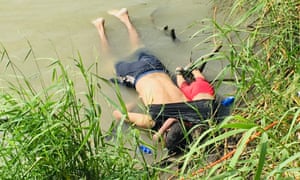
"This is a story about bodies.
A body of water. A river running through mountain, bosque, desert and city; along two pueblos, between two states and separating two countries.
I lived beside a running body of water for a time – this is what I learned: it is impossible to ignore its power. It whispers its summons: cross here. Ford the still points. Wade. Float. Swim. Drown.
Once, many years ago, I heard that after a prolonged torrential rainfall the Rio Grande (Rio Bravo del Norte, to Mexicans) had reached unprecedented levels. Its floodwaters swept through a riverfront church, pulled a large wooden cross from the wall and carried it on its current. A woman who had camped out on the Mexican side of the river with her two children, waiting to cross into the US, saw the dark shape in the water. Before it surged past her, she pushed her children into the river, toward it. “Hold on,” she said. “Hold on to it until you reach the other side.”
Maybe she believed they would be borne above the waters by faith. Maybe she so despaired of their survival on her side of the river she was willing to chance it. Maybe someday she might stop replaying the exact moment when she let go of their hands in the water.
You cannot step into the same river twice, but you can step into the same story again and again and again. A story of desperate need and desperate hope that drives people to risk everything in uncertain and unfamiliar waters.
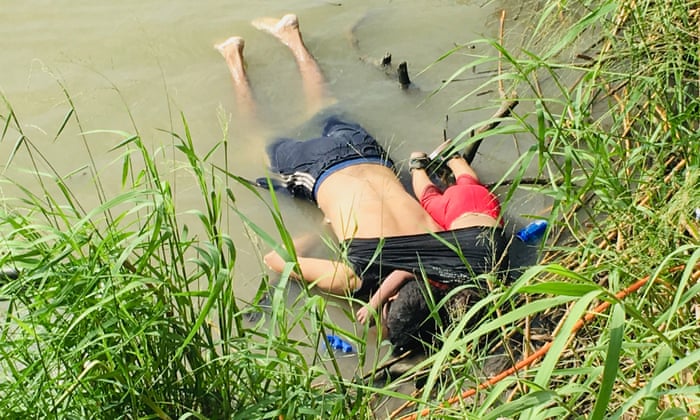
On Monday, Valeria Martínez, a two-year-old Salvadoran child, was found drowned in the shallows of the Rio Grande; her father, Óscar Alberto Martínez, 26, by her side. The photo that circulated is as haunting, in its way, as the 2015 photograph of Alan Kurdi, the three-year-old Syrian child whose image – tiny, lifeless, lying face down in the surf in Greece – moved European leaders to re-examine their policies toward migrants.
In this photo, Valeria wears little black sneakers and her red pants show the padded bottom that indicates a diaper beneath. Martínez, face down in the water, has tucked his daughter under his shirt so she won’t be torn away from him in the river. And then there’s this: she clung to him – as I remember my own daughter at that age, clinging to me when I carried her into a hospital, and we were both terrified to death but together, together – because Valeria’s arm is still flung around his neck when they are found.
This is a story about bodies – but not just Valeria’s body, and Martínez’s.
It is a story about the body politic. About how we, the people of this nation, react to a photo that illuminates the lethal consequences of the manipulation and damage that has been done to the asylum process.
By some accounts Valeria’s family had spent months in Mexico waiting to get on a list that might – no guarantees – enable them to lodge their asylum request at a port of entry. The “metering” and “remain in Mexico” policies that Donald Trump has instituted during his tenure have forced some asylum-seeking families – displaced by the climate crisis or grinding poverty or devastating violence – to try and find another way to have their asylum claim heard in the US, even if it is a risky way, even if it means battling a body of water.
Likewise, the administration’s use of the border patrol – and even active-duty military troops – to physically prevent asylum seekers from reaching ports of entry has had a chilling effect on established asylum processes.
Organizations like Human Rights First have proposed a “genuine humanitarian response” to the asylum crisis the administration has created: deploying Customs and Border Protection (CBP) officers to ports of entry to assist in asylum processing, appointing more immigration judges and interpreters, along with making immigration courts independent, among other solutions. Other NGOs and agencies used to dealing with refugee and asylee needs from a trauma-informed and humanitarian perspective probably have suggestions and potential solutions, too. And from these we may be able to establish a roadmap that is less oppressive than the one proposed by this administration.
Years ago, when I was envisioning the immigration dystopia that would become my novel Ink, I needed to create a “catalyst” moment, when the public at large became aware of what was happening in the novel’s universe in the same sort of way my protagonists were experiencing it. After a lot of dithering, I finally settled on a photograph of a child as that catalyst, and as it was shared and reshared by news sites and individuals alike, it became a proof and test of my proxy world’s humanity.
I have thought about that a lot in the past two years, as I’ve seen people stirred to action by the photographs of immigrant children separated from their parents by CBP and ICE. And now too, with this photo of Valeria and her dad.
What will the body politic do with the evidence before it?
I hope the answer is that we, as the recently coined hashtag says, will not look away. Because if we do, we will be haunted by more than just a photograph.
- Sabrina Vourvoulias is the author of Ink (Rosarium Publishing, 2018), a near-future immigration dystopia, and is the editor of Generocity.org, a Philadelphia social impact news and event group"
Tuesday, June 25, 2019
Opinion | Trump’s ‘Concentration Camps’

"By Charles M. BlowJune 23, 2019
I have often wondered why good people of good conscience don’t respond to things like slavery or the Holocaust or human rights abuse.
Maybe they simply became numb to the horrific way we now rarely think about or discuss the men still being held at Guantánamo Bay without charge or trial, and who may as well die there.
Maybe people grow weary of wrestling with their anger and helplessness, and shunt the thought to the back of their minds and try to simply go on with life, dealing with spouses and children, making dinner and making beds.
Maybe there is simply this giant, silent, cold thing drifting through the culture like an iceberg that barely pierces the surface.
I believe that we will one day reflect on this period in American history where migrant children are being separated from their parents, some having been kept in cages, and think to ourselves: How did this happen?
Why were we not in the streets every day demanding an end to this atrocity? How did we just go on with our lives, disgusted but not distracted?
Thousands of migrant children have now been separated from their parents.
As NBC News reported in May:
“At least seven children are known to have died in immigration custody since last year, after almost a decade in which no child reportedly died while in the custody of U.S. Customs and Border Protection.”
Homeland Security’s own inspector general has described egregious conditions at detention facilities.
And, last week, an attorney for the Trump administration argued before an incredulous panel of judges on the Ninth Circuit that toothbrushes, soap and appropriate sleeping arrangements were not necessary for the government to meet its requirement to keep migrant children in “safe and sanitary” conditions.
As one of the judges asked the attorney:
“Are you arguing seriously that you do not read the agreement as requiring you do something other than what I described: Cold all night long. Lights on all night long. Sleep on the concrete floor and you get an aluminum blanket?”
Stop and think about that. Not only do these children in question not have beds, they are not even turning off the lights so that they can go to sleep. Sleep deprivation is a form of torture, plain and simple.
How is this happening? Why is this happening?
An Associated Press report last week discussed the descriptions by lawyers of “inadequate food, water and sanitation for the 250 infants, children and teens” at a Texas border patrol station.
According to the report:
“A 2-year-old boy locked in detention wants to be held all the time. A few girls, ages 10 to 15, say they’ve been doing their best to feed and soothe the clingy toddler who was handed to them by a guard days ago.”
The report explained at another point:
“Three girls told attorneys they were trying to take care of the 2-year-old boy, who had wet his pants and had no diaper and was wearing a mucus-smeared shirt when the legal team encountered him.”
The report described at another point:
“A 14-year-old girl from Guatemala said she had been holding two little girls in her lap. ‘I need comfort, too. I am bigger than they are, but I am a child, too,’ she said.”
Anyone whose heart doesn’t break upon reading that is a monster. And yet, too many Americans seem perfectly O.K. with these conditions. Last year, Fox News’s Laura Ingraham compared child detention centers to “summer camps.” These are not summer camps. They are closer to what Representative Alexandria Ocasio-Cortez called them: concentration camps.
She received quite a bit of blowback for that description, her critics complaining that the term was too closely tied to the ghastly horrors of the Holocaust.
No one wants to be accused of invoking Godwin’s law: “As an online discussion continues, the probability of a reference or comparison to Hitler or the Nazis approaches 1.” In other words, 100 percent.
However, last week MSNBC anchor Chris Hayes wrote on Twitter:
“Last comment on this: ‘concentration camp’ is an extremely charged term and I get why many people are, in good faith, uncomfortable with its application for Godwin’s Law purposes among others. So let’s just call them “detention camps” and focus on what’s happening in them.”
The creator of the law himself, Mike Godwin, responded:
“Chris, I think they’re concentration camps. Keep in mind that one of their functions by design is to punish those individuals and families who are detained. So even the “charged” term is appropriate.”
Folks, we can use any form of fuzzy language we want, but the United States under Donald Trump is currently engaged in an unconscionable act. He promised to crack down on immigrants and yet under him immigrants seeking asylum have surged. And he is meeting the surge with indescribable cruelty.
Donald Trump is running concentration camps at the border. The question remains: what are we going to do about it?"
Opinion | Trump’s ‘Concentration Camps’
Subscribe to:
Posts (Atom)