Contact Me By Email

Contact Me By Email

Thursday, August 01, 2024

As Republicans Attack Harris on Immigration, Here’s What Her Record Shows

Trump Remarks on Harris Evoke a Haunting and Unsettling History

“White America has long sought to define racial categories — and who can belong to them.

Kamala Harris stops on the tarmac to wave, surrounded by at least five Secret Service agents.
Vice President Kamala Harris on Wednesday in Houston, where she spoke at a prominent Black sorority’s gathering.Erin Schaff/The New York Times

By Lisa Lerer and Maya King

Lisa Lerer reported from New York and Maya King reported from the National Association of Black Journalists’ conference in Chicago.

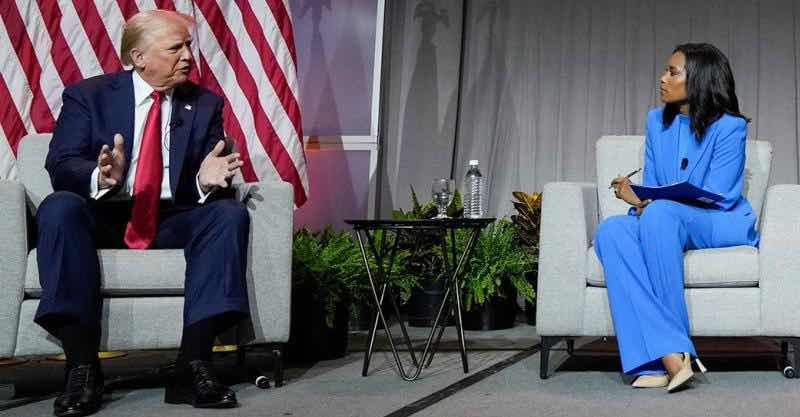
The audience of Black journalists was prepared for a combative exchange well before Donald J. Trump took the stage on Wednesday for an interview at their annual gathering in Chicago.

Yet when Mr. Trump, just minutes in, began questioning Vice President Kamala Harris’s racial identity, there was an instant ripple of reaction — a low rumble that grew into a roar of disapproval.

“I didn’t know she was Black until a number of years ago when she happened to turn Black and now she wants to be known as Black. So I don’t know, is she Indian or is she Black?” Mr. Trump said of Ms. Harris, whose mother was Indian American and whose father is Black.

The moment was shocking, but for those who have followed Mr. Trump’s divisive language, it was hardly surprising. The former president has a history of using race to pit groups of Americans against one another, amplifying a strain of racial politics that has risen as a generation of Black politicians has ascended.

The audacity of Mr. Trump, a white man, questioning how much a Black woman truly belongs to Black America was particularly incendiary.

And it evoked an ugly history in this country, in which white America has often declared the racial categories that define citizens, and sought to determine who gets to call themselves what.

“Give me a break,” said Fred Sweets, a contributing editor at The St. Louis American who watched the discussion from the third row. “He seemed to be denigrating her background. She knows who she is.”

Ms. Harris has embraced her dual racial identities. She has long identified as Black and was shaped by several Black institutions. She graduated from Howard University, a historically Black university in Washington, D.C., and there joined Alpha Kappa Alpha, the nation’s oldest Black sorority. She has spoken extensively about growing up in what she described as a Black community in Berkeley, Calif.

“She had two Black babies, and she raised them to be two Black women,” Harris told The New York Times in a 2016 interview about her mother.

On Wednesday evening, Ms. Harris responded to Mr. Trump’s comment at an event hosted by one of the nation’s most prominent Black sororities, saying they showed “divisiveness and disrespect.”

“The American people deserve a leader who tells the truth,” she said, making no direct reference to Mr. Trump’s personal attacks. “We deserve a leader who understands that our differences do not divide us — they are an essential source of our strength.”

Attacks on Ms. Harris’s racial background have circulated among right-wing figures and Mr. Trump’s close allies for years.

In 2019, Donald Trump Jr. shared a social media post from an alt-right personality that falsely claimed Ms. Harris was not Black enough to be discussing the plight of Black Americans during a primary debate. Though Mr. Trump later deleted the post, it spread widely across conservative social media, prompting a wave of accounts to question her background, which was exactly the point of the effort, according to some far-right activists.

But the Republican nominee’s remarks on Wednesday were perhaps the most overt attack on her identity yet and seemed to be an effort to inject the fringe idea into the mainstream conversation about her bid.

“We’re saying this is shocking. He’ll probably put this in an ad saying how he went to talk to ‘the Blacks’ and how courageous that was,” said Cliff Albright, a liberal organizer and a co-founder of Black Voters Matter. “They’ll eat it up. He gets more out of this than we get out of it.”

Like many of Mr. Trump’s more provocative statements, the comments conveyed several unsettling ideas at once, all of them somewhat open to interpretation: He implied Ms. Harris was deceiving voters and selecting an identity for political gain. He suggested to the predominantly Black audience that she was not one of them — and to Indian Americans listening that she abandoned them, an assertion echoed by the onetime Republican presidential candidate Vivek Ramaswamy on Wednesday.

“Kamala leaned into her Indian heritage when it was convenient in California,” Mr. Ramaswamy wrote on X. “She’s now casting that aside & leaning into black identity when it’s convenient nationally.”

And by calling attention to her background, Mr. Trump seemed to be relying on an old political tactic of exoticizing nonwhite candidates.

Former President Barack Obama — the biracial son of a white mother and Black father — faced similar attacks.

For years, Mr. Trump and other Republicans spread conspiracy theories about Mr. Obama’s racial heritage with innuendo and lies about the authenticity of his birth certificate.

“Was it a birth certificate? You tell me,” Mr. Trump said in 2012, years before running to replace Mr. Obama in the White House. “Some people say that was not his birth certificate. Maybe it was, maybe it wasn’t. I’m saying I don’t know. Nobody knows.”

Mr. Obama’s citizenship was never in any doubt, as he had proved by releasing his entire birth certificate a year earlier. But Mr. Trump’s accusations were aimed at stoking suspicions and fears among white supporters who were all too eager to believe that Mr. Obama was born in Africa.

Throughout 2011, when he was first considering a foray into presidential politics, he repeated the lie about Mr. Obama over and over again, in tweets, speeches and interviews. He hinted at a conspiracy to cover up the truth and he repeatedly brushed aside evidence to the contrary, including the actual birth certificate. And it was effective, to a degree that stunned even Mr. Trump’s political advisers: His popularity among hard-core Republican voters soared.

On Wednesday, Mr. Trump seemed to see similar political opportunities in the moment. In the hours after he questioned Ms. Harris’s identity, he repeated the claim in a Truth Social post. A headline noting Ms. Harris was California’s “first Indian American U.S. Senator” was projected on a large screen above the stage at his Pennsylvania rally on Wednesday evening.

And across social media platforms, Trump supporters circulated questions about whether her race was mentioned on her birth certificate — a throwback to the attacks they once leveled against Mr. Obama.

Yet, with Ms. Harris, such attacks could land differently. Mr. Obama ran as a candidate whose success would signal the arrival of a post-racial America. In her first presidential campaign in 2019, Ms. Harris announced her candidacy on the holiday of Martin Luther King’s Birthday, and ran as an heir to Shirley Chisholm, the first woman to seek the Democratic presidential nomination.

In addition, Mr. Obama, the son of a white, Midwestern mother and Kenyan father, who grew up in Hawaii and Indonesia, hit fewer of the Black cultural touch points than Ms. Harris.

“Obama’s background was a little unusual so people had to remind themselves that there are 55 million ways to Black in America,” said Andra Gillespie, an associate professor of political science at Emory University, who specializes in Black politics.

“I don’t think that anybody has ever questioned her embrace of her Black identity in the same way.”

Michael D. Shear contributed reporting from Washington and Marc Lacey from Chicago.

Lisa Lerer is a national political reporter for The Times, based in New York. She has covered American politics for nearly two decades. More about Lisa Lerer

Maya King is a politics reporter covering the Southeast, based in Atlanta. She covers campaigns, elections and movements in the American South, as well as national trends relating to Black voters and young people. More about Maya King“

The Threat of More War

The Threat of More War

“We examine the contradictions in the Middle East.

A crowd of people hold their arms up and display signs with pictures of Ismail Haniyeh.
Pictures of Ismail Haniyeh at a rally in Tehran yesterday.Arash Khamooshi for The New York Times

This week was supposed to bring a rare moment of amity in the Middle East. Iran inaugurated a new president, and its regional rival, Saudi Arabia, dispatched a royal to Tehran with a jovial letter from its king, sending his best wishes. The United Arab Emirates, attacked by the Iranian-backed Houthis just two years ago, published photos of its smiling foreign minister shaking hands with Iranian officials. And a White House spokesman had said that a cease-fire deal in Gaza was “close.”

Instead, the region now seems to be even further away from peace. Yesterday, Iran and Hamas accused Israel of killing Ismail Haniyeh, one of the most senior leaders of Hamas, while he was in Tehran. (Haniyeh was Hamas’s lead negotiator in cease-fire talks to end the Gaza war, which began with the Oct. 7 attacks.) The day before, Israel killed a leader of Hezbollah in Beirut after a rocket launched from Lebanon had killed 12 children in Israeli-occupied territory.

Diplomats around the world are telling these parties to keep a lid on it. And the groups themselves say they do not want a wider regional war. Israel’s defense minister repeated the message on Wednesday. Iran has said the same thing, and so has Hezbollah. (Hamas has said it wants a wider war, but it is depleted from nearly 10 months of conflict in Gaza.)

Yet the violence persists, as each party claims its attacks are reactions to previous ones. That’s why, in the span of a few months, Israeli bombs have hit Lebanon, Syria, Iran and Yemen. It’s why Hezbollah and Houthi fighters have repeatedly targeted Israel (and also ships passing through the Red Sea, disrupting global trade). It’s why American airstrikes have pummeled Yemen for nearly seven months.

The reality

When I speak to sources in the Middle East, they often struggle to process this contradiction. To them, the calls for peace during what already looks like a regional war can sound strange. Bader Al-Saif, a historian at Kuwait University, lamented “the amount of denialism surrounding this basic fact.” Pretending as if the actual conflict is yet to arrive, he said, risks “normalizing death, violence, fear, dispossession, hunger and lack of dignity across the Middle East.”

True, de-escalation may be wanted — and it may even be possible. Analysts say that Iran and Hezbollah, despite vengeful rhetoric, could keep their responses measured. Israeli assassinations abroad are nothing new, and some top Israeli generals believe a truce, not more war, would free captives still held by Hamas. Israel could seek to limit its response to any counterattack by Iran. Antony Blinken, the U.S. secretary of state, said yesterday that he was still intent on reaching a cease-fire in Gaza.

But recent events suggest that peace is not close. Hezbollah has been launching regular rocket attacks since Oct. 7. Israel continues a military campaign that has killed nearly 40,000 Palestinians, according to the Gaza health ministry — even as its allies push for it to make a cease-fire deal. Haniyeh’s assassination is a blow to Hamas, but it is unlikely to truly destabilize it. And Israeli strikes against a port controlled by the Houthi militia, which attacked Tel Aviv by drone last month, are likely to worsen Yemen’s humanitarian crisis.

A stalemate?

After the Haniyeh strike, Qatari officials — who help moderate Gaza peace talks — threw up their hands. “How can mediation succeed when one party assassinates the negotiator on the other side?” the Qatari prime minister, Mohammed bin Abdulrahman Al Thani, wrote on social media.

Israel suggests that it, too, feels locked in a cycle of violence. Prime Minister Benjamin Netanyahu said on Wednesday that Israel faced threats “from everywhere” and said that he refused to “surrender” to voices telling him simply to “end the war.”

It’s sensible for diplomats around the world to insist on peace and restraint. Combatants do often put their grudges aside; that’s how wars end. But there’s another possible future, too. In that scenario, enmities between Israel and its neighbors are growing only deeper. Officials and scholars I’ve spoken to say they worry that an entire generation could be radicalized by the current war. The events of this week won’t help.

More on the Middle East

THE LATEST NEWS

Trump Interview

Donald Trump Akilah Townsend for The New York Times
  • Donald Trump, in a contentious interview at a conference for Black journalists, questioned Kamala Harris’s racial identity and suggested falsely that she only recently began to identify as Black.

  • Harris, the daughter of an Indian American mother and Jamaican father, has consistently identified as Black in public life. She went to a historically Black college. Read a fact check.

  • Trump repeatedly chided one of the reporters on the panel, Rachel Scott of ABC News, as “rude” and “nasty” for reading a list of his past comments about Black people. Watch a video recap.

More on the 2024 Election

  • The United Automobile Workers union endorsed Harris after initially withholding its support so it could assess her approach to manufacturing jobs and the war in Gaza.

  • A group of pro-Palestinian activists are trying to derail Gov. Josh Shapiro’s nomination as Harris’s running mate. They see Shapiro, an observant Jew, as a face of support for Israel.

  • Trump has tried to distance himself from Project 2025, a contentious set of conservative policy proposals. But JD Vance’s contribution to a book by the project’s chief architect has made that complicated.

International

Outside a voting station in Venezuela. Marian Carrasquero for The New York Times

Climate

Other Big Stories

Opinions

As we did yesterday, we are sharing entries from a project in which columnists write about one thing they think everyone else gets wrong.

People hate on the D.M.V., but it’s great, Tressie McMillan Cottom argues.

Some people think what you preach matters more than what you do. It doesn’t,David French argues.

We should accept that we can all be hypocritical, Lydia Polgreen argues.

In Idaho.Sasha Arutyunova for The New York Times

Art of craft: This cowgirl’s saddles are beautiful. If you’d like one, the wait list is around six years.

Near death: After a couple were swept away while diving and spent days drifting at sea, they were rescued. Their first meal was a pastrami sandwich.

Fast asleep: How much do you know about dreams? Take our quiz.

Social Q’s: “Can I confront the woman who stole my late sister’s evening gowns?”

Most clicked in July: See the 100 best books of the 21st century so far.

Lives Lived: Alma Powell was a quiet force alongside her husband, Colin Powell, the military general, secretary of state and national security adviser. She played a crucial role in his decision not to run for president in 1996. She died at 86.

Katie LedeckyChang W. Lee/The New York Times

Swimming: Wins by Team USA’s Katie Ledecky and France’s Léon Marchand headlined a night worthy of Olympic lore.

Soccer: The Canadian women’s team, despite its steep penalty for using drones to spy on opponents, reached the quarterfinals with a win over Colombia.

Basketball: The U.S. men’s team advanced to the quarterfinals after defeating South Sudan.

Tennis: Rafael Nadal and Carlos Alcaraz of Spain lost to the American doubles specialists Rajeev Ram and Austin Krajicek. Read a recap.

Still watching: For the first time in four decades, Russia, which is banned from the Games, isn’t airing the competition. But Russians are finding ways to tune in, The Wall Street Journal reports.

Dance lessons: A dressage rider explains how she and her horse, Jagerbomb, made it to the Olympics.

Surfing: The competition is being held in the waters off Teahupo’o, Tahiti. Residents are still suffering the effects of a French nuclear test that poisoned the village in the 1970s.

Today: Simone Biles goes for more gold. There’s also golf, swimming and tennis.

ARTS AND IDEAS

Influencers in China.Sun Kissed Bucket List and World Nomac, via YouTube

Travel vlogs from foreigners visiting China are finding large audiences on YouTube and Instagram. But they’re even more popular in China, where the videos go viral and the creators are interviewed in state media. For China, the vlogs do more than encourage tourism: They counter what many see as an anti-China sentiment in the West.

More on culture

A scene from “The Matrix.”Ronald Siemoneit/Sygma, via Getty Images

THE MORNING RECOMMENDS …

Bryan Gardner for The New York Times.

Pair the spicy flavors of mapo tofu with the creaminess of scrambled eggs.

Stream the best in Black cinema.

Eat at the 25 best restaurants in Los Angeles.

See the cardboard beds Olympic athletes are sleeping on.

GAMES

Here is today’s Spelling Bee. Yesterday’s pangram was inclemency.

And here are today’s Mini Crossword, Wordle, Sudoku, Connections and Strands.


Thanks for spending part of your morning with The Times. See you tomorrow.

Sign up here to get this newsletter in your inbox. Reach our team at themorning@nytimes.com.

Vivian Nereim is the lead reporter for The Times covering the countries of the Arabian Peninsula. She is based in Riyadh, Saudi Arabia. More about Vivian Nereim”

Wednesday, July 31, 2024

Donald Trump falsely suggests Kamala Harris ‘happened to turn Black’

Donald Trump falsely suggests Kamala Harris ‘happened to turn Black’


(Trump is so stupid he does not know that Howard University is a Black college and Alpha Kappa Alpha is a Black sorority)

CNN  — 


“Former President Donald Trump falsely claimed Wednesday that his 2024 Democratic rival, Vice President Kamala Harris, “happened to turn Black” a few years ago, saying that “all of a sudden, she made a turn” in her identity.

Trump’s comments at a gathering of Black journalists in Chicago came when an interviewer asked him whether he agreed with Republicans on Capitol Hill who have characterized Harris as a “DEI hire.” Trump responded by questioning Harris’ heritage.

“She was always of Indian heritage, and she was only promoting Indian heritage. I didn’t know she was Black until a number of years ago, when she happened to turn Black, and now she wants to be known as Black. So I don’t know, is she Indian or is she Black?” the former president said.

“I respect either one, but she obviously doesn’t, because she was Indian all the way, and then all of a sudden she made a turn and she went – she became a Black person,” he said at the National Association of Black Journalists convention. “I think somebody should look into that too.”

Trump’s comments are reminiscent of his similar attacks on Black political rivals in the past, including the years he spent pushing the false, racist “birther” conspiracy theory that former President Barack Obama was not born in the United States.

Harris’ mother was Indian and her father is Jamaican; both immigrated to the United States. Harris was born in Oakland, California, and attended a historically Black university, Howard University, in Washington. She is the first female, first Black and first Asian American vice president.

Trump on Wednesday was interviewed by a panel that included ABC News’ Rachel Scott, Semafor’s Kadia Goba and Fox News’ Harris Faulkner.

Scott began the interview by asking Trump: “You have pushed false claims about some of your rivals, from Nikki Haley to former President Barack Obama, saying that they were not born in the United States, which is not true. You have told four congresswomen of color, who were American citizens, to go back to where they came from. You have used words like ‘animal’ and ‘rabid’ to describe Black district attorneys. You have attacked Black journalists, calling them a ‘loser,’ saying the questions they ask are, quote, ‘stupid’ and ‘racist.’ You’ve had dinner with a White supremacist at your Mar-a-Lago resort. So my question, sir – now that you are asking Black supporters to vote for you, why should Black voters trust you after you have used language like that?”

A combative Trump responded: “Well, first of all, I don’t think I’ve ever been asked a question so – in such a horrible manner, first question. You don’t even say, ‘Hello. How are you?’”

Trump goes after Black journalists conference moderator

02:38 - Source: CNN

He asked Scott if she was with ABC, saying the network was “a fake news network” and “a terrible network.”

“I think it’s disgraceful that I came here in good spirit. I love the Black population of this country. I’ve done so much for the Black population of this country, including employment, including opportunity zones with Sen. Tim Scott of South Carolina,” the former president said. “I’ve done so much, and, you know, I say this: Historically Black colleges and universities were out of money, they were stone cold broke, and I saved them. I gave them long-term financing, and nobody else was doing it.”

“It’s a very rude introduction. I don’t know exactly why you would do something like that,” Trump said.

Scott asked if Trump found it acceptable that some Republicans on Capitol Hill have referred to Harris as a “DEI hire” – using the acronym for diversity, equity and inclusion.

“I really don’t know. Could be. Could be,” he said.

White House press secretary Karine Jean-Pierre issued a fiery rejoinder to Trump following his remarks at the convention, calling them “repulsive” and “insulting.”

“As a person of color – as a Black woman, who is in this position that is standing before you at this podium, behind this lectern – what he just said, what you just read out to me, is repulsive. It’s insulting, and, you know, no one has any right to tell someone who they are, how they identify,” Jean-Pierre told reporters during a news briefing Wednesday. “That is no one’s right. It is someone’s own decision.”

Harris’ campaign did not specifically respond to Trump’s comment about her racial identity but said the former president “lobbed personal attacks and insults at Black journalists the same way he did throughout his presidency.”

“Donald Trump has already proven he cannot unite America, so he attempts to divide us,” Harris campaign spokesman Michael Tyler said in a statement.

In Chicago on Wednesday, Trump also repeatedly criticized the NABJ for the event’s set-up, which he said made it difficult to hear other panelists and delayed the start of the event. A spokesperson for NABJ told CNN that technology issues had delayed the start of the panel discussion.

Trump in his remarks called himself “the best president for the Black population since Abraham Lincoln,” a comment that drew audible groans from the journalists in attendance. He ignored a follow-up question about whether he was better than Lyndon B. Johnson, who signed the Civil Rights Act of 1964 and the Voting Rights Act of 1965 into law.

“I have been the best president for the Black population since Abraham Lincoln,” he said. “For you to start off a question-and-answer period, especially when you’re 35 minutes late because you couldn’t get your equipment to work, I think it’s a disgrace. I really do, I think it’s a disgrace.”

Daniel Dale fact-checks Trump's claims on Harris' race

02:21 - Source: CNN

Capitol rioters

Asked by Scott Wednesday if he would pardon January 6 rioters who violently attacked police officers at the US Capitol in 2021, Trump said, “Absolutely, I would.”

“If they’re innocent, I would pardon them,” he said.

Scott responded that they had been convicted.

“Well, they were convicted by a very tough system,” Trump said.

The former president criticized Capitol police officers for shooting and killing rioter Ashli Babbitt, who was attempting to crawl through a broken window leading to the Speaker’s Lobby outside the US House chamber. And he complained that “nothing happened” to those who caused property damage during Black Lives Matter protests in the summer of 2020.

“Nothing happens to those people, but you went after the J6 people with a vengeance,” Trump said.

Vance pick

Trump did not answer directly when asked by Fox News’ Faulkner whether his running mate, Ohio Sen. JD Vance, would be “ready on Day One to be president.

“Historically, the vice president, in terms of the election, does not have any impact – I mean, virtually no impact,” Trump said.

“You have two or three days where there’s a lot of commotion,” he said, pointing to Harris’ consideration of a running mate, “and then that dies down, and it’s all about the presidential pick. Virtually never has it mattered.”

“You can have a vice president who’s outstanding in every way, and I think JD is … but you’re not voting that way. You’re voting for the president,” Trump said.

This story has been updated with additional information.

CORRECTION: This story and headline have been updated to correctly reflect Trump’s exact wording of one quote at the NABJ convention in Chicago.

CNN’s Donald Judd and Samantha Waldenberg contributed to this report.“

Hostile Trump takes the stage at Black journalists’ conference


 “He claimed to be the best president for Black people since Abraham Lincoln and suggested Harris used her race to help her get elected.

Beverly White Higgs, a retired broadcaster, said she’s “not surprised with most of what he said,” ticking off Trump’s riffs on HBCUs, abortion and the vice presidential pick. “It’s how he handles business all the time — freestyling with a loose affiliation with the facts,” said Higgs. “I think the three journalists did the best they could. ... He bulldozes journalists, especially Black women journalists.”

Asked if she thought the exchange with reporters was weird, Higgs said: “I think weird understates this man. The racism, the sexism, it’s not weird. It’s awful. Weird is a three-legged dog. This isn’t weird. It’s gross.”

Trump’s appearance at the annual conference had set off a controversy before he even took the stage.

On Tuesday, some Black journalists and others condemned the former president’s invitation to address journalists, decrying that organizers would offer Trump a platform. Others, however, defended the decision, saying it was an opportunity and duty for journalists to interview a presidential candidate regardless of how they felt about the GOP presidential nominee.

NABJ Co-Chair Karen Attiah said she would step down after not being “involved or consulted with in any way.” Femi Redwood, chair of the NABJ’s LGBTQ+ task force, said she was “disturbed” the task force “was not invited into conversations about hosting Trump considering the damage he has caused Black queer and trans people.”

“This is the single dumbest and worst decision in NABJ history,” Carron J. Phillips, a 2019 and 2020 NABJ award winner, wrote Tuesday on X. “Whoever made this call is an idiot. And I’ll say it to their face this week.”

Harrison Fields, a Trump surrogate who served as assistant press secretary in the Trump White House, called the interview a no-win situation for the former president and described the atmosphere as a hostile environment.

“This is consistent with who Trump is,” Fields said. “Trump is going to go to places that aren’t necessarily his comfort zone, but he understands the value of having these conversations.”

Eugene Daniels contributed to this report.“