Contact Me By Email

Contact Me By Email

Tuesday, April 02, 2024

‘Not a normal war’: doctors say children have been targeted by Israeli snipers in Gaza | Israel-Gaza war | The Guardian

‘Not a normal war’: doctors say children have been targeted by Israeli snipers in Gaza

(A truly evil country)

IDF says it ‘completely rejects’ charge that its soldiers deliberately fired on any of the thousands of civilians killed in Israeli offensive
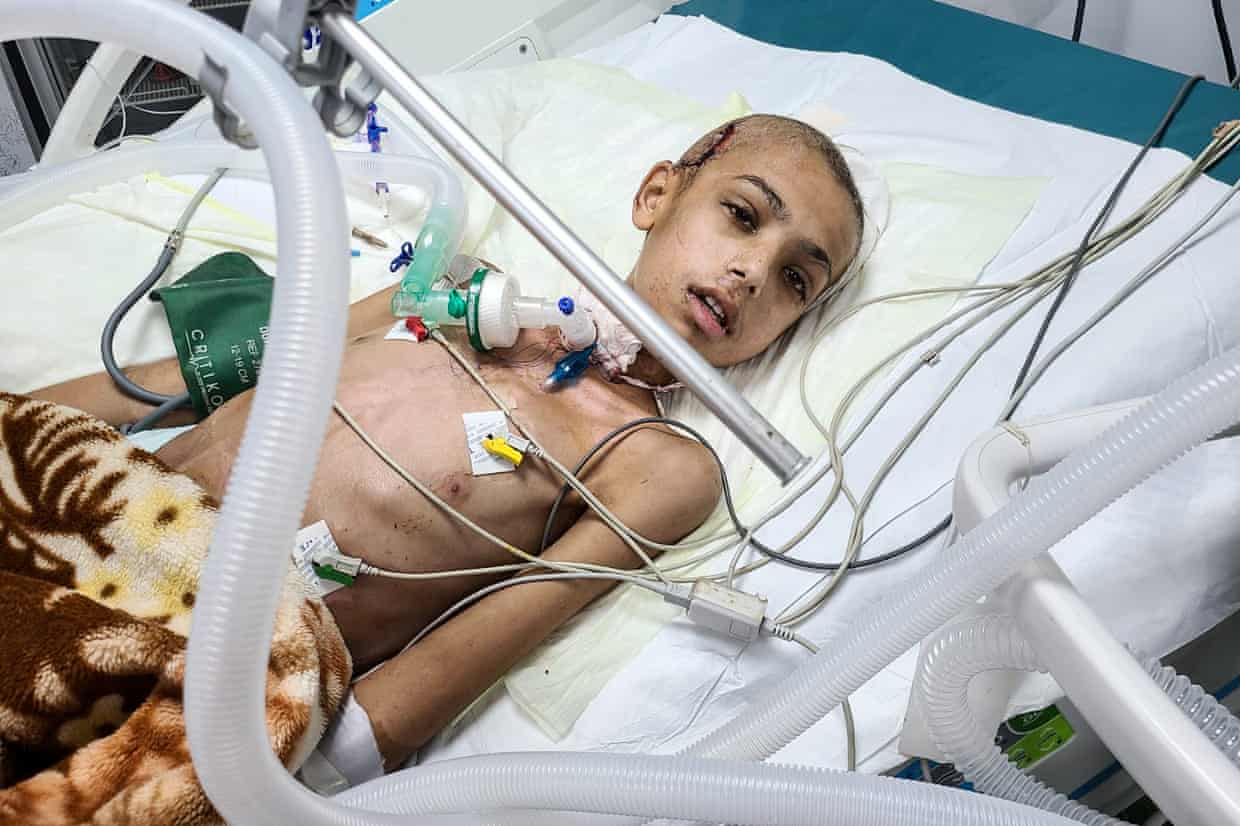
A child recovers in a hospital bed
A child hospitalized with a gunshot wound at the European public hospital near Rafah, Gaza, in February 2024.Photograph: Courtesy of Dr Fozia Alvi

Dr Fozia Alvi was making her rounds of the intensive care unit on her final day at the battered European public hospital in southern Gaza when she stopped next to two young arrivals with facial injuries and breathing tubes in their windpipes.

“I asked the nurse, what’s the history? She said that they were brought in a couple of hours ago. They had sniper shots to the brain. They were seven or eight years old,” she said.

The Canadian doctor’s heart sank. These were not the first children treated by Alvi who she was told were targeted by Israeli soldiers, and she knew the damage a single high-calibre bullet could do to a fragile young body.

“They were not able to talk, paraplegic. They were literally lying down as vegetables on those beds. They were not the only ones. I saw even small children with direct sniper shot wounds to the head as well as in the chest. They were not combatants, they were small children,” said Alvi.

Children account for more than one in three of the more than 32,000 people killed in Israel’s months-long assault on Gaza, according to the Palestinian health ministry. Tens of thousands more young people have suffered severe injuries, including amputations.

A doctor looks at a wounded child in a hospital bed
Dr Fozia Alvi checks in on a child who was shot in Gaza and is receiving care for brain and facial injuries at the European hospital near Rafah. Photograph: Courtesy of Dr Fozia Alvi

Nine doctors gave the Guardian accounts of working in Gaza hospitals this year, all but one of them foreign volunteers. Their common assessment was that most of the dead and wounded children they treated were hit by shrapnel or burned during Israel’s extensive bombardment of residential neighbourhoods, in some cases wiping out entire families. Others were killed or injured by collapsing buildings with still more missing under the rubble.

But doctors also reported treating a steady stream of children, elderly people and others who were clearly not combatants with single bullet wounds to the head or chest.

Some of the physicians said that the types and locations of the wounds, and accounts of Palestinians who brought children to the hospital, led them to believe the victims were directly targeted by Israeli troops.

Other doctors said they did not know the circumstances of the shootings but that they were deeply troubled by the number of children who were severely wounded or killed by single gunshots, sometimes by high-calibre bullets causing extensive damage to young bodies.

In mid-February, a group of UN experts accused the Israeli military of targeting Palestinian civilians who are evidently not combatants, including children, as they sought shelter.

“We are shocked by reports of the deliberate targeting and extrajudicial killing of Palestinian women and children in places where they sought refuge, or while fleeing. Some of them were reportedly holding white pieces of cloth when they were killed by the Israeli army or affiliated forces,” the group said.

The Guardian shared descriptions and images of gunshot wounds suffered by eight children with military experts and forensic pathologists. They said it was difficult to conclusively determine the circumstances of the shootings based on the descriptions and photos alone, although in some of the cases they were able to identify ammunition used by the Israeli military.

Eyewitness accounts and video recordings appear to back up claims that Israeli soldiers have fired on civilians, including children, outside of combat with Hamas or other armed groups. In some cases, witnesses describe coming under fire while waving white flags. Haaretz reported on Saturday that Israel routinely fires on civilians in areas its military has declared a “combat zone”.

The Israel Defense Forces (IDF) deploy snipers – or sharpshooters, as the military calls them – during combat operations, often as part of elite units. They are trained to “target and eliminate particularly difficult terrorist threats”, according to the military’s own definition.

Israeli and foreign human rights groups have documented a long history of snipers firing on unarmed Palestinians, including children, in Gaza and the West Bank.

Palestinians in Gaza also report a terrifying new development in the latest Gaza war – armed drones able to hover over streets and pick off individuals. Called quadcopters, some of these drones are used as remote-control snipers that Palestinians say have been used to shoot civilians.

Doctors care for a patient among bloodstained bandages
Doctors care for a patient at the European hospital near Rafah in February 2024. Photograph: Courtesy of Dr Fozia Alvi

The IDF said it “completely rejects” allegations that its snipers deliberately fire on civilians. It said it cannot address individual shootings “without coordinates of the incidents”.

“The IDF only targets terrorists and military targets. In stark contrast to Hamas’s deliberate attacks on Israeli civilians, including men, women and children, the IDF follows international law and takes feasible precautions to mitigate civilian harm,” it said.

Doctors say otherwise.

Dr Vanita Gupta, an intensive care doctor at a New York City hospital, volunteered at Gaza’s European hospital in January. One morning, three badly wounded children arrived in quick succession. Their families told Gupta that the children had been together in the street when they came under fire and that there had been no other shooting in the area. She said no wounded adults were brought in to the hospital at the same time and from the same place.

“One child, I could see there was a shot to the head. They were doing CPR on this five- or six-year-old girl who obviously died,” said Gupta.

Medical staff perform CPR on a child who was shot in the head.
Medical staff perform CPR on a child who was shot in the head. Photograph: Courtesy Dr Vanita Gupta

“There was another little girl about the same age. I saw a bullet entry wound on her head. Her father was there, crying and asking me, ‘Can you save her? She’s my only child.’”

Gupta said that a third young child also had a shot to the head and was sent for a CT scan.

“The neurosurgeon looked and said, ‘There’s no hope.’ You could see the bullet had gone through the head. I don’t know how old he was, but young,” she said.

Family members told Gupta that the Israeli army had withdrawn from the area about four kilometres from the hospital.

“They said people started returning to their homes because the army was gone. But the snipers stayed on. The families said they opened fire at the children,” she said.

Doctors who worked at the Nasser hospital in southern Gaza said what appeared to be targeted Israeli fire killed more than two dozen people, including children, as they entered or left the hospital in the first weeks of this year.

Among the casualties was 14-year-old Ruwa Qdeih. Doctors say she was shot dead outside the hospital in Khan Younis as she went to collect water. They said there was no fighting in the area at the time and that she was killed by a single shot and then men who went to recover her body were also shot at.

In Gaza City, three-year-old Emad Abu al-Qura was shot outside his home as he went to buy fruit with his cousin, Hadeel, a 20-year-old medical student, who was also killed. The family said they were targeted by an Israeli sniper.

A video of the pair lying together in the street shows Emad still alive after he is first hit and trying to lift his head. More shots hit the ground close by including one that strikes a plank next to Emad. The boy’s mother said he was then hit again and this time killed.

Hadeel’s father, Haroon, saw the shooting.

“The targeting of civilians is very clear. It is a deliberate direct targeting aimed at killing civilians without reason, without there being any events, without there being any resistance. They deliberately killed Hadeel and Emad,” he told Al Jazeera.

Other young victims include 14-year-old Nahedh Barbakh, who was hit by sniper fire alongside his 20-year-old brother, Ramez, as they followed Israeli military orders to evacuate an area west of Khan Younis in late January, according to the Geneva-based Euro-Med Human Rights Monitor.

People walk in a group along a road
Palestinian families flee Khan Younis on 22 January. Photograph: Majdi Fathi/NurPhoto via Getty Images

According to a witness interviewed by Euro-Med Monitor, Nahedh was carrying a white flag to lead the way for his family, but after walking just a few steps from the house he was hit in the leg by a bullet. As the teenager attempted to turn back home he was shot in the back and head, the witness said.

Ramez was shot through the heart when he tried to rescue his brother.

The family decided it was too dangerous to recover the bodies and eventually fled the area, leaving the brothers still lying in the street. A last photograph shows Ramez stretched across Nahedh’s body with the white flag tangled between them.

Witnesses said the shots came from the rooftop of a nearby building taken over by Israeli soldiers.

A new threat

In December, the Palestine Red Crescent Society said that 13-year-old Amir Odeh was killed by an Israeli drone at its headquarters in the Al-Amal hospital in Khan Younis. The family told Euro-Med Monitor he was shot through a window as he played with his cousins on the eighth floor of building where they had sought shelter from the fighting. The killing was especially notable because the single shot to the chest came from a type of drone not seen in combat in Gaza before – a quadcopter, fitted with a gun, camera and speaker. Unlike some other drones, quadcopters are able to hover over their targets.

Dr Thaer Ahmad, a Chicago doctor who volunteered in Nasser hospital’s emergency room, said quadcopters sometimes appeared in swarms, giving orders to Palestinians to clear an area.

“We heard an incredible amount of stories from people recovering from injuries from these quadcopters firing bullets from the sky,” he said.

Ahmad said that on one occasion a drone shot one of the hospital’s doctors in the head, although he survived.

Dr Ahmed Moghrabi described on Instagram “hundreds” of quadcopters descending on the Nasser hospital in the third week of February and ordering people to evacuate the compound before killing a number of them. On another occasion, he filmed quadcopters giving instructions to Palestinians to leave the area.

Although the Israeli military has previously deployed quadcopters for intelligence gathering, this appears to be the first time that versions of the drone able to fire guns have been used against the Palestinians.

Prof Ghassan Abu-Sittah, a British-Palestinian surgeon and who was recently elected rector of the University of Glasgow, told Mondoweiss, a leftwing Israel-Palestine news site, that working at the Al-Ahli hospital in Gaza City “we were getting a lot of people shot by these quadcopters, these drones that have sniper guns attached to them”.

Abu-Sittah, who has operated on Palestinians wounded by Israeli sharpshooters during visits to Gaza in earlier years, described the quadcopters as firing “single high-velocity” shots.

“We have received over 20 chest and neck gunshot wounds fired from Israeli Quadcopter drones. This is a low flying sniper drone,” he wrote on X.

A drone drops teargas canisters
An Israeli quadcopter drone drops teargas canisters during a demonstration in Gaza marking the 70th anniversary of the Nakba, on 15 May 2018. Photograph: Said Khatib/AFP via Getty Images

Quadcopter killings documented by Euro-Med Monitor include two children shot dead on 21 January when drones opened fire at al-Aqsa University near Khan Younis, where thousands of displaced Palestinians were sheltering. The following month, a drone shot dead Elyas Abu Jama, a 17-year-old whose family said had mental and physical disabilities, outside his tent in a Rafah displaced-persons camp. Euro-Med Monitor said that on the same day, a quadcopter killed 16-year-old Mahmoud al-Assar and his 21-year-old sister, Asmaa.

Thaer Ahmad spent three weeks at the Nasser hospital in January as a volunteer with the medical charity MedGlobal. Normally he works at a trauma centre on Chicago’s south side, where he regularly deals with gunshot wounds.

“I did more trauma procedures on paediatric patients in the three weeks that I was at Nasser than I did in the 10 years that I’ve been practising in the US,” he said.

The doctor said he treated five children he believes were shot by snipers because the placing of the bullets suggested they were not hit randomly but targeted.

“They were mostly shot in the thorax, the chest area, some in the abdomen. There was one boy shot in the face. As a result he had a shattered jaw. There were two children who had been shot in the chest, young, under the age of 10, who did not survive. Two others, one shot in the abdomen, did survive. They were still recovering in the hospital when I left,” he said.

Ahmad noted the children were often shot by “one large-calibre bullet” which could produce devastating wounds.

A doctor cares for a child
Dr Fozia Alvi cares for a child at the European hospital near Rafah, Gaza, in February 2024. Photograph: Courtesy of Dr Fozia Alvi

Dr Irfan Galaria, a surgeon based in Virginia, slept on the operating room floor of the European hospital between shifts as a volunteer in January. He too saw children badly wounded by high-calibre bullets.

Galaria said that a 14-year-old boy arrived at the hospital who had been shot once through the back. When surgeons operated they found a bullet in the boy’s stomach.

“He was very lucky because it missed a lot of the vital organs but it was just sitting in his abdomen,” he said.

The surgeon took a photo of the bullet which former IDF soldiers who spoke with the Guardian identified as a powerful .50 calibre round typically fired from a machine gun mounted on an armoured vehicle, although it has also been used in sniper rifles. They said that vehicle-mounted guns often have advanced sighting systems that allow them to target shots but that large numbers of .50 rounds could be fired without precision targeting, making it difficult to establish whether the child was targeted.

Other bullets recovered from young Palestinians include 5.56mm rounds that are standard issue for all IDF infantry rifles but also used by marksmen attached to all infantry units.

Gupta provided the Guardian with CT scans of children with head wounds. These included one of an eight-year-old girl that a pathologist described as showing a “gunshot wound to the head entering right side with bullet in brain (medial right temporal lobe)”.

A brain scan shows a bullet lodged in the skull of an 8-year-old Palestinian girl.
A brain scan shows a bullet lodged in the skull of an 8-year-old Palestinian girl. Photograph: Courtesy Dr Vanita Gupta

Although doctors were shocked at the number of child victims, they said they believed the shootings were part of a broader pattern of targeting Palestinian civilians, including elderly people.

“The vast majority of people we saw were not combatants,” said Ahmad. “There was an elderly woman who was on the back of a donkey cart when she was shot. The bullet lodged in her spine and she was paralysed from the waist down and also her lung collapsed. She was somewhere between 60 and 70 years old.”

‘Sniper wounds were common’

Dr Osaid Alser helped organise a group of doctors outside Gaza to give long-distance guidance to the only Palestinian general surgeon remaining at Nasser hospital, who only had limited experience.

“Sniper wounds were common, and quadcopter gunshots as well,” said Alser, who grew up in Gaza City and now lives in Texas.

Doctors said that apparent sniper shots also account for numerous amputations and long-term disabilities, made all the worse in children because a bullet often causes more damage to small bodies.

Alser argued that it was often possible to distinguish sniper shots.

“When it’s a sniper, usually it’s a bigger bullet, which causes significantly more damage and has more shock-wave energy as compared to a smaller rifle or a pistol. If it’s a sniper, it may cause amputation of the limb because it will cause damage to the vascular structure – nerves, bone, soft tissue, everything,” he said.

“Another pattern is injury to the spinal cord when people are shot in the middle of the abdomen or in the middle of the back. Spinal cord injury is not necessarily fatal, unless it’s the neck, but it can be disabling.”

Patients lie on the floor of a hospital
Patients at the European hospital near Rafah, Gaza, in February 2024. Photograph: Courtesy of Dr Fozia Alvi

Alser said that one of his elderly relatives, a pioneer of dentistry in Gaza, was among the apparent victims of a sniper.

Dr Mohammed Al Madhoun went missing after seeking medical treatment for a chronic condition at a charity hospital west of Gaza City in December. The 73-year-old’s body was found near the hospital a week later alongside that of his great-nephew. They had both been shot.

“The pattern of injury, and the amount of damage from the bullet, was significant, and that’s mainly caused by a sniper,” said Alser, who reviewed CT scans of the injury. “He was obviously old. You wouldn’t expect a 73-year-old to be a target, right?”

The doctor said the cases he reviewed remotely included other elderly people, among them a woman in her 70s.

“She was shot by a sniper and she had a massive head bleed. That is non-survivable. She died a day or two after,” he said.

In October, Israel’s prime minister, Benjamin Netanyahu, described the IDF as “the most moral army in the world”. The Israeli military claims to be guided by a “purity of arms” doctrine that precludes soldiers from harming “uninvolved civilians”.

But Israeli and international human rights groups have long said that the military’s failure to enforce its own standards – and its willingness to cover up breaches – has contributed to a climate of impunity for soldiers who target civilians.

The groups say it is extremely difficult at this stage to quantify the scale of such shootings in Gaza, not least because their own staff are often displaced and under attack. But Miranda Cleland of Defense for Children International Palestine said that over the years there had been a “clear pattern of Israeli forces targeting Palestinian children with deadly force in situations where the children posed no threat to soldiers”.

“In the occupied West Bank, Israeli soldiers routinely shoot children in the head, chest or abdomen, all areas from which a child will quickly bleed out if they aren’t killed instantly. Many of these children are shot by Israeli forces from great distances, sometimes upwards of 500ft, which is something only a trained military sniper would be capable of,” she said.

An Israeli group, Breaking the Silence, collected testimonies from IDF soldiers in earlier conflicts who said they shot Palestinian civilians merely because they were where they were not supposed to be even though it was evident they were not combatants.

IDF snipers boasted about shooting unarmed Palestinian protesters, including young people, in the knees during nearly two years of demonstrations at the Gaza border fence from the spring of 2018.

A combination photo showing 10 Palestinians who were shot in the legs
Palestinians shot in the legs during demonstrations at the Gaza Strip’s border with Israel. Photograph: Felipe Dana/AP

One former Israeli army sniper, who did not want to be named, told the Guardian that the IDF’s open-fire regulations were so broad that a soldier has extensive leeway to shoot at anyone once an area is declared a combat zone.

“The problem is the regulations that enable soldiers who just want to shoot Palestinians. In my experience, most soldiers who pull a trigger only want to kill those who should be killed but there are those who regard all the Arabs as the enemy and find any reason to shoot or no reason at all,” he said, adding that a system of impunity protects such soldiers.

“Even if they are outside the regulations, the system will protect them. The army will cover up. The other soldiers in the unit will not object or they will celebrate another dead Arab. There’s no accountability so even the loosest regulations have no real meaning.”

The Israeli human rights group B’Tselem has described the IDF’s open-fire regulations as “no more than a semblance of legality” in part because they are “repeatedly violated”.

“Other than a handful of cases, usually involving low-ranking soldiers, no one has been put on trial for harming Palestinians,” the group said.

In one of the most notorious cases of soldiers shooting young children in the occupied territories, an army captain fired the entire magazine of his automatic rifle into a 13-year-old Palestinian girl, Iman al-Hams, in 2004 after she crossed into a security zone even though she posed no immediate threat and his own soldiers told him she was “a little girl” who was “scared to death”. The captain was cleared of wrongdoing by a military court.

A man prays over a shrouded body
A Palestinian man prays during the funeral of Iman al-Hams in the al-Awdah mosque in Rafah on 5 October 2004. Photograph: Ibraheem Abu Mustafa/Reuters

The Israeli military also has a long history of covering up the killing of children.

After 11-year-old Khalil al-Mughrabi was shot dead as he played football in Rafah in 2001, the Israeli human rights organisation B’Tselem wrote to the IDF demanding an inquiry.

A mother hugs her dead child
The mother of 11-year-old Khalil al-Mughrabi, who was killed by Israeli troops in Rafah, hugs her son’s body during his funeral procession on 8 July 2001. Photograph: Reuters

Months later, the judge advocate general’s office told B’Tselem that Khalil was shot by soldiers who acted with “restraint and control” to disperse a riot in the area. However, the IDF made the mistake of attaching a copy of its secret internal investigation, which said the riot had been much earlier in the day and that soldiers who opened fire on the child were guilty of a “serious deviation from obligatory norms of behaviour”.

The chief military prosecutor, Col Einat Ron, then spelled out alternative false scenarios that should be offered to B’Tselem to cover up the crime.

More recently, the IDF was accused of lying to cover up the shooting of the Palestinian American journalist Shireen Abu Akleh, almost certainly by an Israeli sniper. The military at first blamed the Palestinians and then falsely claimed that Abu Akleh was caught in crossfire during a gun battle. Her employer, Al Jazeera, presented video evidence that there was no firefight and that at least one Israeli soldier was targeting the journalist.

A child lies in a hospital bed
A child recovers at the European hospital near Rafah, Gaza, in February 2024. Photograph: Courtesy of Dr Fozia Alvi

Alvi, the Canadian physician, left Gaza in the third week of February as Israeli forces were threatening a ground assault against Rafah. Alvi founded the US-based charity Humanity Auxilium, which has worked with Rohingya refugees in Bangladesh, displaced Syrians and earthquake survivors in Turkey.

“This is not a normal war. The war in Ukraine has killed 500 kids in two years and the war in Gaza has killed over 10,000 in less than five months. We have seen wars before but this is something that is a dark stain on our shared humanity.”

‘Not a normal war’: doctors say children have been targeted by Israeli snipers in Gaza | Israel-Gaza war | The Guardian

Monday, April 01, 2024

Senator Raphael Warnock: ‘The Bible doesn’t need Trump’s endorsement’ | Donald Trump | The Guardian

Senator Raphael Warnock: ‘The Bible doesn’t need Trump’s endorsement’

"Ex-president’s decision to sell Bibles branded with his name is ‘risky business’, says Warnock, pastor of historic Atlanta church

Black man with glasses wears blue suit and purple tie
Raphael Warnock delivers a speech at his election night party in Atlanta, Georgia, on 6 December 2022.Photograph: Anadolu Agency/Getty Images

Donald Trump’s decision to sell Bibles branded under his name is “risky business”, the Democratic US senator Raphael Warnock said on Sunday, as the former president stands accused of having few moral scruples in four separate criminal indictments pending against him.

“The Bible does not need Donald Trump’s endorsement,” Warnock, the pastor of Atlanta’s historic Ebenezer Baptist church, said to CNN’s State of the Union on Sunday. Speaking on Easter, one of Christianity’s holiest celebrations, Warnock added: “It’s a risky bet because the folks who buy those Bibles might actually open them up, where it says things like thou shalt not lie, thou shalt not bear false witness, where it warns about wolves dressed up in sheep’s clothing.

“I think you ought to be careful. This is risky business for somebody like Donald Trump.”

Warnock’s comments to CNN came days after the Republican who is running against Joe Biden for a second presidency in November presented an offer for the public to buy Trump-endorsed Bibles for $59.99. “Let’s Make America Pray Again”, Trump wrote on his Truth Social platform, a clear reference to the “Make America Great Again” slogan that he rode to the White House in 2016.

But indeed more than 80 criminal charges filed against Trump over the previous 12 months – including in Warnock’s home state of Georgia – charge Trump with behaving in ways that many true Bible devotees would frown upon.

Trump has pleaded not guilty to allegations that he tried to unduly overturn the outcome of the 2020 election that he lost to his Democratic rival Biden, improperly retained classified government materials after his presidency, and illicitly covered up hush-money payments to an adult film actor who has claimed to have engaged in extramarital sex with him.

He is also facing multimillion-dollar civil penalties for business practices deemed fraudulent and an allegation that he raped a woman – a claim that a judge has determined to be substantially true.

Warnock on Sunday said he wasn’t surprised Trump had turned to selling Bibles to help raise funds for his soaring legal bills as well as his presidential campaign. The senator alluded to Trump’s history of hawking – among other things – Trump-branded steaks, non-accredited business school degrees and, more recently, $399 gold sneakers.

“Now he’s trying to sell the scriptures,” said Warnock, who was first elected to the US Senate in 2020. “At the end of the day, I think he’s trying to sell the American people a bill of goods.”

Warnock went out of his way to mention that Trump lost the popular vote to Hillary Clinton in 2016, but recognized that his tact allowed him to triumph in the electoral college. But Warnock remarked: “It did not work in 2020,” when Trump lost both the popular and electoral college votes.

“And,” the senator said,” I don’t think it’s going to work in 2024.”

During his interview on CNN, Warnock also addressed criticism from Trump and his Republican allies that Biden recognized Transgender Day of Visibility – which falls annually on 31 March – as scheduled on Sunday, even though this year it coincided with Easter.

The Republican US House speaker, Mike Johnson, notably asserted that Biden had “betrayed the central tenet of Easter”, something that he called “outrageous and abhorrent”.

Warnock, who is part of a succession of Ebenezer Baptist church that includes the civil rights leader Martin Luther King Jr, said the fabricated controversy was another instance of people “who do not know how to lead us trying to divide us”.

“Apparently, the speaker finds trans people abhorrent, and I think he ought to think about that,” Warnock said. “The fact of the matter is … March 31 has been a day to lift up transgender people who endure violence and bigotry.

“But this is just one more instance of folks … who do not know how to lead us trying to divide us. And this is the opposite of the Christian faith. Jesus centered the marginalized. He centered the poor. And in a moment like this, we need voices, particularly voices of faith, who would use our faith not as a weapon to beat other people down, but as a bridge to bring all of us together.”

Senator Raphael Warnock: ‘The Bible doesn’t need Trump’s endorsement’ | Donald Trump | The Guardian

The Church of Trump: How He’s Infusing Christianity Into His Movement - The New York Times

The Church of Trump: How He’s Infusing Christianity Into His Movement

"Ending many of his rallies with a churchlike ritual and casting his prosecutions as persecution, the former president is demanding — and receiving — new levels of devotion from Republicans.

People praying at a Trump rally in July in Erie, Pa.
A rally for former President Donald J. Trump in July in Erie, Pa. At many of his recent rallies, Mr. Trump delivers a roughly 15-minute finale that evokes an evangelical altar call. Maddie McGarvey for The New York Times

Long known for his improvised and volatile stage performances, former President Donald J. Trump now tends to finish his rallies on a solemn note.

Soft, reflective music fills the venue as a hush falls over the crowd. Mr. Trump’s tone turns reverent and somber, prompting some supporters to bow their heads or close their eyes. Others raise open palms in the air or murmur as if in prayer.

In this moment, Mr. Trump’s audience is his congregation, and the former president their pastor as he delivers a roughly 15-minute finale that evokes an evangelical altar call, the emotional tradition that concludes some Christian services in which attendees come forward to commit to their savior.

“The great silent majority is rising like never before and under our leadership,” he recites from a teleprompter in a typical version of the script. “We will pray to God for our strength and for our liberty. We will pray for God and we will pray with God. We are one movement, one people, one family and one glorious nation under God.”

The meditative ritual might appear incongruent with the raucous epicenter of the nation’s conservative movement, but Mr. Trump’s political creed stands as one of the starkest examples of his effort to transform the Republican Party into a kind of Church of Trump. His insistence on absolute devotion and fealty can be seen at every level of the party, from Congress to the Republican National Committee to rank-and-file voters.

Mr. Trump’s ability to turn his supporters’ passion into piety is crucial to understanding how he remains the undisputed Republican leader despite guiding his party to repeated political failures and while facing dozens of felony charges in four criminal cases. His success at portraying those prosecutions as persecutions — and warning, without merit, that his followers could be targeted next — has fueled enthusiasm for his candidacy and placed him, once again, in a position to capture the White House.

Video player loading
Donald Trump has been ending many of his rally speeches with theatrical sermons complete with a cinematic music track, solidifying his growing deification among his supporters.Erik Ljung for The New York Times

‘He’s definitely been chosen by God’

Mr. Trump has long defied conventional wisdom as an unlikely but irrefutable evangelical hero.

He has been married three times, has been repeatedly accused of sexual assault, has been convicted of business fraud and has never showed much interest in church services. Last week, days before Easter, he posted on his social media platform an infomercial-style video hawking a $60 Bible that comes with copies of some of the nation’s founding documents and the lyrics to Lee Greenwood’s song “God Bless the U.S.A.”

But while Mr. Trump is eager to maintain the support of evangelical voters and portray his presidential campaign as a battle for the nation’s soul, he has mostly been careful not to speak directly in messianic terms.

“This country has a savior, and it’s not me — that’s someone much higher up than me,” Mr. Trump said in 2021 from the pulpit at First Baptist Church in Dallas, whose congregation exceeds 14,000 people.

Still, he and his allies have inched closer to the Christ comparison.

Last year, Representative Marjorie Taylor Greene, a Georgia Republican and a close Trump ally, said both the former president and Jesus had been arrested by “radical, corrupt governments.” On Saturday, Mr. Trump shared an article on social media with the headline “The Crucifixion of Donald Trump.”

Donald Trump speaking on a stage in front of a large image showing the American flag.
Mr. Trump has mostly been careful not to speak directly in messianic terms. Kenny Holston/The New York Times

He is also the latest in a long line of Republican presidents and presidential candidates who have prioritized evangelical voters. But many conservative Christian voters believe Mr. Trump outstripped his predecessors in delivering for them, pointing especially to the conservative majority he installed on the Supreme Court that overturned federal abortion rights.

Mr. Trump won an overwhelming majority of evangelical voters in his first two presidential races, but few — even among his rally crowds — explicitly compare him to Jesus.

Instead, the Trumpian flock is more likely to describe him as a modern version of Old Testament heroes like Cyrus or David, morally flawed figures handpicked by God to lead profound missions aimed at achieving overdue justice or resisting existential evil.

“He’s definitely been chosen by God,” said Marie Zere, a commercial real estate broker from Long Island who attended the Conservative Political Action Conference in February outside Washington, D.C. “He’s still surviving even though all these people are coming after him, and I don’t know how else to explain that other than divine intervention.”

For some of Mr. Trump’s supporters, the political attacks and legal peril he faces are nothing short of biblical.

“They’ve crucified him worse than Jesus,” said Andriana Howard, 67, who works as a restaurant food runner in Conway, S.C.

An attendee waiting for Mr. Trump to arrive at a religious gathering in Washington in September. Many conservative Christian voters believe Mr. Trump outstripped his Republican predecessors in delivering for them. Kenny Holston/The New York Times

A political weapon and vulnerability

Mr. Trump’s solid and devoted core of voters has formed one of the most durable forces in American politics, giving him a clear advantage over President Biden when it comes to inspiring supporters.

Forty-eight percent of Republican primary voters are enthusiastic about Mr. Trump becoming the Republican nominee, and 32 percent are satisfied but not enthusiastic with that outcome, according to a recent New York Times/Siena College poll. Just 23 percent of Democrats said they were enthusiastic about Mr. Biden as their nominee, and 43 percent were satisfied but not enthusiastic.

The intensity of the most committed Trump backers has also factored into the former president’s campaign decisions, according to two people familiar with internal deliberations. His team’s ability to bank on voters who will cast a ballot with little additional prompting means that some of the cash that would otherwise be spent on turnout operations can be invested in field staff, television ads or other ways to help Mr. Trump.

But Democrats see an advantage, too. Much of Mr. Biden’s support comes from voters deeply opposed to Mr. Trump, and the president’s advisers see an opportunity to spook moderate swing voters into supporting Mr. Biden by casting Mr. Trump’s movement as a cultlike creation bent on restricting abortion rights and undermining democracy.

Gov. Gavin Newsom of California, a top Democratic ally of Mr. Biden, pointed to an increasingly aggressive online presence from the president’s re-election campaign, which has sought to portray Mr. Trump as prone to religious extremism.

“There’s a huge opportunity here,” Mr. Newsom said in an interview. “Trump is so easily defined, and he reinforces that definition over and over and over again. And Biden has a campaign that can weaponize that now.”

Supporters praying during a Trump rally in Warren, Mich., in 2022. Even more than in his past campaigns, Mr. Trump is framing his 2024 bid as a fight for Christianity. Brittany Greeson for The New York Times

‘Does he really care about evangelicals? I don’t know.’

Mr. Trump’s braiding of politics and religion is hardly a new phenomenon. Christianity has long exerted a strong influence on American government, with most voters identifying as Christians even as the country grows more secular. According to Gallup, 68 percent of adults said they were Christian in 2022, down from 91 percent in 1948.

But as the former president tries to establish himself as the one, true Republican leader, religious overtones have pervaded his third presidential campaign.

Benevolently phrased fund-raising emails in his name promise unconditional love amid solicitations for contributions of as little as $5.

Even more than in his past campaigns, he is framing his 2024 bid as a fight for Christianity, telling a convention of Christian broadcasters that “just like in the battles of the past, we still need the hand of our Lord.”

On his social media platform in recent months, Mr. Trump has shared a courtroom-style sketch of himself sitting next to Jesus and a video that repeatedly proclaims, “God gave us Trump” to lead the country.

The apparent effectiveness of such tactics has made Mr. Trump the nation’s first major politician to successfully separate character from policy for religious voters, said John Fea, a history professor at Messiah University, an evangelical school in Pennsylvania.

“Trump has split the atom between character and policy,” Mr. Fea said. “He did it because he’s really the first one to listen to their grievances and take them seriously. Does he really care about evangelicals? I don’t know. But he’s built a message to appeal directly to them.”

Mr. Trump’s supporters tend to describe him as a modern version of Old Testament heroes like Cyrus or David, morally flawed figures handpicked by God to lead righteous missions.Dustin Chambers for The New York Times

Support from local pastors

Trump rallies have always been something of a cross between a rock concert and a tent revival. When Mr. Trump first started winding down his rallies with the ambient strains, many connected them to similar theme music from the QAnon conspiracy movement, but the campaign distanced itself from that notion.

Steven Cheung, a spokesman for Mr. Trump, said in a statement: “President Trump has used the end of his speeches to draw a clear contrast to the last four years of Joe Biden’s disastrous presidency and lay out his vision to get America back on track.”

But the shift has helped turn Mr. Trump’s rallies into a more aesthetically churchlike experience.

A Trump rally in Las Vegas in January opened with a prayer from Jesus Marquez, an elder at a local church, who cited Scripture to declare that God wanted Mr. Trump to return to the White House.

“God is on our side — he’s on the side of this movement,” said Mr. Marquez, who founded the American Christian Caucus, a grass-roots group.

And at a rally in South Carolina in February, Greg Rodermond, a pastor at Crossroads Community Church, prayed for God to intervene against Mr. Trump’s political opponents, arguing that they were “trying to steal, kill and destroy our America.”

“Father, we have gathered here today in unity for our nation to see it restored back to its greatness,” Mr. Rodermond continued, “and, God, we believe that you have chosen Donald Trump as an instrument in your hands for this purpose.”

But some Christian conservatives are loath to join their brethren in clearing a direct path from the ornate doors of Mar-a-Lago to the pearly gates of Heaven.

Russell Moore, the former president of the Southern Baptist Convention’s public-policy arm, said Mr. Trump’s rallies had veered into “dangerous territory” with the altar-call closing and opening prayers from preachers describing Mr. Trump as heaven-sent.

“Claiming godlike authority or an endorsement from God for a political candidate means that person cannot be questioned or opposed without also opposing God,” Mr. Moore said. “That’s a violation of the commandment to not take the Lord’s name in vain.”

The Church of Trump: How He’s Infusing Christianity Into His Movement - The New York Times

China’s Advancing Efforts to Influence the U.S. Election Raise Alarms - The New York Times

China’s Advancing Efforts to Influence the U.S. Election Raise Alarms

"China has adopted some of the same misinformation tactics that Russia used ahead of the 2016 election, researchers and government officials say.

A photo illustration shows a collage of images of President Biden, Donald Trump, the Chinese leader Xi Jinping, a social media account page and the U.S. capital.
Alice Lagarde

Covert Chinese accounts are masquerading online as American supporters of former President Donald J. Trump, promoting conspiracy theories, stoking domestic divisions and attacking President Biden ahead of the election in November, according to researchers and government officials.

The accounts signal a potential tactical shift in how Beijing aims to influence American politics, with more of a willingness to target specific candidates and parties, including Mr. Biden.

In an echo of Russia’s influence campaign before the 2016 election, China appears to be trying to harness partisan divisions to undermine the Biden administration’s policies, despite recent efforts by the two countries to lower the temperature in their relations.

Some of the Chinese accounts impersonate fervent Trump fans, including one on X that purported to be “a father, husband and son” who was “MAGA all the way!!” The accounts mocked Mr. Biden’s age and shared fake images of him in a prison jumpsuit, or claimed that Mr. Biden was a Satanist pedophile while promoting Mr. Trump’s “Make America Great Again” slogan.

“I’ve never seen anything along those lines at all before,” said Elise Thomas, a senior analyst at the Institute for Strategic Dialogue, a nonprofit research organization that uncovered a small group of the fake accounts posing as Trump supporters.

Ms. Thomas and other researchers have linked the new activity to a long-running network of accounts connected with the Chinese government known as Spamouflage. Several of the accounts they detailed previously posted pro-Beijing content in Mandarin — only to resurface in recent months under the guise of real Americans writing in English.

In a separate project, the Foundation for Defense of Democracies, a research organization in Washington, identified 170 inauthentic pages and accounts on Facebook that have also pushed anti-American messages, including pointed attacks on Mr. Biden.

The effort has more successfully attracted actual users’ attention and become more difficult for researchers to identify than previous Chinese efforts to influence public opinion in the United States. Though researchers say the overall political tilt of the campaign remains unclear, it has raised the possibility that China’s government is calculating that a second Trump presidency, despite his sometimes hostile statements against the country, might be preferable to a second Biden term.

China’s activity has already raised alarms inside the American government.

In February, the Office of the Director of National Intelligence reported that China was expanding its influence campaigns to “sow doubts about U.S. leadership, undermine democracy and extend Beijing’s influence.” The report expressed concern that Beijing could use increasingly sophisticated methods to try to influence the American election “to sideline critics of China.”

Ms. Thomas, who has studied China’s information operations for years, said the new effort suggested a more subtle and sophisticated approach than previous campaigns. It was the first time, she said, that she had encountered Chinese accounts posing so persuasively as Trump-supporting Americans while managing to attract genuine engagement.

“The worry has always been, what if one day they wake up and are effective?” she said. “Potentially, this could be the beginning of them waking up and being effective.”

Online disinformation experts are looking ahead to the months before the November election with growing anxiety.

Intelligence assessments show Russia using increasingly subtle influence tactics in the United States to spread its case for isolationism as its war against Ukraine continues. Mock news sites are targeting Americans with Russian propaganda.

Efforts to beat back false narratives and conspiracy theories — already a difficult task — must now also contend with waning moderation efforts at social media platforms, political pushback, fast-advancing artificial intelligence technology and broad information fatigue.

Until now, China’s efforts to advance its ideology in the West struggled to gain traction, first as it pushed its official propaganda about the superiority of its culture and economy and later as it began denigrating democracy and stoking anti-American sentiment.

In the 2022 midterm elections, the cybersecurity firm Mandiant reported that Dragonbridge, an influence campaign linked to China, tried to discourage Americans from voting while highlighting U.S. political polarization. That campaign, which experimented with fake American personas posting content in the first person, was poorly executed and largely overlooked online, researchers said.

The recent campaigns connected to China have sought to exploit the divisions already apparent in American politics, joining the divisive debate over issues such as gay rights, immigration and crime mainly from a right-wing perspective.

In February, according to the Institute for Strategic Dialogue, a Chinese-linked account on X calling itself a Western name alongside a “MAGA 2024” reference shared a video from RT, the Russian television network controlled by the Kremlin, to claim that Mr. Biden and the Central Intelligence Agency had sent a neo-Nazi gangster to fight in Ukraine. (That narrative was debunked by the investigative group Bellingcat.)

The next day the post received an enormous boost when Alex Jones, the podcaster known for spreading false claims and conspiracy theories, shared it on the platform with his 2.2 million followers.

The account with the “MAGA 2024” reference had taken steps to appear authentic, describing itself as being run by a 43-year-old Trump supporter in Los Angeles. But it used a profile photo lifted from a Danish man’s travel blog, the institute’s report on the accounts said. Although the account opened 14 years ago, its first publicly visible post was last April. In that post, the account attempted, without evidence, to link Mr. Biden to Jeffrey Epstein, the disgraced financier and registered sex offender.

At least four other similar accounts are also operating, Ms. Thomas said, all of them with ties to China. One account paid for a subscription on X, which offers perks like better promotion and a blue check mark that was, before Elon Musk bought the platform, a sign of verification conferred to users whose identities had been verified. Like the other accounts, it shared pro-Trump and anti-Biden claims, including the QAnon conspiracy theory and baseless election fraud accusations.

The posts included exhortations to “be strong ourselves, not smear China and create rumors,” awkward phrases like “how dare?” instead of “how dare you?” and signs that the user’s web browser had been set to Mandarin.

One of the accounts seemed to slip up in May when it responded to another post in Mandarin; another was posting primarily in Mandarin until last spring, when it briefly went silent before resurfacing with all-English content. The accounts denounced efforts by American lawmakers to ban the popular TikTok app, which is owned by the Chinese company ByteDance, as a form of “true authoritarianism” orchestrated by Israel and as a tool for Mr. Biden to undermine China.

The accounts sometimes amplified or repeated content from the Chinese influence campaign Spamouflage, which was first identified in 2019 and linked to an arm of the Ministry of Public Security. It once posted content almost exclusively in Chinese to attack the Communist Party’s critics and protesters in Hong Kong.

It has pivoted in recent years to focus on the United States, portraying the country as overwhelmed by chaos. By 2020, it was posting in English and criticizing American foreign policy, as well as domestic issues in the United States, including its response to Covid-19 and natural disasters, like the wildfires in Hawaii last year.

China, which has denied interfering in other countries’ internal affairs, now appears to be building a network of accounts across many platforms to put to use in November. “This is reminiscent of Russia’s style of operations, but the difference is more the intensity of this operation,” said Margot Fulde-Hardy, a former analyst at Viginum, the government agency in France that combats disinformation online.

In the past, many Spamouflage accounts followed one another, posted sloppily in several languages and simultaneously blitzed social media users with identical messages across multiple platforms.

The newer accounts are trickier to find because they are trying to build an organic following and appear to be controlled by humans rather than automated bots. One of the accounts on X also had linked profiles on Instagram and Threads, creating an appearance of authenticity.

Meta, which owns Instagram and Threads, last year removed thousands of inauthentic accounts linked to Spamouflage on Facebook and others on Instagram. It called one network it had removed “the largest known cross-platform influence operation to date.” Hundreds of related accounts remained on other platforms, including TikTok, X, LiveJournal and Blogspot, Meta said.

The Foundation for Defense of Democracies documented a new coordinated group of Chinese accounts linked to a Facebook page with 3,000 followers called the War of Somethings. The report underscores the persistence of China’s efforts despite Meta’s repeated efforts to take down Spamouflage accounts.

“What we’re seeing,” said Max Lesser, a senior analyst with the foundation, “is the campaign just continues, undeterred.”

Tiffany Hsu reports on misinformation and disinformation and its origins, movement and consequences. She has been a journalist for more than two decades. More about Tiffany Hsu

Steven Lee Myers covers misinformation for The Times. He has worked in Washington, Moscow, Baghdad and Beijing, where he contributed to the articles that won the Pulitzer Prize for public service in 2021. He is also the author of “The New Tsar: The Rise and Reign of Vladimir Putin.” More about Steven Lee Myers"

China’s Advancing Efforts to Influence the U.S. Election Raise Alarms - The New York Times