A collection of opinionated commentaries on culture, politics and religion compiled predominantly from an American viewpoint but tempered by a global vision. My Armwood Opinion Youtube Channel @ YouTube I have a Jazz Blog @ Jazz
and a Technology Blog @ Technology. I have a Human Rights Blog @ Law
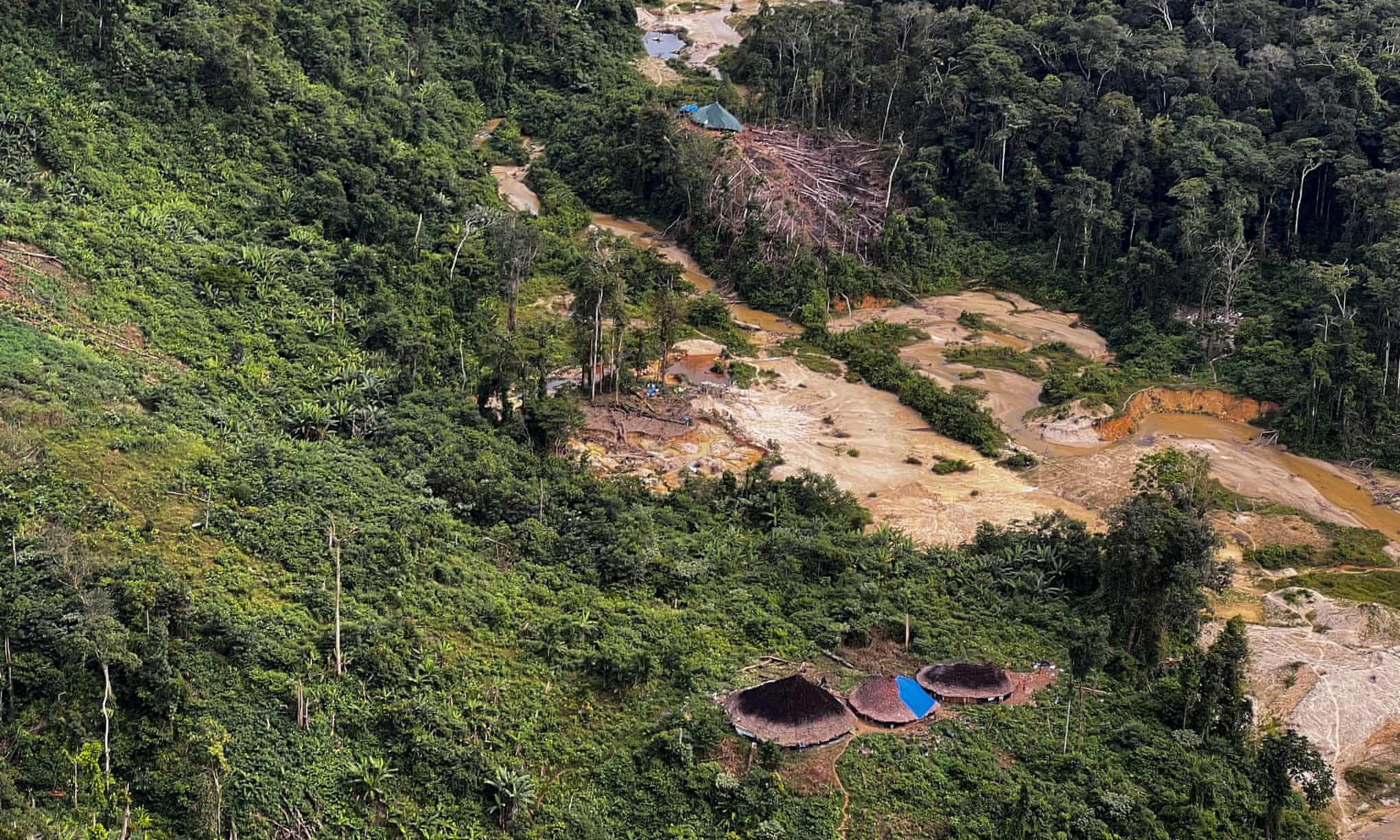
An aerial view of an illegal mining camp surrounding huts of an Indigenous tribe, taken during an operation against Amazon deforestation at the Yanomami territory in Roraima state, Brazil, in February.Photograph: Alan Chaves/AFP/Getty Images
The rapid advance of organised crime groups in the Brazilian Amazon risks turning the region into a vast, conflict-stricken hinterland plagued by heavily armed “criminal insurgents”, a former senior federal police chief has warned.
Alexandre Saraiva, who worked in the Amazon from 2011 to 2021, said he feared the growing footprint of drug-trafficking mafias in the region could spawn a situation similar to the decades-long drug conflict in Rio de Janeiro, where thepolice’s battle with drug gangsand paramilitaries has claimed tens of thousands of lives.
“I experienced how the state lost control of public security in Rio de Janeiro,” Saraiva said. “And in the Amazon today – if nothing is done in terms of public security – we are facing a continent-sized Rio de Janeiro, with the aggravating factors of borders with major drug producers and an extraordinarily difficult jungle setting.”
Alexandre Saraiva, a former senior police chief in the Amazon, warned heavily armed ‘criminal insurgents’ could commandeer parts of the rainforest region.Photograph: João Laet/The Guardian
Saraiva warned of dire consequences for the rainforest and its inhabitants if criminal gangs were allowed to grow into powerful armies like the rebel factions in neighbouring Colombia. “We will have criminal insurgents … [whose] ideology is money,” he said.
“We will have areas of conflagration, of major conflict between groups which are fighting over areas of illegal gold and timber extraction. In the middle of this, we will have Indigenous victims. And we will face immense logistical difficulties in combating this,” warned the police chief, the author ofa recent bookcalled Jungle: Loggers, Miners and Corruption in a Lawless Amazon.
The alert came ahead of the first anniversary of the killings of the British journalist Dom Phillips and the Brazilian Indigenous expert Bruno Pereira, whose deaths exposed widespread environmental devastation and the growing reach of organised crime groups in the Amazon.
A year after their killings, the Guardian has joined 15 other international news media organisations and more than 50 journalists in a collaborative investigation into organised crime and resource extraction in the Brazilian Amazon, in an effort coordinated by Forbidden Stories, the Paris-based non-profit dedicated to continuing the work of reporters who are threatened, censored or killed.
Killed protecting the Amazon: remembering Bruno Pereira and Dom Phillips – video
Quick Guide
Figures collated for the Bruno and Dom project by the Brazilian Forum on Public Safety (FBSP) paint a bleak portrait of organised crime’s deadly impact on the region, showing that:
With more than 8,000 deaths, the rate of intentional lethal violent crime in the Brazilian Amazon’s nine stateswas more than 50% higher than in the rest of the country last year – a murder rate similar to that of Mexico.
In Amazonas state, where Bruno Pereira and Dom Phillips were among 1,432 people killed last year, the murder rate was 74% above the national average. 2021 was even more violent with 1,571 victims and a violent death rate of 36.8 per 100,000 inhabitants – five times that of the US.
Federal police troops – sent to the Javari valley region by Brazil’s new government – travel down a waterway near the river town of Atalaia do Norte.Photograph: João Laet/The Guardian
The number of people killed by military and civil police grew 71% in the Amazon between 2016 and 2021, compared with 35% in the rest of Brazil. The Amazon’s prison population grew 35.1% between 2016 an 2022 compared with 14.1% elsewhere, helping prison-run factions to flourish in overcrowded jails.
Brazil’s two most powerful crime factions – São Paulo’s PCC (First Capital Command) and Rio’s CV (Red Command) – now operate in all nine Amazon states, as do at least 15 other regional crime groups, including Os Crias, the Família do Norte and Class A Command.
Last year, the FBSPrevealedhow the Amazon now contained 10 of Brazil’s 30 most violent municipalities. They included remote illegal mining and drug smuggling hubs such as Jacareacanga and Japurá, and Novo Progresso, a deforestation hotspot from wherePhillips reportedfor the Guardian in 2020. All three towns had staggeringly high murder rates of more than 100 per 100,000 inhabitants.
The advance of organised crime groups in the Amazon was laid bare by the killings ofPereira and Phillipslast year in the Javari valley, an Austria-sized sweep of rivers and rainforests on Brazil’s border with Colombia and Peru, the world’s top two cocaine producers.
Brazil’s environment minister, Marina Silva, told the Guardian that violence had long been “a hallmark of the predatory occupation of the Amazon”, pointing to theassassinations of activistssuch as Chico Mendes in 1988 and Sister Dorothy Stang in 2005.
The military dictatorship’sdecision to colonise the Amazonin the 1960s – supposedly to stop hostile foreign powers commandeering the sparsely populated region – sparked a deadly struggle for land and resources, devastated Indigenous communities and caused deforestation to soar.
However, Silva said the “overlapping of multiple forms of criminality” in the Amazon now meant the state needed to increase its presence in affected regions. She highlighted the new government’sbattle to evict illegal minerswith links to the PCC from the Yanomami Indigenous territory.
The Public Safety Forum’s president, Renato Sérgio de Lima, said the statistics collected by his group’s researchers underlined how the arrival of drug factions had made a bad situation worse, causing Amazon murder rates to soar even as they fell elsewhere in Brazil.
Lima traced the advance of such groups into the Amazon to 2016 when a notoriousdrug trafficker was killedon Brazil’s border with Paraguay. That assassination helped the PCC consolidate its control of the drug smuggling route focused on the border town of Ponta Porã and forced its rival, the CV, to look further north to the Amazon.
The CV’s destination was Tabatinga, a scruffy town on the tri-border with Colombia and Peru, near where Phillips and Pereira were killed last June.
Lima estimated that the cocaine being smuggled through Brazil was now responsible for 4% of the South American country’s GDP – with about 40% of those illegal profits coming through the Amazon.
“We are talking about something like $25bn being injected into the Amazon’s economy every year and the region isn’t ready to deal with this,” he said, warning that the response from the armed forces had been woefully inadequate, with the army and navy seizing just 41 firearms in 2022.
In this photo released by Agencia Brasil, an aerial view shows a laboratory at a coca plantation in Tabatinga, Brazil.Photograph: Valter Campanato/AP
Aerial images filmed by Brazil’s Globoplay, one of the news organisations involved in the Bruno and Dom project, showed a suspected cocaine laboratory and a series of coca farms that had been carved out of the jungles on the Peruvian side of the Javari. “If the Brazilian state doesn’t intervene in an urgent and firm manner, we’re going to have [entire] regions that are run by narco-traffickers,” said Beto Marubo, a prominent Indigenous leader who was close to Pereira.
Lima warned that if nothing was done, “the military’s fear [of losing control of the Amazon] will become almost a self-fulfilling prophesy. We will effectively lose sovereignty over the region and the region will be consolidated as the main narco-trafficking smuggling route in Brazil and to Europe.”
Rodrigo Chagas, an Amazon-based researcher who is studying the drug gangs’ rapid expansion for the FBSP, echoed the warnings of “Colombianisation”, which could see security forces launch a catastrophic “war on drugs” similar to the one that hasblighted Brazil’s neighbourfor decades.
“It’s possible the Amazon will see tremendous havoc. This is a scenario that worries me, because the public security responses we tend to see are ‘war on drugs’-style responses – a war which is utterly detrimental to local populations,” Chagas said.
Saraiva noted how Brazil’s armed forces had historically been obsessed with thesupposed threat of an “external enemy”annexing the Amazon, a vast region nine times the size of France. “Meanwhile, we have an internal criminal insurgency which is corroding the Brazilian nation from within, [and] it’s happening far faster than we imagine,” warned Saraiva, who was the federal police chief in three Amazon states, Amazonas, Maranhão and Roraima.
Federal police and Brazil’s Indigenous protection agency destroy illegal mining vessels during a 2019 operation in the Javari valley region organised by Pereira and Saraiva.Photograph: Federal police
It was while serving in Amazonas that Saraiva came into contact with Pereira. In 2019, shortly before Pereira was forced from his job with the government’s Indigenous protection agency, Funai, the police chief helped the Indigenous defender launch a major anti-mining operation in the Javari region called “Operation Korubo”. Sixty illegal mining dredges were destroyed during those raids, which Saraiva believed put Pereira “in a very delicate position”.
“In the Javari valley we have a convergence between drug trafficking, illegal fishing, illegal logging and mining. And in the middle of all this, there was aguy called Bruno[trying to fight environmental crime],” Saraiva said, remembering a brave and passionate activist with “selflessness in his DNA”.
Federal police have named a shadowy local figure with suspected ties to organised crime as the alleged mastermind behind last year’s killings. Experts say at least four Brazilian drug factions – the CV, PCC, Os Crias and the Família do Norte – operate in the region, as well as groups from Colombia and Peru.
Organised crime’s growing grip on the Amazon was again exposed last month whenalleged PCC operatives attacked government forcesduring a raid on an illegal mine in the Yanomami Indigenous territory near Venezuela. Four men were killed in the shootout, including a PCC leader nicknamed “Presidente”.
A message intercepted by police and shared with the Guardian showed PCC chiefs urging members to retaliate against police for “the deaths of our brothers”. “From what I understand, the PCC isn’t just there to extract gold. Of course they’re doing this too. But the main thing is to use the illegal airstrips to send weapons and drugs to other countries, like Venezuela,” said one police source.
The story of Saraiva, whom Dom Phillips interviewed for the book he was writing about the Amazon, underlines the growing role of criminal factions in environmental crime.
Two years after he stopped working in the Amazon, he still travels in a bulletproof car – the result of intelligence suggesting the PCC planned to assassinate him, even though his focus had been fighting environmental crime, not drug smuggling.
“Organised crime is diversifying into other illegal activities that Brazilian society tends to see as lesser offences,” said Saraiva, who commandedBrazil’s largest ever seizureof illegal wood in 2020.
“The mafia goes wherever there’s money. It doesn’t care if it’s environmental crime, people smuggling, cocaine. And what they see there [in the Amazon] is gold and wood that’s being sold for a very high price. It’s obvious that it wouldn’t take them long to get involved in this.”
A catatonic woman awakened after 20 years. Her story may change psychiatry.
New research suggests that a subset of patients with psychiatric conditions such as schizophrenia may actually have autoimmune disease that attacks the brain
Left: April Burrell at 19 as a bridesmaid in a family wedding in 1992. Right: April in 2022 during a family visit after treatment. (Illustration by Chelsea Conrad/The Washington Post; Family Photo; Tim Sorel)
The young woman was catatonic, stuck at the nurses’ station — unmoving, unblinking and unknowing of where or who she was.
Her name was April Burrell.
Before she became a patient, April had been an outgoing, straight-A student majoring in accounting at the University of Maryland Eastern Shore. But after a traumatic event when she was 21, April suddenly developed psychosis and became lost in a constant state of visual and auditory hallucinations. The former high school valedictorian could no longer communicate, bathe or take care of herself.
Story continues below advertisement
April was diagnosed with a severe form of schizophrenia, an oftendevastating mental illnessthat affects approximately 1 percent of the global population and can drastically impair how patients behave and perceive reality.
“She was the first person I ever saw as a patient,” saidSander Markx, director of precision psychiatry at Columbia University, who was still a medical student in 2000 when he first encountered April. “She is, to this day, the sickest patient I’ve ever seen.”
It would be nearly two decades before their paths crossed again. But in 2018, another chance encounter led to several medical discoveries reminiscent ofa scene from “Awakenings,”the famous book and movie inspired by the awakening of catatonic patients treated by the late neurologist and writerOliver Sacks.
Markx and his colleaguesdiscovered that although April’s illness was clinically indistinguishable from schizophrenia, she also had lupus, an underlying and treatable autoimmune condition that was attacking her brain.
After months of targeted treatments—and more than two decades trapped in her mind — April woke up.
The awakening of April — and the successful treatment of other peoplewith similar conditions — now stand to transform care for some of psychiatry’s sickest patients, many of whom are languishing in mental institutions.
Researchers working with the New York state mental health-care system have identified about 200 patients with autoimmune diseases, some institutionalized for years, who may be helped by the discovery.
And scientists around the world, including Germany and Britain, are conducting similar research, finding that underlying autoimmune and inflammatory processes may be more common in patients with a variety of psychiatric syndromes than previously believed.
Although the current research probably will help only a small subset of patients,the impact of the work is already beginning to reshape the practice of psychiatry and the way many cases of mental illness are diagnosed and treated.
“These are the forgotten souls,” said Markx. “We’re not just improving the lives of these people, but we’re bringing them back from a place that I didn’t think they could come back from.”
Losing April
Even as a teenager growing up in Baltimore,April showed signs of the college accounting student she would later become. She balanced her dad’s checkbook and helped collect the rent on his properties.
She lived with her father, who had served in the Army, and her stepmother and is one of seven siblings. She was keenly focused on academics and would be disappointed if she received a B in a class. She played volleyball in high school, and her family remembers her as being profoundly capable in all things. She helped her dad renovate his dozens of rental properties and could even wire outlets and climb on roofs to tar and repair them.
By all accounts, she was thriving, in overall good health and showing no signs of mental distress beyond the normal teenage growing pains.
“April was a high achiever,” said her older half brother, Guy Burrell. “She was very friendly, very outgoing. She just loved life.”
But in 1995, her family received a nightmarish phone call from one of her professors. April was incoherent and had been hospitalized. The details were hazy, but it appeared that April had suffered a traumatic experience, which The Post isn’t describing to protect her privacy.
Story continues below advertisement
After April spent a few months at a short-term psychiatric hospital, she was eventually diagnosed with schizophrenia.
Her family tried their best to take care of her, but April required constant attention, and, in 2000, she went to Pilgrim Psychiatric Center for long-term care. Her family visited as often as they could, making the four-hour drive from Maryland to Long Island once or twice a month. But April was locked in her own world of psychosis, often appearing to draw with her fingers what appeared to be calculations and having conversations with herself about financial transactions.
April was unable to recognize, let alone engage with, her family. She did not want to be touched, hugged or kissed. Her family felt they had lost her.
A promising medical student
When April was diagnosed with schizophrenia, Markx was still a promising medical student, an ocean away at the University of Amsterdam. His parents were both psychiatrists and he had grown up around psychiatry and its patients.Markx remembers playing as a child in the long-term psychiatric facilities where his parents worked; he was never afraid of the patients or the stigma associated with their illnesses.
As a visiting Fulbright Scholar to the United States, he made the decision not to head to more well-known institutes, but instead chose Pilgrim Psychiatric Center, a state hospital in Brentwood, N.Y., where many of the state’s most severe psychiatric patients live for months, years or even the rest of their lives.
It was during his early days at Pilgrim that he met April, an encounter that “changed everything,” he said.
“She would just stare and just stand there,” Markx said. “She wouldn’t shower, she wouldn’t go outside, she wouldn’t smile, she wouldn’t laugh. And the nursing staff had to physically maneuver her.”
As a student, Markx was not in a position to help her. He moved on with his career, but always remembered the young woman frozen at the nurses’ station.
Almost two decades later, Markx had a lab of his own. He encouraged one of his research fellows to work in the trenches and suggested he spend time with patients at Pilgrim, just as he had done years earlier.
In an extraordinary coincidence, the trainee,Anthony Zoghbi, encountered a catatonic patient, standing at the nurse’s desk. The fellow returned to Markx, shaken up, and told him what he had seen.
“It was like déjà vu because he starts telling the story,” said Markx. “And I’m like, ‘Is her name April?’”
Markx was stunned to hear that little had changed for the patient he had seen nearly two decades earlier. In the years since they had first met, April had undergone many courses of treatment — antipsychotics, mood stabilizers and electroconvulsive therapy — all to no avail.
Markx was able to get family consent for a full medical work-up. He convened a multidisciplinary team of more than 70 experts from Columbia and around the world — neuropsychiatrists, neurologists, neuroimmunologists, rheumatologists, medical ethicists — to figure out what was going on.
The first conclusive evidence was in her bloodwork: It showed that her immune system was producing copious amounts and types of antibodies that were attacking her body. Brain scans showed evidence that these antibodies were damaging her brain’s temporal lobes, brain areas that areimplicated in schizophrenia and psychosis.
The team hypothesized that these antibodies may have altered the receptors that bind glutamate, an important neurotransmitter, disrupting how neurons can send signals to one another.
Even though April had all the clinical signs of schizophrenia, the team believed that the underlying cause was lupus, a complex autoimmune disorder where the immune system turns on its own body, producing many antibodies that attack the skin, joints, kidneys or other organs. But April’s symptoms weren’t typical, and there were no obvious external signs of the disease; the lupus appeared to only be affecting her brain.
The autoimmune disease, it seemed, was a specific biological cause — and potential treatment target — for the neuropsychiatric problems April faced. (Whether her earlier trauma had triggered the disease or was unrelated to her condition wasn’t clear.)
The diagnosis made Markx wonder how many other patients like April had been missed and written off as untreatable.
“We don’t know how many of these people are out there,” Markx said. “But we have one person sitting in front of us, and we have to help her.”
Waking up after two decades
The medical team set to work counteracting April’s rampaging immune system and started April on an intensive immunotherapy treatment forneuropsychiatric lupus. Every month for six months, April would receive short, but powerful “pulses” of intravenous steroids for five days, plus a single dose of cyclophosphamide, a heavy-duty immunosuppressive drug typically used in chemotherapy and borrowed from the field of oncology. She was also treated with rituximab, a drug initially developed for lymphoma.
The regimen is grueling, requiring a month-long break between each of the six rounds to allow the immune system to recover. But April started showing signs of improvementalmost immediately.
As part ofa standard cognitive testknown as the Montreal Cognitive Assessment (MoCA), she was asked to draw a clock — a common way to assess cognitive impairment. Before the treatment, she tested at the level of a dementia patient, drawing indecipherable scribbles.
But within the first two rounds of treatment, she was able to draw half a clock — as if one half of her brain was coming back online, Markx said.
Following the third round of treatment a month later, the clock looked almost perfect.
Despite this improvement, her psychosis remained. As a result, some members of the team wanted to transfer April back to Pilgrim Psychiatric Center, Markx said. At the time, Markx had to travel home to the Netherlands, and feared that in his absence, April would be returned to Pilgrim.
On the day Markx was scheduled to fly out, he entered the hospital one last time to check on his patient, who he typically found sitting in the dining room in her catatonic state.
But when Markx walked in, April didn’t seem to be there. Instead, he saw another woman sitting in the room.
“It didn’t look like the person I had known for 20 years and had seen so impaired,” Markx said. “And then I look a little closer, and I’m like, ‘Holy s---. It’s her.’”
It was as if April had awakened after more than 20 years.
“I’ve always wanted my sister to get back to who she was,” Guy Burrell said.
In 2020,April was deemed mentally competent to discharge herself from the psychiatric hospital where she had lived for nearly two decades, and she moved to a rehabilitation center.
Because of visiting restrictions related to covid, the family’s face-to-face reunion with April was delayed until last year. April’s brother, sister-in-law and their kids were finally able to visit her at a rehabilitation center, and the occasion was tearful andjoyous.
“When she came in there, you would’ve thought she was a brand new person,” Guy Burrell said. “She knew all of us, remembered different stuff from back when she was a child.”
A video of the reunion shows thatApril was still tentative and fragile. But her family said she remembered her childhood home in Baltimore, the grades she got in school, being a bridesmaid in her brother’s wedding— seemingly everything up until when the autoimmune inflammatory processes began affecting her brain. She even recognized her niece, whom April had only seen as a small child, now a grown young woman. When her father hopped on a video call, April remarked “Oh, you lost your hair,” and burst out laughing, Guy Burrell recalled.
The family felt as if they’d witnessed a miracle.
“She was hugging me, she was holding my hand,” Guy Burrell said. “You might as well have thrown a parade because we were so happy, because we hadn’t seen her like that in, like, forever.”
“It was like she came home,” Markx said. “We never thought that was possible.”
Finding more forgotten patients
Markx talked about how, as a teenager, he saw the movie adaptation of Oliver Sacks’s“Awakenings,”featuring Robin Williams and Robert DeNiro, and how it had haunted him. “The notion that people are gone in these mental institutes and that they come back still, that has always stuck with me,” he said.
Before his death in 2015,Sacks had spoken to Markx about the discoveries involving patients likeApril. Sacks, also a professor at Columbia University, had a personal interest in the work. He had abrother with schizophrenia.
“Your work gives me hope about the outcomes we can achieve with our patients that I never before would have dreamed possible, as these are true cases of ‘Awakenings’ where people get to go back home to their families to live out their lives,” Sacks said, according to contemporaneous notes kept by Markx. (The statement was confirmed byKate Edgar, Sacks’s long-term personal editor and executive director of the Oliver Sacks Foundation.)
After April’s unexpected recovery, the medical team put out an alert to the hospital system to identify any patients with antibody markers for autoimmune disease. A few months laterAnca Askanase, a Columbia rheumatologist who had been on April’s treatment team, approached Markx. “I think we found our girl,” she said.
When Devine Cruz was 9, she began to hear voices. At first, the voices fought with one another. But as she grew older, the voices would talk about her. One night, the voices urged her to kill herself.
For more than a decade, the young woman moved in and out of hospitals for treatment. Her symptoms included visual and auditory hallucinations, as well as delusions that prevented her from living a normal life.
Devine was eventually diagnosed withschizoaffective disorder, which can result in symptoms of both schizophrenia and bipolar disorder. She also was diagnosed with intellectual disability.
She was on a laundry list of drugs — two antipsychotic medications, lithium, clonazepam, Ativan and benztropine — that came with a litany of side effects but didn’t resolve all her symptoms. She was often unaware of what was going on; her hair was disheveled, and her medications caused her to shake and drool, her doctors said.
She also had lupus, which she had been diagnosed with when she was about 14, although doctors had never made a connection between the disease and her mental health.
When Markx and his team found Devine, she was 20 and held the adamant delusion that she was pregnant despite multiple negative pregnancy tests.
“That’s when she was probably at her worst,” said Sophia Chaudry, a precision psychiatry fellow at Columbia University Medical Center and physician who was closely involved in Devine’s care.
Last August, the medical team prescribed monthly immunosuppressive infusions of corticosteroids and chemotherapy drugs, a regime similar to what April had been given a few years prior. By October, there were already dramatic signs of improvement.
“She was like ‘Yeah, I gotta go,’” Markx said. “‘Like, I’ve been missing out.’”
After several treatments, Devine began developing awareness that the voices in her head were different from real voices, a sign that she was reconnecting with reality. She finished her sixth and final round of infusions in January.
In March, she was well enough to meet with a reporter. “I feel like I’m already better,” Devine said during a conversation in Markx’s office at the New York State Psychiatric Institute, where she was treated.“I feel myself being a person that I was supposed to be my whole entire life.”
Her presence during the interview was at first timid and childlike. She said her excitement and anxiety about discussing her story reminded her of how she felt in school the day before a big field trip.
Although she had lost about 10 years of her life to her illness, she remembers many details. As a child, she did not know how to explain what she was going through to her family and often isolated herself in her room.
“Because the crisis was so bad, it felt like I was being mute,” Devine said. “I was talking without making any sense, so they wouldn’t understand what I was saying.”
Devine still remembers what the voices sounded like and the often disturbing images she hallucinated: a hand reaching down from the ceiling as she lay in bed, the creepy nurse with the crooked head and black teeth who approached her in the hospital.
She remembers the paranoia she felt at times. “I thought that the world was ending, I thought that the police were out to get me.”
But she also remembers that fateful first phone call with Markx when she learned that her lupus could be affecting her brain. She remembers asking, “If it affects my brain, what does this have to do with my mental illness?”
Her recovery is remarkable for several reasons, her doctors said. The voices and visions have stopped. And she no longer meets the diagnostic criteria for either schizoaffective disorder or intellectual disability, Markx said.
In a recent neuropsychiatric evaluation, Devine not only drew a perfect clock, but also asked how the physician was doing, a level of engagement that the doctor found so surprising that she noted it in the patient report.
But more importantly, Devine now recognizes that her previous delusions weren’t real. Such awareness is profound because many severely sick mental health patients never reach that understanding, Chaudry said.
Today, Devine lives with her mother and is leading a more active and engaged life. She helps her mother cook, goes to the grocery store and navigates public transportation to keep her appointments. She is even babysitting her siblings’ young children — listening to music, taking them to the park or watching “Frozen 2” — responsibilities her family never would have entrusted her with before her recovery.
She is grateful for her treatment and the team that made it possible. “Without their help, I wouldn’t be here,” Devine said.
“I feel more excited,” she said. “Like a new chapter is beginning.”
Expanding the search for more patients
While it is likely that only a subset of people diagnosed with schizophrenia and psychotic disorders have an underlying autoimmune condition, Markx and other doctors believe there are likely many more patients whose psychiatric conditions are caused or exacerbated by autoimmune issues.
The cases of April and Devine also helped inspire the development of the SNF Center for Precision Psychiatry and Mental Health at Columbia, which was named for theStavros Niarchos Foundation, which awarded it a $75 million grant in April. The goal of the center is to develop new treatments based on specific genetic and autoimmune causes of psychiatric illness, saidJoseph Gogos, co-director of the SNF Center.
Markx said he has begun care and treatment on about 40 patients since the SNF Center opened. The SNF Center is working with theNew York State Office of Mental Health, which oversees one of the largest public mental health systems in America, to conduct whole genome sequencing and autoimmunity screening on inpatients at long-term facilities.
For “the most disabled, the sickest of the sick, even if we can help just a small fraction of them, by doing these detailed analyses, that’s worth something,” saidThomas Smith, chief medical officer for the New York State Office of Mental Health. “You’re helping save someone’s life, get them out of the hospital, have them live in the community, go home.”
Discussions are underway to extend the search to the 20,000 outpatients in the New York state system as well. Serious psychiatric disorders, like schizophrenia, aremore likely to be undertreatedin underprivileged groups. And autoimmune disorders like lupusdisproportionately affect womenandpeople of colorwith more severity.
Changing psychiatric care
How many people ultimately will be helped by the research remains a subject of debate in the scientific community. But the research has spurred excitement about the potential to better understand what is going on in the brain during serious mental illness.
“I think we, as basic neuroscientists, are now in a position, both conceptually and technologically, to contribute, and it’s our responsibility to do so,” saidRichard Axel, Nobel laureate and co-director of Columbia’s Zuckerman Mind Brain Behavior Institute.
“It opens new treatment possibilities to patients that used to be treated very differently,” saidLudger Tebartz van Elst, a professor of psychiatry and psychotherapy at University Medical Clinic Freiburg in Germany.
In one study, published last year inMolecular Psychiatry, Tebartz van Elst and his colleagues identified 91 psychiatric patients with suspected autoimmune diseases, and reported that immunotherapies benefited the majority of them.
Belinda Lennox, head of the psychiatry department at the University of Oxford, is enrolling patients in clinical trials to test the effectiveness of immunotherapy for autoimmune psychosis patients.
In addition to more common autoimmune conditions, researchers also have identified 17 diseases, many with different neurological and psychiatric symptoms, in which antibodies specifically target neurons, saidJosep Dalmau, a neurologist at the University of Barcelona Hospital Clinic. Dalmau first identified one of the most common of these diseases, called anti-NMDA receptor autoimmune encephalitis.
As a result of the research, screenings for immunological markers in psychotic patients are already routine in Germany, where psychiatrists regularly collect samples from cerebrospinal fluid.
Markx is also doing similar screening with his patients. He believes highly sensitive and inexpensive blood tests to detect different antibodies should become part of the standard screening protocol for psychosis.
Also on the horizon: more targeted immunotherapy rather than current “sledgehammer approaches” that suppress the immune system on a broad level, saidGeorge Yancopoulos, the co-founder and president of the pharmaceutical company Regeneron.
“I think we’re at the dawn of a new era. This is just the beginning,” said Yancopoulos.
In June, Markx will present the findings at aconferenceorganized by the Stavros Niarchos Foundation.
And Devine will be there to share her story in her own words.
“The message I want to give people is that there is time to heal,” Devine said. “There’s time to heal yourself from many obstacles you’ve been facing in life.”
The future for patients like April and Devine
April, who is turning50 this year,has lived in a rehabilitation center for the past three years. Her family continues to visit, but she has recently regressed because she was not receiving adequate maintenance care, Markx said. Markx and April’s family remain optimistic that she will improve after resuming treatment.
“She would not want society to give up on her or people like her,” Guy Burrell said.
Devine, now 21, is still living with her family, writing poetry and hopes for a future helping others, possibly as an art therapist. She still needs support after losing more than a decade of her childhood.
Her experience is akin psychologically to being in a coma for 10 years, and then waking up “and the world’s moved on,” saidSteven Kushner, co-director of the SNF Center. The treatment team is working to help Devine and other patients to catch up on lost time and navigate life after recovery.
Devine said she wants to help motivate others in their struggles. When asked to share a piece of herpoetry, she picked“The Healing,”which reads, in part:
“Hello Dear,
I know you’re struggling, struggling to find out what’s wrong from right.
Figuring out is it even too late to start anything.
Going off based on fear
Is it even real.
Take your time dear one there’s no need to rush in a hurry.
You are precious to those around you…
You are not alone for the world has beautiful creations made just for you.”