Thursday, December 06, 2018


Wednesday, December 05, 2018
Tuesday, December 04, 2018
Opinion | What Happens If ...

By Charles M. Blow Opinion Columnist
The special counsel, Robert Mueller, is still investigating the alleged connections between Russia and the Trump campaign in 2016.
Photo by: J. Scott Applewhite/Associated Press
I no longer think that anyone in America, including Donald Trump’s most loyal supporters, can afford to put off the consideration of the central question of this administration: What if Donald Trump or those closest to him were compromised by the Russians or colluded with them?
There have always been those of us on the left who viewed his presidency as compromised, asterisk-worthy if not wholly illegitimate, because of the Russian interference.
A crime had been committed by Russia and Trump cheered the crime and used the loot thereof to advance his candidacy. That is clear.
The Russians made repeated attempts to contact people in Trump’s orbit and in some cases were able to meet with members of the team, as evidenced by the Trump Tower meeting. That is clear.
Members of Trump’s team were extremely interested in and eager to accept any assistance that the Russians could provide. That is clear.
And since assuming office, Trump has openly attempted to obstruct justice and damage or impede the investigation into what the Russians did and whether anyone in his orbit was part of the crime. That too is clear.
But for the people who support and defend Trump, this has already been absorbed and absolved. They may not like it, but they are willing to overlook it. Indeed, they are so attached to Trump that his fortunes and his fate have become synonymous with theirs. There is a spiritual linkage, a baleful bond, between the man and his minions.
But what happens if the evidence that the investigation by the special counsel, Robert Mueller, uncovers reveals a direct link between Trump and the Russians? How do Trump’s boosters respond?
Last week, when Trump’s former lawyer, Michael Cohen, pleaded guilty to lying to Congress about the timeline and the extent of Mr. Trump’s involvement in negotiations for a Trump Tower in Moscow, the political earth shifted.
If Trump was lying to or misleading the American people about his efforts to do business in Russia while running for president and the Russians knew — and presumably had evidence — that he wasn’t being completely honest and forthcoming, then he was compromised.
While it is by no means clear that the Russians ever used any information that they may have had to blackmail or otherwise pressure Trump, Cohen’s plea makes clear that they had the material to do just that.
This brings ever more clarity to Trump’s curious inclination to go soft on Russia condemnation, to take Russian President Vladimir Putin’s word over that of his own intelligence agencies, and to drag his feet in acknowledging that Russia attacked our election in 2016 and may continue to do so in the future.
How would Americans who support Trump now respond to evidence that Team Trump put their own personal and financial interests over the national interest? Would they break from their blind support and turn away from him and turn on him? How could they justify wearing the blinders for so long and countenancing so much? What language would they use to correct their complicity?
There is a precedent in the Nixon investigation. When the evidence of wrongdoing was clear and incontrovertible, people began to peel away, tails tucked and full of shame.
But that was a different time, one in which media wasn’t so fractured and partisan, before the advent of social media and our current dissociable mentalities.
Nixon had no propaganda arm. Trump has one. It’s called Fox News. There is little daylight between the network’s programming and the White House’s priorities. If Trump goes down, so too does Fox, in some measure. So the network has a vested interest in defending Trump until the bitter end, and that narrative-crafting could impede an otherwise natural and normal disaffection with Trump.
Furthermore, Trump does not strike me as a man amenable to contrition or one interested in the health and stability of the nation.
I expect Trump to admit nothing, even if faced with proof positive of his own misconduct. There is nothing in the record to convince me otherwise. He will call the truth a lie and vice versa.
I also don’t think that Trump would ever voluntarily leave office as Nixon did, even if he felt impeachment was imminent. I’m not even sure that he would willingly leave if he were impeached and the Senate moved to convict, a scenario that is hard to imagine at this point.
I don’t think any of this gets better, even as the evidence becomes clearer. I don’t believe that Trump’s supporters would reverse course in the same way that Nixon’s did. I don’t believe that the facts Mueller presents will be considered unassailable. I don’t believe Trump will go down without bringing the country down with him.
In short, I don’t believe we are reaching the end of a nightmare, but rather we are entering one. This will not get easier, but harder.
The country is about to enter the crucible. This test of our republic is without a true comparison. And we do not have a clear picture of how the test will resolve. But, I believe damage is certain."
Opinion | What Happens If ...
Monday, December 03, 2018
America Media Stop Lying. George Bush Opposed Civil Rights His Whole Career
George Bush Sr. on Civil RightsPresident of the U.S., 1989-1993; Former Republican Rep. (TX) |
1998: gay status of personal aide "doesn't matter to us"
For the first 4 years after leaving the White House, my father's personal aide, Michael Dannenhauer, went just about everywhere with Dad. They had developed a very close relationship, but all that time Michael also lived with a deeply held fear. "All those years I always wondered if the president assumed I was gay," Michael said. "In 1998, in the back of my mind I wondered if he would want me to be his chief of staff if he knew I was gay."
1980: Supported Equal Rights Amendment, but not as V.P.
[In the 1980 GOP primary], the press forced George to clarify his positions, most of which contrasted sharply with Ronald Reagan's. Bush said he favored an Equal Rights Amendment, and he opposed an amendment that would overturn Roe v. Wade and ban abortion. He also opposed licensing and registering firearms.
1964: Advocated states' rights over Civil Rights Act
When Pres. Johnson signed the 1964 Civil Rights Act, George wrapped himself in the mantle of states' rights, which was conservative code for no federal intervention on racial matters. "The new civil rights act was passed to protect 14% of the people," George said. "I'm also worried about the other 86%."
1990: Signed Americans with Disabilities Act
Dr. John Walker, the brother of George's mother, Dorothy, had joined Memorial Sloan-Kettering in 1952 as a clinical assistant in surgery. He was struck with polio in 1950 and lost most of the use of his limbs, eventually becoming bound to a wheelchair.
1959 home carried a restrictive racial covenant
Moving from Midland to Houston in the summer of 1959 required logistical planning by the Bushes because they were transporting a business, building a house, and expecting a baby.
1963: Civil Rights Bill violates constitutional rights
In June 1963, the President sent to Congress the most far-reaching civil rights bill in the country's history. To demonstrate a mandate for the legislation, Martin Luther King led 250,000 people to Washington that summer with the incandescent rhetoric of his "I Have a Dream" speech.
1983: Debated Geraldine Ferraro; "We kicked a little ass"
Geraldine Ferraro, a former congresswoman from NYC, had been chosen as the first woman to run for national office on a major-party ticket. Her selection by Walter Mondale as his running mate had galvanized many women. [There was] enormous pressure on Ferraro, who had to surmount the bigotry and sexism her candidacy unleashed, particularly among men in the media.
No professional women on Bush staff, nor in Bush family
The day after the [1983 VP debate with Geraldine Ferraro] the Vice President referred to the previous evening: "I tried to kick a little ass." Hours later his staff showed up on the press plane wearing buttons that said, "We kicked a little ass."
1990: vetoed Civil Rights Act & voter registration bill
Ralph Neas, the executive director of the Leadership Conference on Civil Rights, felt the sting of Bush's retaliation after the President vetoed the Civil Rights Act of 1990, which was intended to prohibit discrimination in employment. "I was very critical of the President for that veto and for calling the bill a quota bill simply to pander to the right wing," said Neas. "I said he was acting beneath the dignity of his office."
Signed 1991 Voting Rights Act after 1990 veto
The president had already vetoed the Civil Rights Act of 1990, claiming it was a "quota bill." Determined not to veto any more civil rights legislation, the President directed his White House counsel to work with the Senate and House Democrats to reach a bipartisan agreement on the 1991 Civil Rights Act.
Legislation is not enough to eliminate discrimination
If we seek--and I believe that every one of us does--to build a new era of harmony and shared purpose, we must make it possible for all Americans to scale the ladder of opportunity. If we seek to ease racial tensions in America, civil rights legislation is, by itself, not enough. The elimination of discrimination in the workplace is a vital element of the American Dream, but it is simply not enough.(Remarks on signing the Civil Rights Act of 1991, Rose Garden.)
Civil Rights Act: ban discrimination without quotas
I wrote this note to Senator Jack Danforth, when we could not agree on a civil rights bill.Dear Jack,I signed the Civil Rights Act of 1991 on November 21. It did not include quotas. It did promote the goals of ridding the workplace of discrimination based on race, color, sex, religion, national origin, and disability....Needless to say we don’t feel we are “turning back the clock on civil rights.” Indeed I have stated that I want to sign a civil rights bill. I’ve also said that it is important that we get a bill, and rather than haggle over what some have called tiny differences, why not take a gigantic step forward by going with a bill where we have total agreement, leaving a handful of the knotty unresolved questions to later on.Isn’t it more important to take a 90% step forward than to take no step at all? Anyway, let’s keep plugging away not letting the extremes on either side of this debate carry the day.
ADA is first declaration of equality for disabled people
Author's note: The Americans with Disabilities Act of 1990 President Bush would later call "really the world's first comprehensive declaration of equality" for disabled people.(Remarks on signing the Americans with Disabilities Act of 1990, White House South Lawn.)
Avoiding censorship more important than defunding NEA
The National Endowment for the Arts (NEA) were under fire for underwriting an art exhibit that featured a controversial painting of Jesus.Diary entry March 28th:
Take the NEA for example. When I see Jesus Christ shooting up heroin or floating on a bottle of urine, I figure that there ought not to be one dime of federal funds going into this. And then you think of the alternative that comes to mind-federal censorship-and you worry, “Where will this lead?”
Called for Constitutional Amendment against flag burning
Much to my disappointment, the Supreme Court had just ruled 5-4 that the Constitution did not protect the flag from being burned. Justice Scalia was in the majority opinion. His wife feared I might be holding it against him, which of course I did not. However, I did immediately call for a constitutional amendment banning flag burning.
Supports school prayer, like Pledge of Allegiance
I think you’re wrong on prayer in schools. It is not just ideologues who want the voluntary prayer in school. Believe me, it is much deeper that that. And then there’s the Pledge of Allegiance. It feels good to go to some Rotary meetings in Iowa and say the Pledge-it really does-especially that part “one nation under God.” It’s all winners and no losers. I have a funny feeling it keeps us a little more together. Is it okay to say the Pledge in schools but not to have voluntary prayers?
Will Anger About Voter Suppression Drive Turnout in the Georgia Runoff for Secretary of State? | The New Yorker

"During the high-profile race for governor of Georgia—which the Republican Brian Kemp won, beating the Democrat Stacey Abrams by around fifty-five thousand votes—another political office came under an unusual amount of scrutiny: secretary of state. That was Kemp’s job, until shortly after he declared victory in the governor’s race, when he stepped down from the position. In Georgia, the secretary of state is responsible for overseeing elections, and Kemp provoked outrage with his refusal to resign from the post while running for another office. He was also accused of suppressing the vote, by purging the rolls of more than three hundred thousand voters, and of undermining confidence in the result by allowing the use of a “dated, vulnerable voting system that provides no independent paper audit trail,” as a civil lawsuit filed in September, and naming Kemp as a defendant, put it. When Kemp finally stepped down after the election, the state’s outgoing governor, the Republican Nathan Deal, appointed an interim secretary of state, Robyn Crittenden; she is also a defendant in a lawsuit, filed last Friday, that seeks a new election for lieutenant governor on account of a “large number of missing votes and other significant election irregularities.”
As it happens, that election, in November, did not decide upon Kemp’s replacement: the race for the next secretary of state, between the Democrat John Barrow and the Republican Brad Raffensperger, a state representative, went to a runoff, because Raffensperger, who earned less than one percentage point more of the vote than Barrow, did not reach the fifty-per-cent-plus-one-vote threshold required to settle elections in Georgia. On Tuesday, when the runoff election will be held, the many people who were furious about the way Kemp fulfilled his duties have the chance to pick someone who might perform the task better. The question, though, is how many of them will show up.
“I think people aren’t as much interested in this race,” Adrian Durden, a fifty-nine-year-old electrician who is currently unemployed and who has voted for both Democrats and Republicans in the past, told me. Durden, who is African American, lives in southeast Atlanta. “I don’t even know the people who are running,” he said. Turnout for the runoff is unlikely to resemble the historic levels seen in the governor’s race, in which nearly four million Georgians voted. An organizer for the New Georgia Project, a voter-mobilization group that Abrams once directed, told the Washington Post that she had to let go of her canvassers in suburban Atlanta because she did not have enough funding. At a planned televised debate recently, Raffensperger was a no-show—the Republican attended a fundraiser in rural Georgia instead—leaving Barrow “debating against an empty podium,” as the Atlanta Journal-Constitution put it.
Still, Durden said, he would be voting—“straight Democrat.” He added, “I just want to vote against the party in office now. It wasn’t a fair election.” Seni Alabi-Isama, a forty-year-old restaurateur in Statesboro, in the middle of the state, agreed. “It’s clear that something needs to be done with how voting is handled in Georgia,” he said. Alabi-Isama, who is also African-American, said he, too, planned to vote for Barrow, though he didn’t express unchecked enthusiasm for the candidate. “Barrow might not yield the result we want,” he said. “But it’s the only option we have to vote against the party that sustains the current system.”
Barrow, who is white, strikes a decidedly moderate tone—for one thing, he, like Raffensperger, and in contrast to Stacey Abrams, is in favor of current voter-identification laws. He has largely staked his chances on pushing for a transition to paper ballots, which many deem a safer as well as cheaper alternative to the machines that Georgia currently uses. Raffensperger, meanwhile, has defended the use of electronic voting machines as well as Kemp’s culling of voter rolls.
Marilyn Marks is the executive director of the Coalition for Good Governance, a nonpartisan nonprofit which filed Friday’s lawsuit against Georgia’s interim secretary of state. “Barrow is clearly committed to the universal recommendation of cybersecurity and computer-science experts,” she told me over e-mail, citing his support for “hand-marked paper ballots, counted by machines and audited for accuracy.” Raffensperger, on the other hand, “has fallen for the vendor-promoted next generation of un-auditable high-risk touchscreen voting machines that turn votes into barcodes, with little improvement over the current machines that plague Georgia’s elections,” she wrote.
On Saturday afternoon, on a conference call with journalists, Abrams talked up Barrow, too, as well as the Democrat in a runoff for Georgia’s next public service commissioner. Of Barrow, she said, “He understands that rampant voter suppression on Election Day and during early vote disincentivized voters.” Abrams mentioned issues that her new political-action group, Fair Fight Action, seeks to address with a federal lawsuit alleging gross mismanagement of the recent election, including long lines, registration-database issues and missing absentee ballots disproportionately affecting the poor and minorities. “While we’ve been able to use the court systems to force some of these changes, we need a leader who will do these voluntarily,” she said.
Everlean Burston, a fifty-nine-year-old house cleaner in Decatur, Georgia, near Atlanta, voted for Abrams last month, in what she called the second most disappointing election of her life after the 2016 election. She told me that a lot of people weren’t able to vote—especially in black neighborhoods like the one she grew up in—“because of the lack of machines and messed-up machines.” She went on, “I’m frustrated about what happened. It’s like a cycle. A never-ending cycle, a merry-go-round. It keeps spinning, but there’s no results for the people who are really, really in trouble.” She sighed. She’ll be voting on Tuesday, she said. “I’ll vote Democrat. Something has got to be better than what it is now.”
Will Anger About Voter Suppression Drive Turnout in the Georgia Runoff for Secretary of State? | The New Yorker

Opinion | American Capitalism Isn’t Working. - The New York Times
"The October 1944 edition of Fortune magazine carried an article by a corporate executive that makes for amazing reading today. It was written by William B. Benton — a co-founder of the Benton & Bowles ad agency — and an editor’s note explained that Benton was speaking not just for himself but on behalf of a major corporate lobbying group. The article then laid out a vision for American prosperity after World War II.
At the time, almost nobody took postwar prosperity for granted. The world had just endured 15 years of depression and war. Many Americans were worried that the end of wartime production, combined with the return of job-seeking soldiers, would plunge the economy into a new slump.
“Today victory is our purpose,” Benton wrote. “Tomorrow our goal will be jobs, peacetime production, high living standards and opportunity.” That goal, he wrote, depended on American businesses accepting “necessary and appropriate government regulation,” as well as labor unions. It depended on companies not earning their profits “at the expense of the welfare of the community.” It depended on rising wages.
These leftist-sounding ideas weren’t based on altruism. The Great Depression and the rise of European fascism had scared American executives. Many had come to believe that unrestrained capitalism was dangerous — to everyone. The headline on Benton’s article was, “The Economics of a Free Society.”
In the years that followed, corporate America largely followed this prescription. Not every executive did, of course, and management and labor still had bitter disputes. But most executives behaved as if they cared about their workers and communities. C.E.O.s accepted pay packages that today look like a pittance. Middle-class incomes rose faster in the 1950s and 1960s than incomes at the top. Imagine that: declining income inequality.
And the economy — and American business — boomed during this period, just as Benton and his fellow chieftains had predicted.
Things began to change in the 1970s. Facing more global competition and higher energy prices, and with Great Depression memories fading, executives became more aggressive. They decided that their sole mission was maximizing shareholder value. They fought for deregulation, reduced taxes, union-free workplaces, lower wages and much, much higher pay for themselves. They justified it all with promises of a wonderful new economic boom. That boom never arrived.
Even when economic growth has been decent, as it is now, most of the bounty has flowed to the top. Median weekly earnings have grown a miserly 0.1 percent a year since 1979. The typical American family today has a lower net worth than the typical family did 20 years ago. Life expectancy, shockingly, has fallen this decade.
The great stagnation of living standards is a defining problem of our time. Most families do not enjoy the “rapidly rising level of living” that Benton called for. Understandably, many Americans are anxious and angry.
The solution will need to involve a return to higher taxes on the rich. But it’s also worth thinking about pre-tax incomes — and specifically what goes on inside corporations. It’s worth asking the question that Benton asked: What kind of corporate America does the rest of America need?
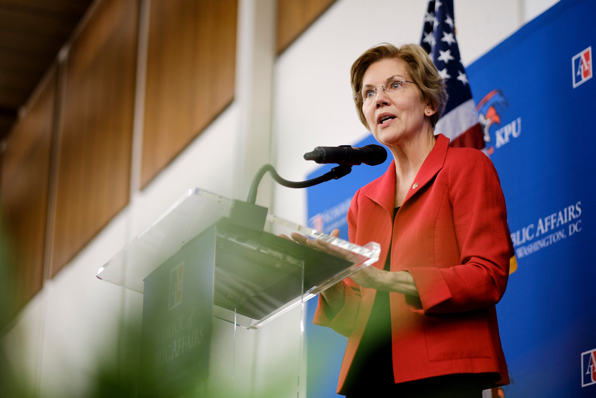
Elizabeth Warren, the Massachusetts senator, is now rolling out a platform for her almost-certain presidential campaign, and it includes an answer to this question. It is a fascinating one, because it differs from the usual Democratic agenda of progressive taxes and bigger social programs (which Warren also supports). Her idea is the most intriguing policy idea to come out of the early 2020 campaign.
Warren wants an economy in which companies again invest in their workers and communities. Yet she doesn’t believe it can happen organically, as it did in the 1940s, because financial markets will punish well-meaning executives who stop trying to maximize short-term profits. “They can’t go back,” she told me recently. “You have to do it with a rule.”
She has proposed a bill in the Senate — and Ben Ray Luján, a top House Democrat, will soon offer it there — that would require corporate boards to take into account the interests of customers, employees and communities. To make sure that happens, 40 percent of a company’s board seats would be elected by employees. Germany uses a version of this “shared-governance” model, mostly successfully. Even in today’s hypercompetitive economy, German corporations earn nice profits with a philosophy that looks more like William Benton’s than Gordon Gekko’s.
Is Warren’s plan the best way to rein in corporate greed? I’m not yet sure. I want to see politicians and experts hash out her idea and others — much as they hashed out health care policy in the 2008 campaign.
But I do know this: American capitalism isn’t working right now. If Benton and his fellow postwar executives returned with the same ideas today, they would be branded as socialists. In truth, they were the capitalists who cared enough about the system to save it. The same goes for the new reformers."
Opinion | American Capitalism Isn’t Working. - The New York Times: