Saturday, January 31, 2026


U.S. Allies Are Drawing Closer to China, but on Beijing’s Terms - The New York Times
U.S. Allies Are Drawing Closer to China, but on Beijing’s Terms
"As Washington unsettles its partners, Beijing is reaping diplomatic gains, without backing down on human rights, trade or security.

When President Trump upended global trade with his “Liberation Day” tariffs last year, China could have seized the moment to win over bewildered U.S. allies and partners with a charm offensive. Instead, it did the opposite.
Beijing threatened countries that dared to cooperate with the Trump administration in restricting trade with China. And when China unveiled a plan to choke exports of its critical supplies of rare earths, it targeted the world, not just the United States.
It was a high-stakes gamble by President Xi Jinping of China. Rather than provide relief to spurned American allies, Beijing wanted to compound their dilemma, analysts say, so that countries unnerved by Washington would learn that crossing China also carried economic pain.
The calculation was that those countries would eventually seek closer ties to China to hedge against the United States, and that when they did so, they would be more accommodating of Beijing’s interests.
That bet is now paying off with the procession of European and Canadian leaders arriving in China seeking to deepen ties with the world’s second-largest economy — even as Beijing has conceded little on the issues that once divided them, like human rights, espionage, election interference and unbalanced trade. (This outreach has drawn a sharp rebuke from Mr. Trump, who warned on Friday that it was “dangerous” for Britain and Canada to look to China as the answer to their economic woes.)
“China chose to accentuate rather than alleviate the pressure on the allies to force them to tilt closer to Beijing’s position,” said Jonathan Czin, a researcher at the Brookings Institution who previously worked at the C.I.A. analyzing Chinese politics. “Beijing’s patient policy now seems to be paying dividends.”
That was underscored by Prime Minister Keir Starmer of Britain, who reversed years of frosty relations on a visit to China this week, the first by a British leader since 2018.
Mr. Starmer made clear that his priority was cutting business deals while tiptoeing around contentious issues like the imprisonment of the Hong Kong democracy activist Jimmy Lai, a British citizen. Critics of Mr. Starmer say he also caved to Beijing when his government recently approved a new Chinese mega-embassy in London despite concerns that it would enable China to ramp up spying.
Similarly, Prime Minister Mark Carney of Canada arrived in Beijing this month as the first Canadian leader to travel to China in almost a decade. He sought a “pragmatic” reset with a country that has imprisoned Canadian nationals, meddled in Canada’s elections and dressed down its former prime minister.
Mr. Carney announced a “new strategic partnership” with China, agreed to cut tariffs on a small number of Chinese electric vehicles and made clear that Canada was willing to break ranks with the United States for its economic survival.
“Beijing has played this all extremely well, much better than they could have reasonably expected at this time last year,” Mr. Czin added.
Some Chinese analysts argued that China’s refusal to budge in the face of U.S. pressure commanded a certain geopolitical deference.
America’s allies need to “diversify the risk of their dependence on the United States,” said Wang Yiwei, a professor of international relations at Renmin University in Beijing. “Naturally, they chose China.”
“China’s might has won respect,” he said. “China’s stance has won respect.”
Beijing has been quick to capitalize on this opening. Mr. Trump’s aggressive maneuvers — like tariffs and military strikes in Venezuela, the Middle East and Africa — have allowed Beijing to cast itself, however improbably, as a defender of the rules-based order, the global trading system and a leader of the Global South.
China has long sought to drive a wedge between the United States and Europe. This campaign has been helped by Mr. Trump’s threats to seize Greenland, which have rattled the foundations of the North Atlantic Treaty Organization, the security alliance that Beijing has long considered one of America’s greatest strengths.
Since December, when President Emmanuel Macron of France toured China (and was mobbed by adoring students at a university in Sichuan Province), Western leaders have been lining up to seek an audience with Mr. Xi, while he holds court as the indispensable partner in an unstable world. In addition to the prime ministers of Canada and Britain, visitors have included leaders from Ireland, South Korea and Finland, and Chancellor Friedrich Merz of Germany is expected to arrive in the coming weeks.
“As Trump widens divisions between America and its traditional partners, China is sitting back and collecting the diplomatic windfall,” said Ryan Hass, the director of the John L. Thornton China Center at the Brookings Institution.
“The growing rift between America and its traditional partners gives Beijing more margin for error in its diplomacy with these countries,” Mr. Hass continued. “Beijing does not feel it needs to make concessions to pull these countries closer, it just needs to remain predictable and firm on its top goals.”
That could make it more difficult for Europe and other Western allies to push back on matters that are important to them, like China’s support for Russia in the war in Ukraine and China’s global trade surplus, which reached a record $1.2 trillion last year.
It could also leave Taiwan, the self-governing island claimed by Beijing, more isolated and exposed to Chinese coercion. Already, two Canadian members of Parliament cut their visits to Taiwan short at their government’s request days before Mr. Carney was set to embark on his trip to China.
“Beijing will increasingly use whatever it has to make sure that countries do not speak or act out of line on these trigger issues, especially when it comes to Taiwan,” said Yanmei Xie, a senior associate fellow at the Mercator Institute for China Studies and a senior adjunct researcher at RAND’s China Research Center.
Ms. Xie argued that Canada and China have effectively swapped roles. Canadian prime ministers used to arrive in Beijing dangling offers of nuclear energy technology and other advanced industrial products. This time, Mr. Carney traded a foothold for Chinese electric vehicles in Canada for the easing of Chinese tariffs on Canadian canola.
“It’s a poignant display of the techno-industrial rise of China and the technical industrial decline of the West,” Ms. Xie said.
The parade of Western leaders has provided a propaganda win for China, masking a domestic reality of an economy in the doldrums and a military leadership hollowed out by political purges. “Xi leads China’s diplomacy to usher in new chapter in turbulent world,” one headline in a state media report said.
“The applause for China at Davos is sincere,” said another headline, referring to the World Economic Forum, a gathering this past month in Switzerland of world leaders and corporate executives.
Still, some Chinese analysts view the rebalancing by Western countries as a short-term pivot rather than an enduring change of heart. The United States, they said, has long underwritten the global trading system that allowed its allies and partners to thrive. China, on the other hand, has frustrated many countries by dumping exports onto their markets and using state subsidies to tilt the playing field in favor of Chinese firms.
“This is purely a short-term tactical remedy, not a reorientation toward China,” on the part of the West, said Shen Dingli, an international relations expert based in Shanghai.
David Pierson covers Chinese foreign policy and China’s economic and cultural engagement with the world. He has been a journalist for more than two decades.
Berry Wang is a reporter and researcher for The Times in Hong Kong."
ICE Expands Power of Agents to Arrest People Without Warrants - The New York Times
ICE Expands Power of Agents to Arrest People Without Warrants
"An internal memo changed the standard from whether people are unlikely to show up for hearings to whether they could leave the scene.

Amid tensions over President Trump’s immigration crackdown in Minnesota and beyond, federal agents were told this week that they have broader power to arrest people without a warrant, according to an internal Immigration and Customs Enforcement memo reviewed by The New York Times.
The change expands the ability of lower-level ICE agents to carry out sweeps rounding up people they encounter and suspect are undocumented immigrants, rather than targeted enforcement operations in which they set out, warrant in hand, to arrest a specific person.
The shift comes as the administration has deployed thousands of masked immigration agents into cities nationwide. A week before the memo, it came to light that Todd M. Lyons, the acting director of the agency, had issued guidance in May saying agents could enter homes with only an administrative warrant, not a judicial one. And the day before the memo, Mr. Trump said he would “de-escalate a little bit” in Minneapolis, after agents fatally shot two people in the crackdown there.
The memo, addressed to all ICE personnel and signed on Wednesday by Mr. Lyons, centers on a federal law that empowers agents to make warrantless arrests of people they believe are undocumented immigrants, if they are “likely to escape” before an arrest warrant can be obtained.
ICE has long interpreted that standard to mean situations in which agents believe someone is a “flight risk,” and unlikely to comply with future immigration obligations like appearing for hearings, according to the memo. But Mr. Lyons criticized that construction as “unreasoned” and “incorrect,” changing the agency’s interpretation of it to instead mean situations in which agents believe someone is unlikely to remain at the scene.
“An alien is ‘likely to escape’ if an immigration officer determines he or she is unlikely to be located at the scene of the encounter or another clearly identifiable location once an administrative warrant is obtained,” Mr. Lyons wrote.
The Times shared a description of the memo’s contents with several former senior ICE officials from the Biden administration. Claire Trickler-McNulty, a former senior adviser at ICE, called the new definition “an extremely broad interpretation of the term ‘escape.’”
“It would cover essentially anyone they want to arrest without a warrant, making the general premise of ever getting a warrant pointless,” she added.
Mr. Lyons’s memo explicitly portrays the revised interpretation of “likely to escape” as a change from how ICE had “previously applied the phrase.” But Tricia McLaughlin, a Department of Homeland Security spokeswoman, said that “this is not new.”
“This is simply a reminder to officers,” she wrote in a statement, to keep “detailed records on their arrests.”
The Trump administration has pushed ICE to significantly increase arrests per day as part of its mass deportation campaign. The agency has carried out more indiscriminate sweeps — like rounding up people in Home Depot parking lots looking for work — rather than targeted operations in which agents set out, warrant in hand, to arrest specific people.
Such roundup operations could still involve administrative warrants if supervisors on the scene quickly fill out the paperwork, known as a Form I-200. The change lowers the standard for arrests even without a supervisor’s approval.
Mr. Lyons’s memo lists factors agents can consider when deciding whether the standard has been met, including whether someone obeys commands or tries to evade them; has access to a car or other means to leave; has identification or work authorization documents agents suspect are fraudulent; or provides “unverifiable or suspected false information.”
The memo tells agents who make warrantless arrests to fill out a form afterward that documents the factors they considered in determining that someone was “likely to escape.” That includes situations in which agents set out to arrest a particular person and then take others in the vicinity into custody. Mr. Lyons called that group “collateral aliens.”
“If an immigration officer encounters and arrests multiple collateral aliens, his or her analysis as to the likelihood of escape must be specific to each alien arrested,” the memo said. “That one collateral alien is likely to escape does not necessarily mean another collateral alien is also likely to escape.”
But this kind of assessment requirement only goes so far: The memo stresses that “particular factors may be common to multiple aliens arrested at the same time.”
During the first Trump administration, a class-action lawsuit claimed that agents had been illegally profiling in traffic stops as a pretext for warrantless arrests. In 2022, the Biden administration agreed to a settlement that included a three-year nationwide policy. Plaintiffs last year accused the second Trump administration of violating the agreement, prompting litigation.
The policy standard in the 2022 settlement included factors that resembled Mr. Lyons’s list. But it also included “ties to the community (such as a family, home or employment) or lack thereof, or other specific circumstances that weigh in favor or against a reasonable belief that the subject is likely to abscond.”
But Mr. Lyons’s memo noted that when agents encounter people they suspect are in the country illegally, the agents are not likely to be able to know much about them. “This on-the-spot determination as to the likelihood of escape is often made with limited information about the subject’s identity, background or place of residence and no corroboration of any self-serving statements made by the subject,” he wrote.
Scott Shuchart, a former head of policy at ICE during the Biden administration, said the memo would open the door to more frequent warrantless arrests.
“This memo bends over backwards to say that ICE agents have nothing but green lights to make an arrest without even a supervisor’s approval,” he said. The memo, he warned, said that “even that supervisor’s note can almost always be sidestepped so long as the officer can say anything remotely plausible about the person being arrested possibly leaving the area.”
Hamed Aleaziz covers the Department of Homeland Security and immigration policy for The Times.
Charlie Savage writes about national security and legal policy for The Times."
Friday, January 30, 2026
Thursday, January 29, 2026
Battles Are Raging Inside the Department of Homeland Security - The Atlantic
Battles Are Raging Inside the Department of Homeland Security
"Officials overseeing Trump’s mass-deportation campaign are fighting one another for power.
This article was featured in the One Story to Read Today newsletter. Sign up for it here.
Homeland Security Secretary Kristi Noem appeared before a bank of television cameras in Washington, D.C., on Saturday night to blame the man who had been shot to death by federal agents in Minneapolis that morning for his own death, claiming without evidence that he had intended “to kill law enforcement” and had been “brandishing” a weapon. Behind her stood the commissioner of Customs and Border Protection, Rodney Scott, sending a silent message of unity.
But behind the scenes, the senior ranks of the Department of Homeland Security were divided. Until minutes before they walked in front of the cameras, Noem and Scott had not spoken to each other that day, even as Noem took charge of her department’s response to the shooting and coordinated with the White House and other officials in Scott’s agency, two people familiar with their interactions told us.
Donald Trump has said over the years that he welcomes and even encourages rivalries in his administration, and delights in watching aides compete to please him. But for the past year, the president has allowed a rift to widen within the team tasked with delivering on the mass-deportation plan that is his most important domestic-policy initiative. That has led to months of acrimony and left many veteran officials at DHS—including those who support the president’s deportation goals—astonished at the dysfunction.
The president’s crackdown has adopted an improvisational approach, not an institutional one, with blurred leadership roles and no clear chain of command. White House Deputy Chief of Staff Stephen Miller has been holding daily conference calls pressuring DHS and other federal agencies to prioritize immigration arrests and deportations above all other objectives. Noem and her de facto chief of staff, Corey Lewandowski, who has been working at DHS as a “special government employee,” have aggressively tried to meet Miller’s demands and use the department’s advertising budgets and social-media accounts to promote anti-immigrant messaging. They have worked around Tom Homan, the White House “border czar,” who has had little role in operations, instead dispatching a second-tier Border Patrol official named Gregory Bovino to sweep through cities led by Democrats. Bovino told his superiors that he reported directly to Noem, not to Scott—who wanted his agents to go back to protecting U.S. borders, and has struggled to maintain control of his own agency.
This story about the infighting around Trump is based on interviews with 12 people familiar with the tensions inside DHS, including senior administration officials, most of whom requested anonymity to speak frankly about internal events. “The President’s entire immigration enforcement team are on the same page,” the White House spokesperson Abigail Jackson wrote to us in response.

Scott and Homan declined to comment. Tricia McLaughlin, a spokesperson for DHS, told us that Noem’s Saturday comments on the shooting were based on CBP reports “from a very chaotic scene.” McLaughlin added, “We are not going to spend time giving any oxygen to these anonymous accounts.”
When Noem and Scott stepped before the cameras on Saturday, Noem appeared to have the upper hand. But the balance of power has since shifted. Frustrated by the bipartisan backlash to Alex Pretti’s death, Trump announced on Monday that Homan would take over the operation in Minnesota. Bovino has been stripped of his “commander” role and sent back to his old job on the border in El Centro, California. Seemingly well aware of the divides around him, Trump announced that he was removing Noem from the chain of command in Minnesota. “Tom is tough but fair, and will report directly to me,” Trump said.
When Homan spoke to reporters today, with Scott standing behind him, he tried striking a conciliatory tone and that he’d arrived to make changes in federal operations. “I didn’t come to Minnesota for photo ops or headlines,” he said. Homan urged Minnesota leaders to give ICE more access to detainees in local jails, and said he’d withdraw federal forces if cooperation improves.
Homan and Scott arrived in the state Monday with orders to de-escalate tensions in Minneapolis, which Trump has flooded with 3,000 federal agents—the largest Homeland Security deployment in history. That same day, Noem and Lewandowski went to the White House for a two-hour meeting with the president and some of his top aides, but not with Miller. The following day, Trump said that he had come to share the concerns of Scott and Homan, saying that it was normal for him to “shake up teams.”
“You know, Bovino is very good, but he’s a pretty out-there kind of a guy,” Trump told Fox News. “And in some cases that’s good; maybe it wasn’t good here.”
But the battle inside the agency continued. Scott sent an email to senior officials at CBP on Monday reminding them that he was in charge of the agency and that they report to him, according to two people familiar with the document. Yesterday, the DHS general counsel James Percival notified CBP employees to disregard the email because it had not gone through legal review, the people told us.
The split between the two factions is not ideological. Homan and Scott are no less hard-line on border and immigration enforcement than Noem and Lewandowski are. Homan—who was an architect of the family-separation policy during Trump’s first term—wants to ramp up deportations with more ICE officers, detention capacity, and deportation flights, but without the social-media trolling and the show-me-your-papers approach to fishing for deportees in American cities.
Both men worked their way up through the ranks of their agencies. They represent an institutional wing of MAGA that wants to pursue the president’s deportation goals using existing chain-of-command structures and the conventional division of labor, in which the Border Patrol guards the border and ICE handles immigration arrests in U.S. cities, usually aiming to minimize disruption. They also have the backing of many career officials at DHS who told us that they see Noem’s approach as ad hoc, performative, and possibly motivated by her own political ambitions, with Lewandowski pulling the strings. At DHS headquarters in southeast Washington, staffers address Lewandowski as “chief” even though he doesn’t have an actual title there, three current officials told us.
Allies of Noem, meanwhile, have decided that Homan and Scott are bureaucratic dinosaurs who are unable to achieve the president’s objectives. They have tried to satisfy the demands of Miller, who runs immigration policy inside Trump’s orbit and functions as the actual “czar” of the president’s deportation campaign. Miller has set aggressive benchmarks for using the $170 billion in ICE and CBP funding included in Trump’s budget bill last year, telling ICE officials to make 3,000 immigration arrests a day to hit the White House target of 1 million deportations a year. Noem put CBP officials in charge of ICE offices and diverted highly trained investigative agents from trafficking cases and drug cartels to make immigration arrests on city streets.
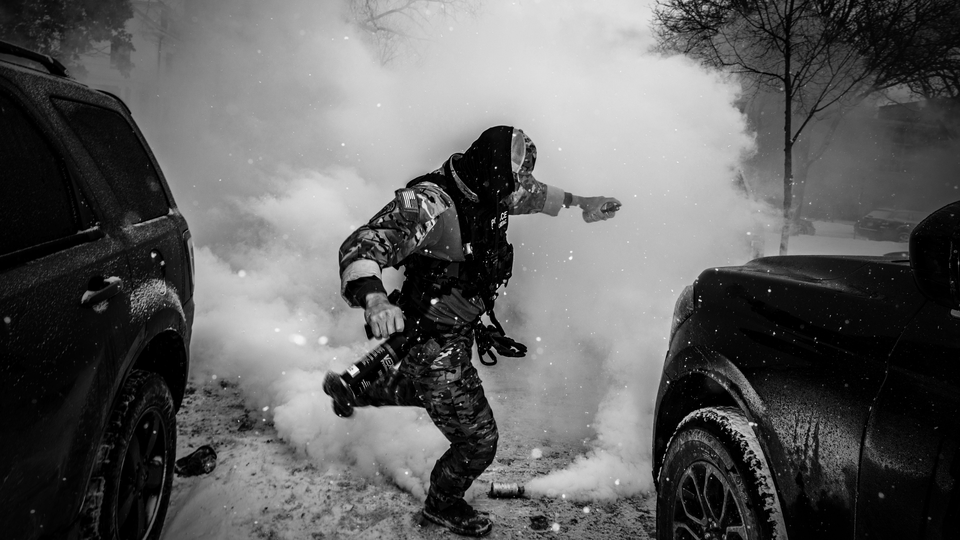
The killings of Pretti and Renee Good this month have been the two most politically damaging events in a wider, militarized show of force that has turned Trump’s best-polling issue into a political liability. Noem has spent more than $200 million on advertising to promote the deportation campaign, but it has instead been defined largely by images of excess: toddlers being taken into custody, U.S. citizens being yanked from their cars, Bovino’s masked commandos storming a Chicago apartment building after rappelling from a Black Hawk helicopter.
Read: Who wants to work for ICE? They do.
“Memes don’t win the media narrative. Professionalism does,” a veteran official critical of Noem and her team told us. Another former DHS official told us that Trump’s mass-deportation goals have been held back in the process. “Look at the whole thing playing out in Minnesota,” the former official said. “A lot of the controversy and negative optics could have been avoided—and are avoided in other locations—if not for Corey and the secretary.”
Allies of Homan and Scott believe that a reckoning may be coming. “Lewandowski messed up by going to war with Rodney Scott and deploying Bovino to the interior,” one senior DHS official told us. “There is no one at DHS with higher credentials than Scott, and sidelining him for petty reasons distracts from POTUS missions.”
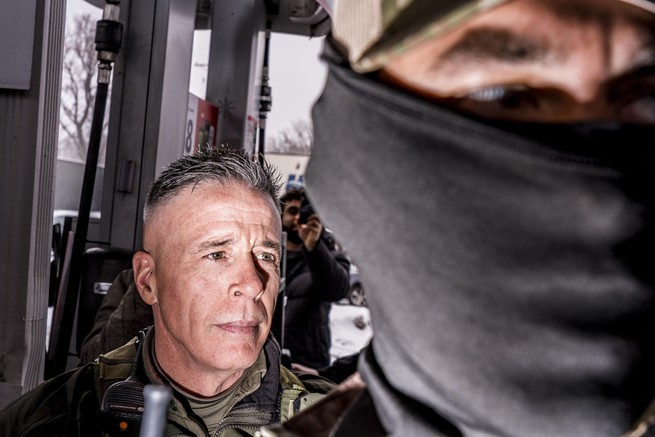
Critics of Scott who spoke with us argue that he lacks the focus and drive to achieve the president’s priorities, spends too much time in meetings that don’t end in decisions, and is failing to do enough to drive the president’s top priority of finishing the border wall. They say that he had little involvement in the CBP deployment to Minnesota and other cities, and did not visit the state to meet with commanders on the ground until this week. “He is not a team player,” one Homeland Security official told us of Scott. “I really think Rodney is kind of on an island.”
During the meeting with Trump on Monday, Noem spoke at length about her concerns with the slow pace of border-wall construction, according to a person briefed on the conversation. Since the start of Trump’s second term, only about 24 miles of wall have been built, including replacement sections, the person said. Noem has made clear that she holds Scott responsible.
“The president was very focused on the status of the wall,” the official said. “The president is pissed.”
The breakdown that led to this week’s shift inside DHS dates back months. Noem lacks the ability to fire Scott, who was confirmed by the Senate, so she has had to get creative. Late last year, her deputies forced Scott to fire several of his senior staff, moves that were recently reported by the Washington Examiner. Scott’s chief of staff was then promoted, and Noem’s office selected a replacement. After Joseph N. Mazzara, an attorney working in Noem’s office, was installed as CBP deputy commissioner, Scott attempted to reclaim control of his agency.
In a memo sent on January 6, described to us by four people familiar with its contents, Scott asked senior leadership at CBP to report to his office any contact they had with “special government employees”—a request that many interpreted as an effort to curtail the influence of Lewandowski. Within hours, the DHS general counsel James Percival had objected to the memo, as had the White House counsel’s office. A White House official told us that the involvement of the White House counsel followed a normal practice of engaging with general counsels at government departments on “issues of common concern.”
Despite the pushback, Scott’s office issued a second memo later that day to senior CBP officials: They should log any communications with officials outside the agency, including senior DHS and White House officials. Both memos were ultimately rescinded after legal pushback from DHS and the White House counsel, these people told us. Scott’s fumbled attempts to curtail outside influence on his agency raised further concerns at DHS headquarters about his leadership. “You don’t get to this level where you jump on your horse and play cowboy like that,” one person familiar with the events told us.
Days later, Scott found his credibility publicly under attack. Politico reported that top brass in Noem’s office had objected to plans for a $2.1 million office refurbishment at CBP headquarters in Washington. (Renovation questions are known to get the president’s attention. Just days earlier, the Justice Department had launched an investigation into the chairman of the Federal Reserve and a $2.5 billion renovation he was overseeing.) The Office of Management and Budget, in a move that has not been previously reported, began asking CBP about the plans, exploring whether they violated the Antideficiency Act, which prohibits spending that contradicts congressional appropriations, according to three people familiar with the outreach.
Read: The wrath of Stephen Miller
On the same day that the Politico article was published, Miller gathered agency leaders at the White House to discuss the administration’s success in spending funds appropriated with the One Big Beautiful Bill Act. Scott told those gathered that starting on February 1, wall construction would speed up dramatically. Others in the department doubt he will be able to achieve his new goals.
A veteran official involved with the border-wall project told us that contracting rules imposed by Lewandowski last summer—which require Noem’s signature on any contract or modification exceeding $100,000—have slowed the pace of construction. The funding bill provides nearly $50 billion for the border wall (10 times the amount that triggered a congressional shutdown in late 2018), and the official estimated that more than two-thirds of the contracts are worth $100,000 or more.
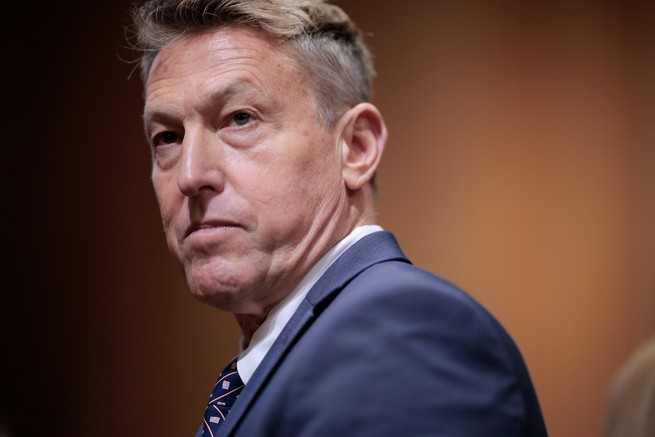
Noem’s team says that this is false, contending that she quickly approves contracts and that CBP has not yet awarded all of the prime contracts for construction. “None of this is on Noem,” the DHS official told us.
In recent weeks, DHS officials have discussed hiring a management contractor to oversee the planning and construction of the border wall, replacing senior officials at CBP. The idea has faced some resistance because it would echo an effort undertaken by former President George W. Bush in 2006, when his administration hired Boeing, a defense contractor and commercial-airplane manufacturer, to oversee $2.5 billion in spending on border security. By 2010, CBP’s inspector general was reporting that the agency had failed to properly manage the contract, which was dogged by missed deadlines and cost overruns.
“Adults have arrived.” That’s how one DHS official deployed in Minneapolis described the appearance of Homan and Scott.
Homan began by meeting with Minnesota Governor Tim Walz and Minneapolis Mayor Jacob Frey. “While we don’t agree on everything, these meetings were a productive starting point and I look forward to more conversations with key stakeholders in the days ahead,” Homan announced on social media afterward. Trump officials have been targeting the two men and other Democratic leaders in the state with a criminal investigation and possible obstruction charges. Todd Blanche, the deputy attorney general, accused them of “terrorism” just two weeks ago.
Administration officials insist that the Minneapolis crackdown will continue, but they have started pulling Border Patrol agents out of the city. Homan is trying to compel Democratic leaders to ease local “sanctuary policies” and give ICE more access to local jails and immigrants with criminal records. Walz and other Minnesota leaders want the government to allow the state to conduct an investigation into Pretti’s killing.
Read: The truth about ICE’s recruiting push
Bovino’s return to his old job on the border leaves the administration without a field commander for the rolling conquest of blue cities that has defined its strategy since May. The White House has not clarified whether that approach will continue or whether Homan will now be in charge of the president’s wider removal campaign. But McLaughlin, the DHS spokesperson, announced that Noem is “very happy” to have Homan take over in Minnesota. “Her portfolio is really huge,” McLaughlin said.
When the 2018 family-separation policy became a political debacle, Trump officials scrambled to distance themselves. The same impulse is again on display. After previously championing Bovino’s efforts in Minnesota, Noem’s team has this week privately pointed to the arrest quotas pushed by Miller at the White House as a cause of the problems. Miller called Pretti an “assassin” within hours of the shooting. But on Tuesday, he suggested that the failure of the CBP team in Minneapolis to follow White House guidance may have played a role in Pretti’s death.
Bovino’s Border Patrol agents were sent to U.S. cities in part because ICE didn’t have enough deportation officers to meet Miller’s goals. But since last summer, Noem has hired 12,000 new officers, agents, and other staff, more than doubling the size of the ICE workforce. Many of those officers are not ready for deployment, but they could hit the streets in full force over the coming months, giving Homan—or whoever is running the deportation campaign—the ability to ramp up ICE arrests in multiple cities at once. Without Bovino in charge, the effort could look very different, and produce even more deportations."
What MAGA Sees in the Minnesota Mirror
What MAGA Sees in the Minnesota Mirror

"You’re reading the David French newsletter. Reflections on law and culture, war and peace, and the deeper trends that define and divide America.
It’s important to know exactly what is happening in our country. President Trump suffered a setback in Minneapolis. His larger project proceeds apace, however, and it’s creating a parallel MAGA reality that is laying the foundation for a further escalation of state violence.
Here’s how the process works. First, federal officers (mainly from ICE and the Border Patrol) engage in extraordinarily aggressive and lawless conduct, including initiatingphysical contact with protesters or members of the public.
And they’re not limiting their aggression to criminal illegal immigrants, the “worst of the worst.” They’re detaining people who have been granted lawful status, they’ve swept up citizens in the dragnet and they’re claiming the authority to enter people’s homes without judicial warrants granting them a right to search.
Second, as many people (including me) have noted, when a confrontation occurs, the administration and its allies in Congress immediately release statements blaming the victims, often using the strongest possible language — calling them “domestic terrorists” or “seditionists.”
Think of the dreadful things they’ve said about Renee Good and Alex Pretti, two Minnesota residents who were gunned down by federal agents on the streets of Minneapolis. Kristi Noem accused Good of committing an act of “domestic terrorism.” Vice President JD Vance called her actions “classic terrorism.” President Trump said she “violently, willfully, and viciously ran over the ICE Officer.”
None of those statements are remotely supported by the available evidence.
The administration’s slander of Pretti may have been even worse. Gregory Bovino, then still serving in Minnesota in his capacity as Border Patrol commander at large, saidPretti (who had a valid firearms permit and was carrying a gun but did not appear to touch it, much less brandish it) looked like he was attempting “to do maximum damage and massacre law enforcement.” Noem accused him, too, of “domestic terrorism,” and Stephen Miller called him “an assassin” who “tried to murder federal agents.” Vance reposted Miller’s slanderous accusation.
Again, none of those claims were supported by any meaningful evidence.
The administration makes these statements before there’s any investigation and sometimes before they’ve even had an opportunity to review all the publicly available evidence, including cellphone videos. If the encounter isn’t fatal, they’ll often file criminal charges and put out news releases trumpeting their prosecution.
You get the feeling that if they could charge the dead with crimes, they’d do so, with glee.
Third, when members of the media try to carefully report the facts and call into question the administration’s account, then that’s a fresh outrage. To MAGA, contrary media accounts are yet another example of the activist legacy media lying and spinning.
Finally, when the criminal cases come before the court, the administration often can’t support its claims, and the cases are dismissed again and again. Adverse legal rulings anger MAGA even more — now the judges are also engaged in a form of “legal insurrection” or nullification of federal law.
Protests make MAGA mad. Journalism makes MAGA mad. Accountability makes MAGA mad. And the anger keeps building until a single sentence starts to spread across the length and breadth of Trump’s base: “Invoke the Insurrection Act.”
Viewed through one prism, this pattern is a form of political suicide. As the polling demonstrates, many Americans who thought they were voting for better border controls and tougher immigration restrictions are unhappy with Trump’s aggression.
Voters don’t like the sight of masked officers dragging people out of homes and stores and cars. They don’t like the hype videos on social media in which ICE and the Border Patrol cosplay as low-rent versions of SEAL Team 6.
They don’t like it when the administration lies and slanders the very people that it hurts and kills, and they get especially angry when cellphone video immediately debunks the administration’s spin.
And to the extent that they pay attention to court proceedings, they definitely don’t like it when the administration is caught lying and defies court orders.
For example, on Wednesday, Patrick Schiltz, the chief judge for the U.S. District Court of Minnesota, issued a remarkable order that cataloged a total of 96 court orders that he said ICE had violated in 74 different cases. “ICE has likely violated more court orders in January 2026,” the judge wrote, “than some federal agencies have violated in their entire existence.”
Schiltz’s order came on the heels of yet another scathing ruling from a federal court. Earlier this month, after the fatal shooting of Renee Good, I wrote about U.S. District Court Judge Sara Ellis’s 233-page opinion that meticulously and carefully exposed a host of lies from the Trump administration — lies it was using to justify its tactics on the streets of Chicago.
At each and every step along the way, the administration is squandering whatever good will it had and increasing the chances of a blue wave in the midterms.
The problem, however, is that the administration is playing a different game. It’s not trying to win hearts and minds, but rather impose its will.
In September 2020, I published a book that argued that American divisions were growing so profound that we risked our national union. I did not think a national divorce was imminent, nor did I think we were drifting toward a civil war like the one we endured from 1861 to 1865, but instead that we were on a dangerous path. There were disturbing parallels between the 1850s and our nation today.
What made a minority faction of American politics decide to break the Union? Obviously, the defense of slavery was ultimately incompatible with the American creed. The nation was on course for a collision between its rising abolitionism and the tenacious forces of slave power, who saw the South’s “peculiar institution” as central to its prosperity and identity.
But why were Southerners so eager to secede in 1860 and 1861? Part of the answer lies with the Southern press. After the December 1859 execution of John Brown, the violent Northern abolitionist who had raided the federal arsenal in Harpers Ferry in an effort to trigger a large-scale slave rebellion, the partisan Southern press amplified the voices of Northerners who admired Brown — even if they admired only his cause, not his tactics — and used those words to intensify latent fear and anger in the white Southern public.
James McPherson, in his magnificent single-volume history of the Civil War, “Battle Cry of Freedom: The Civil War Era,” sets the stage vividly.
A publication called De Bow’s Review wrote that the North “has sanctioned and applauded theft, murder, treason.” A Baltimore newspaper questioned whether the South could “live under a government, the majority of whose subjects or citizens regard John Brown as a martyr and a Christian hero.”
As McPherson wrote, historians have compared the “paroxysm of anger” that seized the South in 1859 and 1860 to the “Great Fear” in France in 1789 when French peasants believed the king’s forces were bent on slaughtering them.
You can see the same dynamic in play in the MAGA movement today. It is gripped by its own “paroxysm of anger.” When undocumented immigrants commit a violent crime, the news blankets right-wing media. We know from the 2024 election that the right will traffic in the wildest lies about immigrant communities, including indulging the fantasy that Haitian immigrants were eating household pets in Springfield, Ohio. Words like “invasion” are omnipresent in right-wing media.
Against that backdrop, from MAGA’s viewpoint, the rest of the country’s response to the deaths of Good and Pretti looks a lot like the North’s response to the execution of John Brown. Neither Good nor Pretti had blood on their hands like Brown, but in the eyes of the MAGA right, they’re dangerous criminals who are responsible for their own deaths.
They are guilty of impeding officers. They are guilty of resisting arrest. Pretti is guilty of bringing a gun to a protest (an odd thing for the right to object to, given its own penchant for armed protest). They are guilty of protecting vicious and violent criminal immigrants.
The right’s echo chamber is so powerful and so hermetically sealed that even serious conservatives can fall for the administration’s disinformation.
On Monday, a Chicago woman named Marimar Martinez filed a motion in federal court asking for relief from a protective order to allow her to share information about her encounter with the Border Patrol with the public.
A Border Patrol agent shot Martinez multiple times on Oct. 4, 2025, and the Trump administration initially claimed that she’d either “rammed” Border Patrol agents or helped “box in” Border Patrol agents with “approximately 10 vehicles.” The Trump administration filed criminal charges against her, only to later ask the court to dismiss the charges, with prejudice (meaning that they can’t be filed again).
Much of the evidence in the case, however, remains under seal. And why would Martinez want all the evidence disclosed? Perhaps because the administration still describes her as a domestic terrorist on the Department of Homeland Security website?
Also, and equally disturbing, Justice Samuel Alito repeated the administration’s false account of the encounter in his dissenting opinion in Trump v. Illinois, the Supreme Court’s recent decision blocking the Trump administration’s National Guard deployment to Illinois.
“In a widely publicized event on Oct. 4,” Alito wrote, “a federal vehicle carrying Border Patrol agents was boxed in on a public road by 10 civilian vehicles, and two of those vehicles rammed the government vehicle. As the agents exited their vehicle, one of the civilian vehicles was driven directly at an agent, forcing the agent to fire in self-defense.”
If that is correct, then why did the Department of Justice ask to dismiss the case, with prejudice?
I don’t think for a moment that Alito would knowingly repeat false information, but it is difficult to discern the truth when you’re exposed to a blizzard of lies — especially when those lies are coming from an institution, the Department of Justice, that has long demonstrated such integrity that judges have granted it a “presumption of regularity,” that is, the presumption that federal law enforcement is operating honestly and lawfully.
It no longer deserves any such presumption. In fact, the Trump administration lies with such regularity and brazenness that one should presume that it’s being dishonest until we can see with our own eyes the evidence that supports its account.
Trump seems to be backing down in Minnesota — to some degree. Bovino, the Border Patrol commander who had been in charge of the Minnesota operation, has been recalled from Minnesota and apparently blocked from posting on social media.
The president sent his border czar, Tom Homan, to the state. Trump has even softened his tone toward the governor of Minnesota, Tim Walz, and the mayor of Minneapolis, Jacob Frey — at least temporarily. On Wednesday, Trump indicated that Frey was “playing with fire” if he refused to enforce federal immigration laws.
Homan is an immigration hawk, but he’s not as aggressive and pugilistic as Noem, and the two have reportedly clashed over Noem’s preference for showy, military-style enforcement operations.
But there is a difference between a change of heart and a tactical retreat. As of this writing, Miller’s post accusing Pretti of being an assassin is still up. Vance’s retweet of Miller’s post is still up. On Tuesday, a homeland security spokesman pointedly refused to back away from calling Pretti a domestic terrorist during an interview with Dana Perino on Fox News.
It was only this past Sunday that Miller claimed that Democrats, “after losing an election, launched an armed resistance to stop the federal government from reversing the invasion.”
And then, as if on cue, Miller attacked the judiciary again just as I was finalizing this newsletter. A federal court in Minneapolis issued an order blocking the administration from arresting or detaining refugees who are legally in the United States, which prompted Miller to post on X, “The judicial sabotage of democracy is unending.”
Do not mistake crisis management for real reform, and don’t believe for a second that MAGA’s fury is easing. It is not chastened by footage showing that Pretti was pepper-sprayed without justification, never reached for his weapon and was riddled with bullets after he was disarmed.
Nor is it chastened by footage showing that the officer who killed Renee Good was already out of harm’s way when he fired the first shot, or by footage showing that he created much of the danger by unwisely walking directly in front of a running car in a chaotic and confused situation. Nor is it chastened by the sound of someone close enough to be heard calling Good a “fucking bitch” right after she was shot and killed in front of her horrified partner.
And if you think MAGA believes that its fury and rage will cripple its ongoing bid for ever-greater power, think of the lesson it took after Jan. 6: Trump could trigger what amounted to an attempted coup and still return to the Oval Office.
So it doesn’t believe the polls. It doesn’t believe the media. It doesn’t believe the courts. In Trump it still trusts, and it’ll remain under his spell when someone else dies and the whole cycle starts over again.
Some other things I did
On Monday, we published a round-table conversation with my colleagues Michelle Goldberg, Lydia Polgreen and Matthew Rose. We talked about the killing of Alex Pretti, and we talked about how to reform ICE:
I like the idea of getting aggressive and specific in response. Take off their masks. End their immunities. Limit their jurisdiction. Restrain their tactics. All of this can be done through legislation without inhibiting humane immigration enforcement. And if it’s done correctly, legislative reform can lead to greater accountability across the whole of government.
On Sunday, I wrote about the way in which the culture war is poisoning higher education. It’s turning colleges into engines of activism, and when activism is more important than inquiry, it can have a pernicious effect:
Over time, this mind-set results in a startling ideological monoculture, in which almost everyone around you is broadly in your ideological camp. When almost every smart person you know agrees with you to some important degree, then it’s very easy to slide to the conclusion that your opponents aren’t just wrong but potentially even stupid or evil.
And who wants stupid or evil people on campus?
The best colleges, by contrast, take the opposite approach. They don’t teach you to double down on your convictions but rather to approach the world with a spirit of curiosity. It’s not that curious people shouldn’t have convictions; but their convictions should be tempered by humility.
Finally, on Saturday, we published a fun conversation with my colleagues Emily Bazelon and Aaron Retica. We discussed the oral arguments in Trump v. Cook in which Lisa Cook, a member of the Federal Reserve’s Board of Governors, is fighting to keep her job after Trump tried to fire her. The argument featured a traditional conservative, Paul Clement, arguing against the Trump administration, and the traditional conservative is going to win:
But there’s another thing that was very interesting, and I don’t think enough people have noticed this. The advocate for Lisa Cook was Paul Clement. This is significant because what you had was a fight between the archetype of MAGA legal philosophy in the solicitor general — probably the best advocate for MAGA legal philosophy in America is the current solicitor general, John Sauer — against not just any conservative attorney, but a guy who would be at the Council of Elrond of originalism.
I mean, this is a guy who is the archetype of the conservative attorney. So, you had MAGA law versus classical conservatism, quite frankly, in that fight. What Clement was able to do was to ping all of Justice Roberts’s and Barrett’s and Kavanaugh’s and Gorsuch’s originalism — set off all of their originalism bells — and he was able to do that fluently.
It was fascinating to listen to the argument because as it went on, I felt like Clement was getting so much more confident. It was like: Oh, I win through door No. 1. But if you don’t like door No. 1, door No. 2 is fabulous, as well. I win through door No. 2.
Rarely have I left an oral argument or listened to an oral argument and emerged from it thinking that the outcome was more clear than this one."