Trump hits South Africa with 30% tariffs - no African country has a higher rate
BBC News in Johannesburg

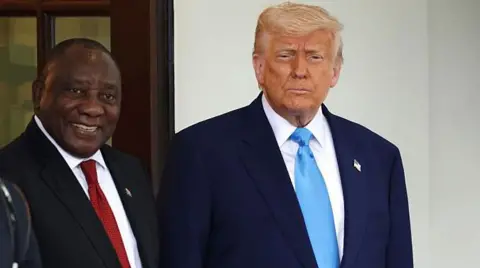 Getty Images
South African products exported to the US will be hit by a 30% tariff from 7 August, President Donald Trump has announced.
South Africa faces the highest rate in sub-Saharan Africa, reflecting Trump's strained relationship with the government of President Cyril Ramaphosa.
Other African nations, including Nigeria, Ghana, Lesotho and Zimbabwe have been hit with a 15% tariff, which will also come into effect in seven days.
The decision is a huge blow to South Africa, as the US is its second-biggest trading partner.
Looking across the whole continent, including North Africa, exports from Algeria and Libya will now also incur a 30% tariff at the US border.
Tunisian goods are facing a 25% rate. Goods from Kenya and Ethiopia, on the other hand, will be charged at the lower 10% rate.
Tariffs are taxes charged on goods bought from other countries - typically, they are a percentage of a product's value.
Trump argues that introducing tariffs will protect American businesses from foreign competition and also boost domestic manufacturing and jobs.
South Africa's automobile, farming and textile sectors had enjoyed duty-free access to the US market under the African Growth and Opportunity Act (Agoa), which was enacted in 2000 to help countries on the continent create jobs and grow their economies.
Trump's announcement effectively spells the end of Agoa, even though it is officially up for review in September.
Ahead of Trump's 1 August deadline, South Africa had been trying to agree a trade deal with the US, which included buying US liquefied natural gas, simplifying rules for US poultry imports and investing $3.3bn (£2.5bn) in US industries like mining, according to the Reuters news agency.
- Ramaphosa struggles to mend fences with Trump
- Lesotho factory that made Trump golf shirts hit hard by US tariffs
- What tariffs has Trump announced and why?
Reacting to the news of the 30% tariff, Ramaphosa said his administration would "continue negotiating with the US" and had "submitted a framework deal" to its US counterpart.
"In the meantime, government is finalising a package to support companies that are vulnerable to the reciprocal tariffs."
The government also noted that there were exceptions for certain goods, such as copper, pharmaceuticals, semiconductors, some critical minerals, stainless steel scrap and energy products.
US-South Africa relations have hit rock-bottom since Trump took office in January.
The US president has stopped all aid to South Africa, accusing it of discriminating against its white minority. South Africa has repeatedly denied this.
Ramaphosa held talks with Trump in May in a bid to mend relations but this failed to make any headway.
Earlier this week, Trump indicated he would "maybe send someone else" to the G20 Leaders Summit taking place later this year in Johannesburg.
"I've had a lot of problems with South Africa. They have some very bad policies," he told reporters.
South Africa Wine said Trump's announcement placed the sector at a "severe disadvantage" compared to competitor countries with lower tax rates.
The association urged the US and South Africa to "intensify efforts to resolve this matter swiftly to avoid long-term harm to trade, investment and jobs".
The US is the fourth biggest importer of South African wine, which also enjoyed duty-free access under Agoa, according to a local report looking at wine exports.
Other African nations have also reacted to the tariffs announcement.
Kenya said it welcomed having the "lowest rate among nations with comparable export interests".
The east African country's trade and industry department also said it remained "committed to deepening its longstanding trade and investment" with the US and would continue engaging with its counterpart to "safeguard and grow the historical trade ties that have benefited both our countries".
In Lesotho, Trade Minister Mokhethi Shelile lamented the announcement of the 15% tariff, telling the BBC that the country's textile and garment industry "will not be able to compete at all" with other markets.
Lesotho is one of the African nations that have benefited most from Agoa, exporting jeans for iconic American brands such as Levi's and Wrangler among others. It had initially been threatened with a rate of 50% - higher than any other country.
TZICC, a Lesotho garments factory that produced sportswear for American companies JC Penney, Walmart and Costco, said it was unhappy with the 15% rate because it "still affects our orders and buyers".
The textile industry, the country's largest private employer, has already been affected by the uncertainty around Agoa and the tariffs, leading to some factories cutting staff or shutting down altogether."
Additional reporting by Shingai Nyoka
Trump Video Doesn’t Show ‘Burial Sites’ in South Africa
Este artículo estará disponible en español en El Tiempo Latino.
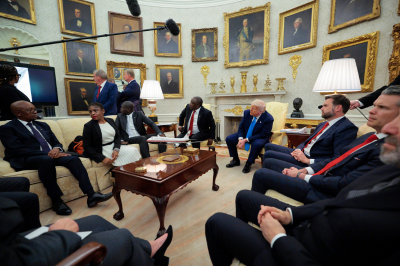
"In a salient moment with the leader of South Africa, President Donald Trump played a video that he said showed “burial sites” for a thousand white farmers — the victims of what he has called a genocide — along a roadside in South Africa.
It actually showed a 2020 demonstration bringing attention to the issue of violence against farmers of all races in South Africa.
Trump made his comments during a May 21 Oval Office meeting with South African President Cyril Ramaphosa a week after the U.S. accepted the first white South African refugees, whom Trump has described as victims of genocide. Ramaphosa pushed back against the claim that there is a white genocide happening in South Africa, and in response, Trump had a staffer dim the lights to play a video.
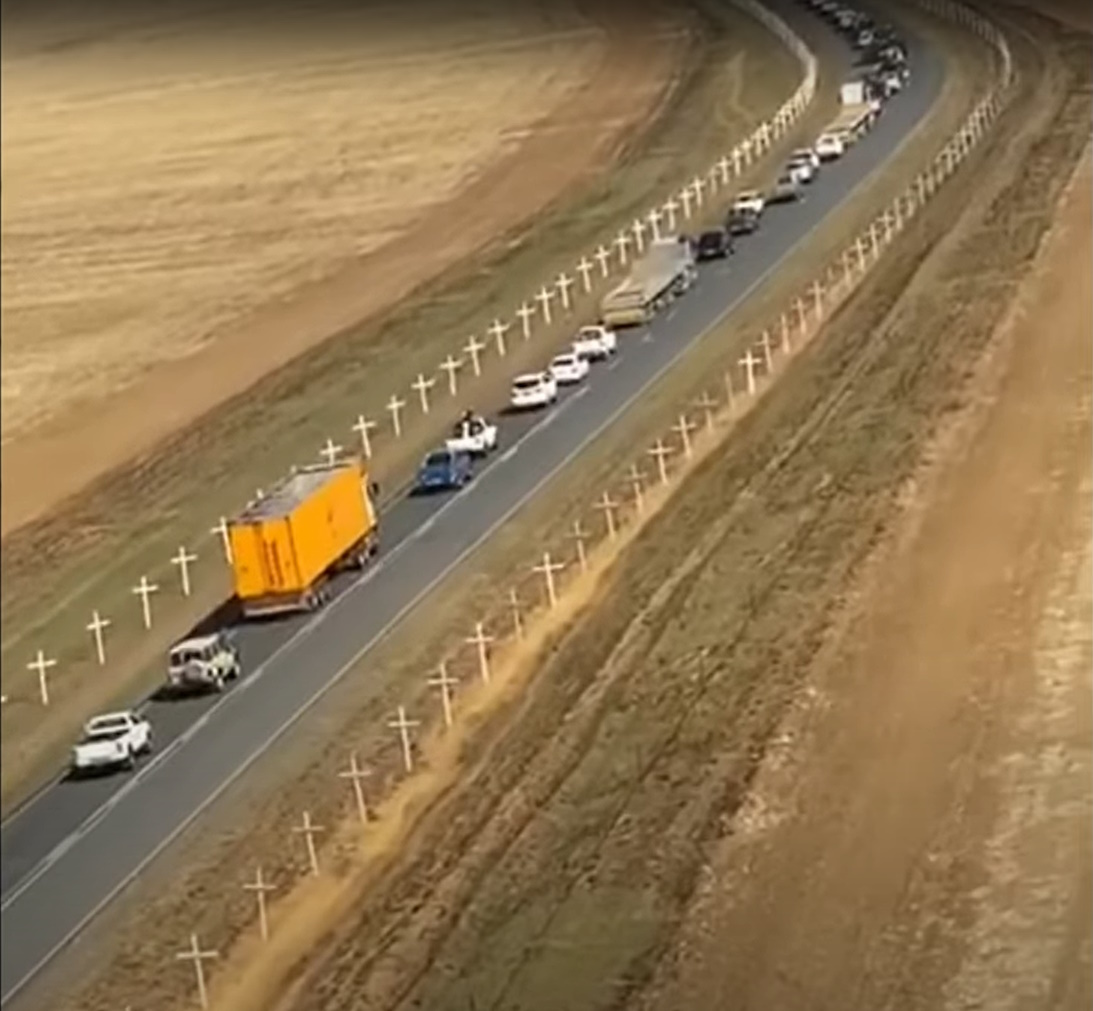
Pointing to the screen, which showed an aerial view of a rural highway dotted on each side with white crosses, Trump said, “These are burial sites, right here. Burial sites — over a thousand of white farmers. And those cars are lined up to pay love on a Sunday morning. Each one of those white things you see is a cross and there’s approximately a thousand of them. They’re all white farmers. The family of white farmers.”
“I’d like to know where that is, because, this — I’ve never seen,” Ramaphosa said.
“I mean, it’s in South Africa,” Trump said.
Rather than burial sites, as Trump claimed, the video showed a demonstration following the August 2020 murder of Glen and Vida Rafferty, who had been killed during a robbery at their farmhouse in Normandien, a rural area about 200 miles southeast of Johannesburg. The crosses along the road were meant to memorialize and draw attention to the many farmers who have been killed over the years.
There is a real issue with South African farmers being killed. Although some have cast the killings as a “white genocide,” experts say that’s not accurate, as we wrote recently. Rather, they said, most of the violent acts are committed during robberies in a country where most of the wealth and land post-apartheid are still owned by a relatively small white minority. White people own about 72% of the farm and agricultural holdings despite making up about 7% of the population, according to a 2017 land audit report commissioned by the South African government.
And, experts told us, while there is a high rate of murder and violence in the country, there is no evidence that white farmers are being singled out. According to police data, murders of farmers are less than 1% of all murders in South Africa. There were 51 murders on farms in 2022-23, figures that aren’t delineated by race, out of a total of nearly 27,500 murders in the country.
“On average, 76 people are murdered in South Africa every day according to 2023/2024 official police statistics,” Lizette Lancaster, of the Institute for Security Studies in South Africa, told us in an email.
“Robberies and murders on farms are recognised as a serious problem by all sectors of society,” she said, going on to explain, though, that “almost all South Africans from all walks of life will agree that there is no white genocide. The government has reacted to persistent claims of a white genocide and the conflation of that with farm murders since Democracy in 1994.”
In an interview with South Africa’s public broadcasting news service, Darell Brown, a farmer who helped organize the demonstration featured in the video Trump showed, said, “The message we’re trying to convey is: farm murders must stop. I don’t mean just murders of white commercial farmers. Farm murders must stop.” He explained that the roadside crosses were representative of farmers who had been killed and called on the government to take the issue seriously.
The demonstration was held on Saturday, Sept. 5, 2020, and took place along the P39 highway between the Raffertys’ home and the nearby town of Newcastle.
The South African news website IOL quoted a participant in the demonstration, Bob Hoatson, as saying that the initiative was not about white farmers: “It was for people from all walks of life who were concerned about farm murders,” he said.
During the Oval Office exchange, Trump asserted, “When they kill the white farmer, nothing happens to them.”
But according to Lancaster, it’s not true that “the government is willfully ignorant (e.g. police) or the security sector is actively complicit in the crimes committed against vulnerable groups.” In South Africa, she said, “government, public sector and community partnerships are yielding results. Farm murders have gone down, rural safety strategies are now in place, and there is nothing particularly exceptional about how gruesome these murders are when you look at the scale of violence in townships, for example.”
In the case of the Rafferty murders, three men have been convicted and are serving time in prison.
“The lives of farmers, farm workers and farm dwellers as well as every citizen of the country, black and white, matters,” then Deputy President David Mabuza said after the Rafferty murders, as he convened a meeting to discuss programs to curb violence against farmers. “It is for this reason that government will continue to work with the Justice, Crime Prevention and Security Cluster to ensure prevention as a priority in dealing with farm murders.”
While violence remains a serious issue in South Africa, the video Trump played did not show 1,000 “burial sites” or prove there is a white genocide in the country."


No comments:
Post a Comment