Wednesday, July 29, 2026


Tuesday, July 28, 2026
The Human Cost of DOGE’s War on U.S.A.I.D
The Human Cost of DOGE’s War on U.S.A.I.D.
Elon Musk, Donald Trump, and the “public man-made death” that they’ve caused.

Illustration by Diego Mallo
Listen and subscribe: Apple | Spotify | Wherever You Listen
Sign up for our daily newsletter to get the best of The New Yorker in your inbox.
In 1988, Richard Rhodes, a historian and a journalist who wrote a definitive study of the creation of the atomic bomb, published an article in the Journal of the American Medical Association called “Man-made Death: A Neglected Mortality.” Rhodes argued that demographers and public-health officials ought to take greater care to account for deaths caused by war, neglect, privation, and other effects of policy. His emphasis was on deliberate acts—artificially induced famines, for example, and the willful dismantling of public-health aid and infrastructure.
Atul Gawande, who was a leading administrator at U.S.A.I.D. until the Trump Administration’s DOGE initiative, led by Elon Musk, set about defunding and destroying the agency, is a surgeon and a longtime New Yorker contributor. In our latest conversation for The New Yorker Radio Hour, Gawande uses Rhodes’s concept to help describe the colossal human cost that Musk and DOGE have exacted on the world. Gawande, backed up by recent academic studies, says that the decimation of U.S.A.I.D. around the globe has been responsible for some seven hundred thousand deaths, and that number will likely ascend into the seven figures. The policy is not only immeasurably cruel, Gawande argues; it is also stupid, badly undermining what remains of American soft power and prestige, from Africa to Latin America. Our conversation has been edited for clarity and length.
Atul, Elon Musk claims there’s no evidence at all that DOGE cuts to U.S.A.I.D. led to even a single death. He tweeted—and I’m quoting here—that “no validated medical funding was stopped,” and that “legitimate life saving funding continued.” You’ve replied saying that the reduction in life-saving aid has already led to no fewer than seven hundred thousand deaths. How did you come to that number?
The seven-hundred-plus thousand that have been estimated to have died at the end of a year since the U.S.A.I.D. closure comes from a couple of different sources. One is a Boston University estimate. A separate one comes from an international study published in The Lancet, looking at the impact U.S.A.I.D. had over the past twenty years—saving ninety-two million lives—and projecting, based on the cuts that have occurred, how many deaths have occurred, and they came up with a very similar number. This is what pissed off Elon Musk. Representative Ro Khanna cited the estimate that 4.5 million children, just children, could die by the end of 2030. The precision of the numbers is a question, but it’s clear that it’s, at minimum, tens of thousands in 2025, and very likely hundreds of thousands.
This is an enormous number, so I think it would be worth specifying: people where? People dying of what? Maybe if you could put some more specificity on this, then it ceases to be just a gigantic number.
Yeah—this is an example of what Richard Rhodes, the historian, called “public man-made death.” A big part of what U.S.A.I.D. did was humanitarian response: disaster relief for tens of millions of people who are fleeing war or in conflict zones or were driven out by floods, and those kinds of things. W.H.O. estimates that, where eighty million people were reached by emergency-health services in 2024, that number in 2025 dropped by more than fifty million people. That included, for example, fourteen million people who were victims of severe, acute malnutrition. 2.5 million of them were children.
Like, a peanut bar that gives you your calories for the day, distributed by community health workers, that the U.S. manufactured, but was cut off—that cut the death rate to less than one per cent. That’s just one category. Another one is childbirth. You know, many of these people who are being forced out of their homes are pregnant. They deliver thousands of babies, and die when they have no services. Another example is Ukraine, which was the biggest single beneficiary of aid—and that was energy infrastructure that kept heat going. It was services for three and a half million children and pregnant women displaced from their homes.
I could go into the H.I.V. story. I could go into the tuberculosis story. I could go into the ways that U.S.A.I.D. was insuring that vaccines were going out in the world. We’re not even beginning to see the vaccine-preventable deaths, the H.I.V. deaths, the TB deaths rise. We know these are only going to grow with time.
Atul, there’s a great deal of discussion about the number seven hundred thousand and the mortality data itself. Help me on that.
One of the complaints is: these are projections. And therefore the projections are fake. When will we actually know what the child-mortality rates are? It’s going to be a while. The U.S. was the provider of some of the best, highest-quality data in the world—out of U.S.A.I.D., which was dismantled. The inspectors general who would be doing audits and investigations to show what systems were broken—they fired the inspector general at U.S.A.I.D. and have intimidated the I.G.s from doing those kinds of investigations. And so the result is, in the best of circumstances, we will have data over the next two to three years.
This is not like deaths of war, where there are mass graves. You have a jump in child mortality from three per cent to four per cent. That’s a one-third jump. And yet, when you’re in a community that has a ninety-seven-per-cent survival rate versus a ninety-six-per-cent survival rate, you don’t feel it, and you don’t see it just from people walking around. We’ve been compiling a tracker. I say “we”—I have put together a team, a group of reporters and journalists that have been compiling all of these reports. And, already, they have documented not only the systems that have gone down but twelve hundred different individually identified people who have directly died from the shutdown of foreign aid.
Musk’s defenders have responded saying that the United States shouldn’t be responsible for taking care of people around the world. What do you say to that argument?
When J.F.K. argued for U.S.A.I.D., he was arguing that assistance abroad, first and foremost, was also assistance to the United States itself. One of the direct benefits to the United States was eradicating polio in the world, eradicating outbreaks. We were the driver of eradicating smallpox, interestingly, with the Soviet Union as the instigator of the idea. This was rooted in the Marshall Plan: the idea that, instead of pillaging the world around us as other nations were defeated in war or weakened, we would invest—invest in their liberty, invest in their economic capacity, invest in their survival. And the result was thirteen out of the top fifteen trade partners of the United States received assistance from the United States along the way, whether it was Germany, or South Korea, or India, or then places like Mexico and Latin America, and now we see Africa starting to become middle-income along the way.
Total foreign aid from the United States was in the sixty-billion-dollar range, got cut by more than sixty per cent, and then what was left has been sort of turned into “Give me your critical minerals or I won’t give you H.I.V. drugs.” This goes hand in hand with an approach that says, “We don’t coöperate in the world, we try to dominate.” U.S.A.I.D. couldn’t be more opposite in its approach.
You mentioned J.F.K. Let me mention R.F.K., Jr. I haven’t heard that much about him in this context. What has he been doing with the C.D.C. and other agencies that fall under Health and Human Services, his agency? What’s he had to say about all this?
First of all, he’s reached beyond H.H.S. by stepping in to block foreign assistance—with White House backing—for vaccines around the world. But, within the H.H.S., C.D.C. is hollowed out as an organization capable of acting, abroad or at home, in public health. More than a quarter of their staffing has been removed. Their laboratories have been shuttered, significant parts of them. The vaccine-advisory committees that are needed to approve vaccines are not functioning at this point, and it’s going to take a while to recover that. C.D.C. can recover it, because they still have an institution. They still have budgets that can be restored. It will take a while to build the expertise and infrastructure. U.S.A.I.D. is a shell and will be hard to bring back. It will take time for countries to trust that every election does not become a change in the goals in the first place.
It takes years to eradicate polio, years to build their surveillance for pandemics, years to reduce malnutrition in the world. And if we’re divided about that, and that becomes political fodder, then the institutions can’t function. We won’t be able to make a way forward. So, I’d say, the No. 1 thing to restore capacity is getting back to a place where we believe that these kinds of institutions are what we all want.
Atul, you can’t read anybody’s mind, but what was Elon Musk’s motivation when it came to cutting U.S.A.I.D. so severely?
The approach of DOGE was like the approach he’s taken with companies like Twitter: take over, slash and burn, and, if anything’s broken, we’ll fix it after. That continues, to this day, to be his argument.
So it’s the vanity of an efficiency expert.
Only he’s destroying in the name of efficiency, and left no efficiency behind at all. He came in believing you could cut two trillion dollars out of government, and it hit the shoals of U.S.A.I.D.—this obscure agency accounting for less than ten dollars per American taxpayer per month—and, within weeks, suddenly it became apparent that there would be catastrophic loss of life, and it made the enterprise incredibly unpopular. He thought this was going to be, you know, a weekend and we’ll move on, and it didn’t turn out to be the case at all.
I wonder if you could give a specific example of a program that went down in flames in this effort, and what the effect of its destruction has been, in concrete terms.
The TB program, which dealt with a long-term effort to try to reverse what is still the biggest infectious killer in the world—and there are drug-resistant strains that are now evading our current arsenal of TB drugs. That work involved a project that I was part of that brought chest X-rays that were read by an A.I. reader, for countries that didn’t have a radiologist. You would screen, get a molecular test the same day, and be able to be put on treatment and follow-up, so that you stay on your medicines, because you have to stay on your medicines for a year. Those trials, the innovation was stopped. The programs to roll out the innovations that have been created were stopped. In South Africa, in Mozambique, in other places like that, where you had high rates of TB, they have now seen the tuberculosis deaths starting to rise. The cases have grown by multiples—and they have the names of people who’ve died.
A couple of things happened financially in the world in the past month. The first is that we have now conclusively discovered that the President of the United States—who we have to say is the person most responsible for this—has enriched himself and his family by, at the very least, a couple of billion dollars in cryptocurrency scams that have taken hold while he’s been President. And Elon Musk has become the first trillionaire in the history of humanity. When you think about this, what possibly motivates these two unbelievably wealthy human beings to exact what seems to me, and certainly seems to you, such ruthless destruction on the health of humanity? What could possibly motivate them? And here I’m enlisting someone who is a surgeon as a possible psychiatrist.
Let me put it this way. In the memorandums of understanding that they now make with countries where they are putting some foreign assistance in, you don’t see commitment to goals like “We’re going to reduce the over-all mortality for children in the world. We’re going to stop neglected tropical diseases.” And the U.S. has led the way in eliminating conditions that ranged from leprosy to river blindness. It’s unimaginable that this is a group of people who would commit to such goals. They see them as woke. They see them as signs of weakness. Their view of the world is—
Wait, wait, wait. How is it “woke” to save the lives of children? Is it because they’re not white European children, in the main?
The world view, the actions that you see, are that you believe the world is an amoral, ruthless “Mad Max” world of the dominators and the dominated, and it is woke to believe that we can come together and solve problems. It is naïveté—and, worse, it’s a distraction from the fact that we’re in a battle, and the world is governed by those who are strong, dominating the weak.
I’ve never had the impression that Trump voters wanted this—that Trump voters were voting for Trump the first time, the second time, or the third time because they wanted to see aid to really disadvantaged populations all around the world dry up and disappear, leading to hundreds of thousands of deaths.
I couldn’t agree more. That has been extremely unpopular. As the word filtered out of abandoning H.I.V. patients, people in clinical trials, you name it . . . the U.S., across both parties and independents, reacted with horror.
What is your sense of how reversible this is? In other words, how much more damage is going to be done, and how much is it possible to put this terrible genie back in its bottle, if that’s the right metaphor?
It’s so unpopular that both Republicans and Democrats in the House and the Senate voted for restoring the budget for foreign aid. They also refused to end and close down U.S.A.I.D. completely, so it exists on paper. And they want the President and his officials to spend the funds on the things they specified—the power of the purse includes instructing the executive branch. It’s already become apparent to the Administration that they need these functions after all. They are now attempting to rehire into the State Department disaster-assistance teams that were dismantled, but they have none of the infrastructure we had, with offices and embassies around the world, depots that had stockpiles ready to go. And it’s not clear they have the intent, but they know that it’s unpopular, so they’re trying to say, “We’re doing some of this stuff.”
So, let’s assume the best thing happens: the money is restored, the infrastructure is rebuilt. In the end, what will be the damage report for this adventure in DOGE?
It’s already public man-made death. We’re at hundreds of thousands of dead. We’re seeing the signs of reversal of gains in H.I.V. I just received information from the African Neonatal Network, and they already have spikes in pregnant women with untreated H.I.V delivering babies. So we know these conditions are getting worse.
It’s not just Democrats turning some of these things back on. We have to have a bipartisan commitment about the idea of the role the United States plays in discovering solutions, coöperating and leading the world together, to get them out into the world, and to set high standards for what the world can accomplish. That’ll take time. But it’s going to be millions of deaths.
Millions of deaths?
It’s millions of deaths.
Earlier, I asked you to be a psychiatrist. Now I’m asking you to be a political analyst—and both things are asking a lot. Who will be held accountable by either the law or, more likely, history in this episode? And let’s hope it’s a limited episode. How will the amount of destruction and death be accounted? And what effect do you think it’ll have on the lives of those responsible for executing this?
I think the reason why Elon Musk, the same month he’s been made a trillionaire, is screaming online and aloud at congressmen and others, and responding to things that I put online, is because he believes he’s going to be held accountable by history.
Trump routinely asks publicly—and, reportedly, privately—about whether he’s going to hell or not. And the anger that is directed at those who suggest there has been public man-made death, the anger comes from the cognitive dissonance between what they want to think they are—world dominators, people who will be remembered in history as having done good—they can’t countenance the image that is suggested by this, which is that they are monsters.
Atul, you were in South Sudan not long ago. Tell me, why were you there in the first place, and what were you trying to find out?
The United States has been instrumental in supporting its very establishment as a country. It’s the youngest country in the world. It has still unresolved political issues and conflicts that have left people very vulnerable, and providing aid against suffering has been a key thing that the United States did. The subcounties I visited, where these primary-health-care centers were, did not have intact government services otherwise.
Who did you talk to?
I met with, first of all, a woman named Angelina David, who is the clinical manager in Panyijiar for the International Rescue Committee clinics. She was overseeing the clinics that were shut down and could tell me exactly what happened. It was a complete shutdown, and a scramble, because there were medicines and other things on the shelves they didn’t want looted, so they had to get out to these places—and they’re very far away. You have to travel, in some cases, seven or eight hours in order to get to the extent of what’s there.
I then went and visited some of those facilities, and I connected, with her help, to the subcounty chiefs—they’re called the payam administrators—who keep their own records of deaths. So one of the things I found was that their own records showed that they are measuring an over-all tenfold increase in child and adult deaths.
Wait. A tenfold increase?
Yes.
And how much of that increase can be put at the feet of DOGE and the cutting of American aid?
I can’t exactly parse it out, but a huge amount of it. You know, it went from forty-two deaths in those seven subcounties for children, for example, over two years, 2023 to 2024, and those deaths rose to two hundred and fourteen, that they recorded.
I also met with villagers and learned of dozens of cases of direct effects. I’ll give you an example. One was a woman I met in a community called Machar, and her name was Nyajiek Gai Guol. Her niece was staying with her, a two-year-old girl, who developed the symptoms of pneumonia. The clinic that would have been there to take the girl to was no longer there. In order to travel, she had to go three hours, walking and by canoe.
The girl arrived alive. They attempted to do resuscitation. She had already gone into organ failure, and died. Completely avoidable. And I found numerous cases like these.
I have to say, not only must this make you beyond furious—the people there, their attitude toward the United States must be transformed, no?
It’s heartbreaking and devastating to see the people we’ve abandoned. They, first and foremost, are furious at their own government. These are people with leaders who have been at war with one another on and off for a couple of decades. Part of our role there has been to be a steady force of support against suffering. America is loved there, and that has not faded.
How is that possible?
Because we’ve generally been there, and there is belief that we have not yet completely abandoned them, that we may yet come back. They know Trump has done it. When I left, however—this was the first time I’d seen this—there was someone from China Aid. China has rebranded their agency in providing coöperation and assistance. And there was an official coming to visit to offer their capabilities.
Let’s say that, in the best scenario, the system is reconstructed. What will that require? And, if the best scenario comes about, what do you think, ultimately, the death toll will be?
You know, my parents came from India, and India was a place of starvation and recurrent droughts, and, with support that lasted a quarter century, emerged after the Green Revolution and food aid as a place that was a food exporter and a breadbasket to the world. And, if we’re not committed to this fundamental proposition, then nothing happens. If we are committed, as we were—as the vast majority of Americans were, for six decades—then incredible things happen. If we believed in it today, we could stop this from being in the millions. The only reason I predict that it gets to seven figures is because we’re so deeply divided over everything right now, as a country. We’ll halt worsening the damage, but it’ll take joint effort to actually stop it and regain our momentum. ♦“
Lindsey Graham, longtime senator from South Carolina and Trump ally, dies at 71
Lindsey Graham, longtime senator from South Carolina and Trump ally, dies at 71
“Senator Lindsey Graham, a prominent Republican from South Carolina and close ally of former President Trump, passed away at 71 due to an aortic dissection. Graham, who served in the Senate since 2002, was known for his strong foreign policy stance and influence on the federal judiciary. He was a close friend of John McCain and Joe Lieberman and left a lasting impact on South Carolina and national politics.
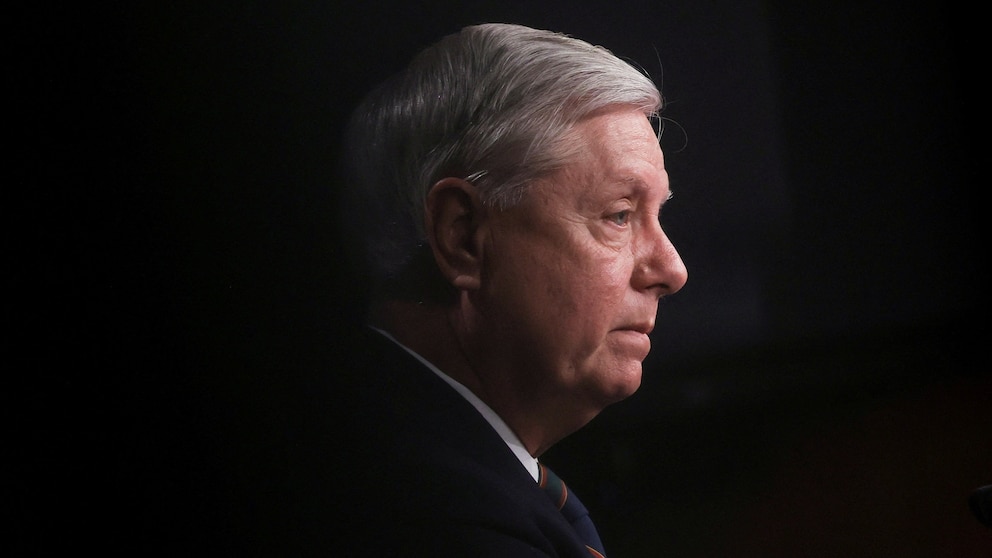
Lindsey Graham, a longtime Republican senator from South Carolina, who had become one of President Donald Trump's staunchest political allies, died on Saturday after a "brief and sudden" illness, his office said in a statement. He was 71.
"Senator Graham's family appreciates prayers at this time and asks for privacy during this incredibly difficult period," said the statement, which was postedearly Sunday on social media.
Preliminary findings from the Medical Examiner of the District of Columbia released on Sunday said the senator died from an "aortic dissection due to arteriosclerotic cardiovascular disease."

Senate Judiciary Committee Chairman Lindsey Graham, R-S.C., prepares for a hearing with Department of Justice Inspector General Michael Horowitz on Capitol Hill in Washington, Wednesday, Dec. 11, 2019.
Susan Walsh/AP
First elected to the Senate in 2002, Graham had in 23 years risen to be one of the chamber's most prominent figures. He won reelection three times, most recently in 2020.
"Senator Lindsey Graham, one of the greatest people and Senators I have ever known, is dead!" Trump said on social media on Sunday morning. "He was always working, and was a true American Patriot. Lindsey will be greatly missed!!!"
Graham was once one of President Trump's most blunt detractors, calling him "a kook," "crazy" and "unfit for office" during Trump's 2016 presidential campaign. Yet he ultimately became one of the president's strongest allies in the Senate, aligned with Trump on most matters. He advised the president on matters of foreign policy, including recently on the Iran war, and was outspoken in support of the president's decision to lead strikes on nuclear sites in Iran last year.
Graham served as the current chair of the Senate Budget Committee, a role he had most recently used to lead the Senate's efforts to pass a roughly $70 billion budget reconciliation bill to provide funding for border security. That legislation was signed by Trump in June.
He was also a member of the Appropriations, Judiciary and Environment and Public Works committees.
In his time in the Senate, Graham also helmed the powerful Senate Judiciary Committee from 2019 to 2022.

Sen. Lindsey Graham speaks to reporters as he arrives at the Capitol during the impeachment trial of President Donald Trump on charges of abuse of power and obstruction of Congress, in Washington, Jan. 27, 2020.
Manuel Balce Ceneta/AP
While atop the panel, he led the committee through the swift confirmation of Justice Amy Coney Barrett to the Supreme Court, following the death of Justice Ruth Bader Ginsburg in the final months of Trump's first term. Graham had earlier been among those who blocked President Barack Obama's nomination of Merrick Garland, his pick to fill the vacancy left by the death of Justice Antonin Scalia, almost 11 months before the 2016 presidential election.
Graham would have returned to the top GOP position on the committee next Congress.
Before his time in the Senate, Graham had served in the House, where he represented South Carolina's third district. He was first elected to that office in 1994 and served four terms.
In his more than three decades in Washington, Graham had sparred with several presidents. As a member of the House in 1998, he was appointed a manager of the impeachment proceedings against then-President Bill Clinton. He was a harsh critic of Obama, as well as President Joe Biden, whom he also considered a longtime friend from their years together in the Senate.
Graham was also once numbered among the fiercest critics of Trump, whom he ran against in the 2016 presidential election, a race he withdrew from before the primaries. But their relationship had softened, with Graham saying he had turned into one of his closest friends.
"On a professional level, I am proud to have been there at the beginning when President Trump -- through sheer force of will -- achieved the greatest political comeback in American history," Graham said in March 2025. "On a personal level, I genuinely enjoy our friendship. He's an awesome golfing buddy, who I have yet to beat."

President Donald Trump jokingly urges Senator Lindsey Graham and his fellow senators to return to the Capitol to vote for more judge nominees during an event to celebrate federal judicial confirmations in the East Room of the White House in Washington, Nov. 6, 2019.
Jonathan Ernst/Reuters
The president recently endorsed Graham in his primary campaign, in which Graham sailed to victory in June with nearly 57% of the vote, defeating several challengers. He was slated to appear on the ballot this November.
Trump held a tele-rally for Graham ahead of the race, praising their partnership amid the war in Iran, which Graham staunchly defended.
"They cannot have a nuclear weapon," Trump said at the time. "And Lindsey has been fighting with me all the way. All the way for that. We've been a very tough team and I think we are winning that battle."
He was a member of the Judiciary committee since he first joined the Senate in 2003. His time on the panel was spent working to mold the federal judiciary. While serving on the committee he helped to advance confirmation of conservative judges to the federal bench, and also became a staunch defender of Trump, his close friend and ally.
Graham in recent statements appeared positive that he and Trump would continue in lockstep if Graham was reelected the in fall.
"Let me tell you in '27, if I win in November, I'll be chairman of the Judiciary Committee," he said. "I'll wake up every morning and go to bed every night, thinking, 'How many judges can we put on the bench before Trump leaves in '28.'"
He had been a foreign policy hawk during his time in office, supporting the president in his war with Iran, making visits to Israel and fostering a strong and at-times contentious relationship with Ukrainian President Volodymyr Zelenskyy. He pushed for military aid to the country, including weapons and financial assistance.

Sen. Lindsey Graham speaks with Christiane Amanpour at a townhall panel on the future of Iran at the 62nd Munich Security Conference, Feb. 13, 2026, in Munich, Germany.
Sean Gallup/Getty Images
Shortly before his death, Graham made his 10th visit to Ukraine -- meeting with Zelenskyy and visiting a drone manufacturer in the country. He and a bipartisan group of senators announced on Friday a bipartisan deal with the White House on a Russia-sanctions bill that Graham had long-championed.
"In my opinion, this summer is the time to go all in to put pressure on [Russian President Vladimir] Putin to get to the peace table and end the bloodbath," he said on July 7.
Zelenskyy said on Sunday that he and Graham met twice in the past week, adding that he was "deeply saddened" by the news, calling the senator a "true defender of freedom," a "staunch advocate" for Ukraine and a "determined leader."
Israeli Prime Minister Netanyahu, in a statement posted on Sunday morning, called the senator a "dear friend," going on to say, "Israel has lost one of its greatest friends. America has lost a great patriot. I have lost a beloved friend."
Graham was also highly involved, earlier in his career, in efforts to craft a bipartisan deal on immigration. He worked across the aisle in 2013 to negotiate a border security bill that created a pathway to citizenship for some undocumented migrants while increasing border security and changing immigration rules. That legislation never became law.

Sen. Lindsey Graham speaks during a press conference at the U.S. Capitol, April 27, 2026, in Washington.
Heather Diehl/Getty Images
Lindsey Olin Graham was born on July 9, 1955, in Central, South Carolina, a town in the state's northwest that, at that time, had little more than 1,000 residents.
His official Senate biography described his family as "blue collar," saying his parents ran a local restaurant and pool hall. He became the legal guardian to his younger sister and raised her after his parents died.
"The first member of his family to go to college, Graham earned his undergraduate and law degrees from the University of South Carolina," his bio said.
The year after he earned a law degree in 1981, he joined the U.S. Air Force, where he served as a lawyer. He was assigned overseas in Germany between 1984 and 1988, before leaving active duty the following year.
As a reservist, he was later called to active duty during the first Gulf War, during which he served state-side.
He retired as a reservist in June 2015 at the rank of colonel.

Sen. Lindsey Graham attends a news conference a day after supporters of President Donald Trump occupied the Capitol building, in Washington, Jan. 7, 2021.
Jonathan Ernst/Reuters
Graham lived in Seneca, South Carolina, and was not married. His official biography says he was a member of Corinth Baptist Church.
He last voted in the Senate on June 24, right before the chamber departed for the Fourth of July recess. The Senate is slated to return on Monday.
The flags above the White House, as well as those on its North Lawn, were lowered on Sunday to half staff following the news of Graham's death.
South Carolina Gov. Henry McMaster said he and his family were "devastated" by Graham's death, describing Graham as the "fiercest of fighters for South Carolina and America -- and a loyal and steadfast friend. ... We shall not see his likes again."
Graham had been a longtime friend of Sen. John McCain, a Republican, who died in 2018, and Sen. Joe Lieberman, a Democrat-turned-independent, who died in 2024.
The three "traveled the world together," Graham said in 2018.
"I've seen these guys in action," Graham said at the time. "I've learned a lot from both of them and we had so much fun."
Majority Leader John Thune said on Sunday that his "heart is heavy" to learn of the death of his friend and colleague.
"As South Carolina's senior senator, Lindsey fought passionately for the Palmetto State," Thune said in a post on social media. "He was a trusted adviser and colleague to me and many others, and numerous presidents and heads of state have relied on his counsel. His influence on the federal judiciary, our national defense, and his beloved South Carolina will be felt for generations."
ABC News' Shannon Kingston, Nicholas Kerr and Charlotte Gardiner contributed to this report.”
Iran War Enters 6th Month and a Period of Greater Uncertainty
Iran War Enters 6th Month and a Period of Greater Uncertainty
“The Iran War, entering its sixth month, has resulted in significant casualties and economic impact. Despite initial claims of a swift resolution, the conflict persists with unresolved issues and ongoing hostilities. The war has led to a substantial increase in gasoline prices and significant losses for both the U.S. and Iran.
Here is a rundown of the major events of the war, as both sides consider their next moves.

Soon after the war began on Feb. 28, President Trump declared that Iran was “totally defeated and wants a deal.”
Then in March, Mr. Trump said the U.S. military would wrap up its campaignagainst Iran in two to three weeks. “We will be leaving very soon,” he said.
Now the conflict is entering its sixth month and a period of deep uncertainty. After nearly two weeks of attacks and counterattacks, Mr. Trump has held off a major escalation. But major issues between the two sides remain unsettled.
The cycles of fighting have resulted in staggering losses.
An estimated 1,700 Iranian civilians have been killed in airstrikes, which have devastated Iran’s infrastructure and deepened the country’s economic crisis.
Eighteen U.S. service members have died in the war, which the Pentagon estimates has cost $37.5 billion.
Here’s a rundown of the biggest moments of the war, and some of its deadliest incidents.
February
After the United States and Israel launch the war, Iran begins firing on ships in the Strait of Hormuz, effectively closing the waterway and sending oil prices skyrocketing around the world.
Feb. 28: In the opening barrage of the war, a salvo of Tomahawk cruise missiles launched from U.S. Navy warships kills 175 people at an elementary school in Minab, in southern Iran, most of whom are children.

A new type of American weapon called the Precision Strike Missile hits a sports hall, a school and two residential areas in southern Iran, killing 21 people.
The White House and Pentagon have not publicly acknowledged responsibilityfor either attack.
March
On March 1, the second day of combat, Iran attacks U.S. military facilitiesacross the region with medium-range ballistic missiles and one-way attack drones. An Iranian attack drone kills six U.S. Army soldiers in Kuwait.
March 1: Three U.S. Air Force F-15 warplanes are shot down by Kuwaiti air defenses in an apparent friendly fire incident. All crew members are rescued.
March 4: A Navy submarine torpedoes an Iranian warship near Sri Lanka, likely killing more than 100 Iranian sailors. Iran calls it an “atrocity at sea.”

March 7: A U.S. Army soldier dies of wounds suffered in an attack on Prince Sultan Air Base in Saudi Arabia.
March 12: Six U.S. airmen are killed when their KC-135 aerial refueling tanker crashes in western Iraq.
March 31: Mr. Trump says the United States will be out of Iran in two or three weeks.
The average price of a gallon of regular unleaded gasoline in the United States, which according to AAA had been $2.98 before the war, jumps to $3.98.
April
In early April, another F-15 is shot down — this time over Iran. The pilot is quickly rescued, but the jet’s weapons systems officer is rescued later. Multiple U.S. aircraft were destroyed in the second rescue operation, which involved hundreds of Special Operations troops and other military personnel. Another U.S. warplane, an A-10 Warthog, crashes and the pilot is rescued.
April 6: Central Command, which directs military operations in the Middle East, says the U.S. has hit more than 13,000 targets in Iran. It is the last update Centcom offers on the numbers of targets struck until airstrikes resume in earnest in July.
April 7: Mr. Trump announces a cease-fire.
April 11: Vice President JD Vance says the two sides have failed to reach a peace deal after 21 hours of talks in Pakistan.

April 12: The U.S. announces a blockade of Iranian ports.
April 19: A U.S. destroyer fires on an Iranian-flagged cargo ship in the Arabian Sea, and Marines seize the vessel. It is believed to be the first vessel that has tried to evade the U.S.-imposed blockade.
April 21: Mr. Trump extends the cease-fire.
The national average price for regular unleaded gasoline rises to $4.30 per gallon.
May
May 3: Mr. Trump announces “Project Freedom” to help stranded civilian merchant ships leave the Strait of Hormuz. The president is forced to pause the operation after less than 48 hours.
May 5: Defense Secretary Pete Hegseth and Gen. Dan Caine, the chairman of the Joint Chiefs of Staff, give a briefing to reporters on the Iran war. They have not given any since then.

May 7: Mr. Trump says his cease-fire is still in effect.
May 10: Mr. Trump rejects an offer from Iran to return to peace talks.
May 13: The Congressional Research Service says the U.S. military has suffered losses or damage to 42 warplanes, helicopters and drones in the war.
May 23: Mr. Trump says a peace deal is near.
In the three weeks leading up to the end of March, Centcom said it had guided around 70 commercial ships through the strait using a new route that hews tightly to the Omani coastline.
The national average for regular unleaded gasoline is $4.42 per gallon.
June
Mr. Trump began the month by saying peace negotiations with Iran are “very boring” and told a news outlet that he “couldn’t care less” if those talks with Iran break down.
June 11: The president again claims a peace deal is near.
June 14: The White House and Tehran reach a deal to reopen the Strait of Hormuz, but leave the issue of Iran’s nuclear program unresolved. Mr. Trump says the strait will be “permanently toll-free.”
June 17: Text of the “memorandum of understanding” between the U.S. and Iran is released. But its language is vague, and the two sides have contradictory interpretations.
June 20: Mr. Vance departs Washington for more peace talks.
June 22: Mr. Trump eases U.S. economic sanctions on Iranian oil.
June 23: Iran attacks a commercial ship transiting the Strait of Hormuz. Over the next two days, U.S. forces launch airstrikes in response.
By the end of the month, the cost of a gallon of regular unleaded gasoline falls to $3.91.
July
July 1: The month begins with news that a U.S. Navy helicopter has made an emergency landing in the Arabian Sea. Days later, the senior aviator aboard is declared lost at sea.
July 4: The Pentagon launches an air show of warplanes, helicopters and parachutists over the National Mall in Washington. The event continues even after an evacuation is ordered because of the threat of extreme weather.
July 8: U.S. forces launch new airstrikes against Iran, hours after Mr. Trump said he thought a three-week-old cease-fire between the two countries was “over.”
July 9: Iran launches medium-range ballistic missiles at Jordan. U.S. Central Command says that it has struck 170 targets during the first 48 hours of renewed attacks.
July 11: Mr. Trump orders more airstrikes after Iran attacks a container ship in the Strait of Hormuz.
July 13: Mr. Trump threatens to impose fees on ships passing through the strait and reimposes a naval blockade on Iranian ports.
July 17: Three U.S. Army soldiers are killed by an Iranian attack on a military base in Jordan.
July 18: One U.S. Army soldier is killed during the disposal of an Iranian drone in northern Iraq.
July 26: The Pentagon changes the way it tallies casualties from the war, reporting a total of 624 U.S. service members wounded and 18 deaths.
Across the United States, the average price of a gallon of regular unleaded gas rises to $4.11.
After nearly two weeks of attacks by both sides, the war has remained on pause for several days.
John Ismay is a reporter covering the Pentagon for The Times. He served as an explosive ordnance disposal officer in the U.S. Navy.“
Subscribe to:
Posts (Atom)